Feed millers may feel complicated sometimes while choosing the right protein source for animals. And the main concern is which one is better: maize gluten or rice gluten? While forming the batches, you have to be worried about protein costs and other essentials. Someone in your team may recommend you swap ingredients, and still you question, ‘Maize gluten or rice gluten?’
Sometimes you may find it simple, and other times it might be a little tricky due to the pressure of choosing the right option. As both are co-products of grain processing. These contribute protein to the diet. But you can use them interchangeably without understanding the differences, and you’ll see it in your numbers — and eventually in animal performance.
Here’s what you actually need to know.
They’re Not as Similar as They Look
Maize Gluten Meal: What It Is and Where It Comes From
- Maize gluten meal is a by-product of the wet milling of corn.
- Under the standard procedure, the starch and germ are separated out first to ensure fine, clean separation.
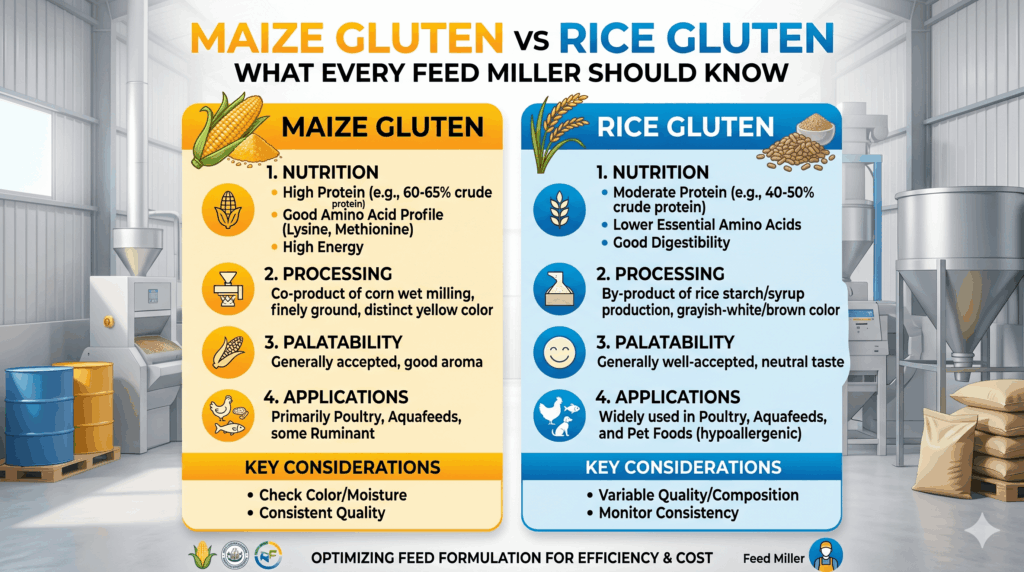
- The leftover portion is a concentrated protein fraction. And it is dried into a dense, high-protein ingredient carrying at least 60 to 65% crude protein on a dry matter basis.
- It is known for being the most protein-rich plant-based ingredient available in the feed market.
- Popular large-scale corn processing industries in the US, India, and parts of Europe ensure the supply is consistent and well-documented most of the time.
- For feed millers, that reliability matters as much as the numbers on a spec sheet.
Rice Gluten Meal: What It Is and Where It Comes From
- Rice gluten meal is a by-product of rice starch production.
- During the rice wet-milling procedure, an extraction of rice starch follows, and the remaining ratio is left behind.
- That ratio is processed and dried to create rice gluten meal. It is also labelled as ‘rice protein concentrate’. It depends on the supplier how much protein it covers in the remaining portion.
- The amount of protein levels typically ranges between 45 and 55%, but this may differ from the expectations of feed millers.
- The method of processing may be different across different facilities. And the final result can be more unique than the available sources.
- Other than maize gluten, rice gluten is a more regional commodity.
- Rice and gluten are known for being produced primarily in South and Southeast Asia.
- The supply ratio is lower, and batch-to-batch consistency deserves closer attention when sourcing.
Protein: Maize Gluten Pulls Ahead
This is the clearest difference.
Maize gluten meal is one of the densest plant-based protein sources in the feed market. At 60–65% crude protein, it gives you more in every tonne.
Rice gluten delivers less, but it’s not without merit. Its amino acid profile is slightly more balanced in some respects, and its lysine content, while still low, is marginally better than that of maize gluten.
The honest summary:
- Maize gluten = higher protein per tonne, better value on density
- Rice gluten = slightly more balanced amino acid contribution
- Both require amino acid supplementation — neither stands alone.
The Amino Acid Story
Amino acids are where the real formulation decisions happen.
Maize gluten meal is genuinely rich in methionine and cysteine. For poultry diets — especially layers and broilers — those sulphur amino acids matter. But it is very low in lysine, which means you’re almost always supplementing when maize gluten forms a significant part of the diet.
Rice gluten has a bit more lysine, but not enough to change the supplementation equation dramatically.
For millers, this means:
- Maize gluten suits poultry diets well, especially where methionine is limiting.
- Rice gluten may slightly reduce synthetic lysine requirements.
- Neither ingredient removes the need for careful amino acid balancing.
Digestibility and Predictability
- Maize gluten meal has decades of research and field data behind it.
- Protein digestibility in poultry sits at roughly 85–90%.
- In ruminants, its high rumen undegradability works in your favour — making it a valuable ingredient in dairy cattle diets.
- Supply consistency from established processing industries means composition is largely predictable batch to batch.
- For millers, that means fewer surprises when formulating.
Rice Gluten Meal: Digestibility and Predictability
- Digestibility data for rice gluten meal are patchier compared to maize gluten.
- Not because it performs badly, but because the product is less standardised across the market.
- Processing methods vary significantly from one facility to the next, and so does the final composition.
- Protein digestibility figures can differ meaningfully between suppliers and even between shipments from the same supplier.
- Always ask for batch-specific composition and digestibility data before formulating.
- Never assume consistency across shipments.
Quick read: Maize DDGS vs Soybean Meal
The Pigmentation Advantage (Maize Gluten Only)
This one surprises some millers the first time they hear it.
Maize gluten meal is naturally rich in xanthophylls — zeaxanthin and lutein — which give egg yolks and broiler skin their yellow colour. In markets where yolk colour is a purchase signal for consumers, this is real commercial value baked into an ingredient you’re already buying for protein.
Rice gluten has none of this. Zero pigmentation contribution.
If your customers care about yolk depth or skin colour — and many do — maize gluten carries a measurable advantage that goes beyond nutrition.
Cost and Supply: Know Your Market
When it comes to cost and supply, maize gluten and rice gluten sit in very different positions in the market. Knowing that difference upfront saves you from sourcing headaches down the line.
Maize Gluten Meal: Cost and Supply
- Maize gluten is produced at scale globally, with major sources in the US, India, and parts of Europe.
- Large-scale corn processing industries mean supply volumes are consistently high.
- Pricing is relatively stable and easier to forecast across seasons.
- Well-established trade routes make procurement straightforward for most markets.
- At Brinda Foods, we maintain strong sourcing relationships for maize gluten meal and can give you a clear picture of current availability and pricing in your region.
Rice Gluten Meal: Cost and Supply
- Rice gluten is a more regional commodity, concentrated around rice starch processing hubs in South and Southeast Asia.
- Supply volumes are significantly lower compared to maize gluten.
- Prices can move more sharply, making cost forecasting less predictable.
- Regional availability means sourcing options may be limited depending on your location.
- At Brinda Foods, we maintain sourcing relationships for rice gluten meal, too — reach out to understand what’s available and what pricing looks like right now.
Which One is the Right Alternate for You?
Go with maize gluten meal when:
- You need maximum protein density
- Natural pigmentation matters to your customers
- You’re formulating for poultry or dairy cattle
- You want a well-documented, consistent ingredient
Go with a rice gluten meal when:
- Maize gluten is priced out or in short supply
- You’re formulating for aquafeed or swine
- You want to diversify your protein matrix
- Regional sourcing makes it a more practical option
Many millers use both, rotating based on price and availability. A good formulation can accommodate either as long as you know what you’re working with.
Final Thought
You cannot call an ingredient universally accepted, as there are different scenarios, and the product must follow what is needed for it. It means the formulation must satiate a particular need. At the same time, profit margin, maintenance performance, and even the right sourcing are needed to manage in the moving market.
Responsibly decide the right product for your goals, and get the most benefits out of it. At Brinda Foods, that’s exactly the kind of conversation we’re here to support.