
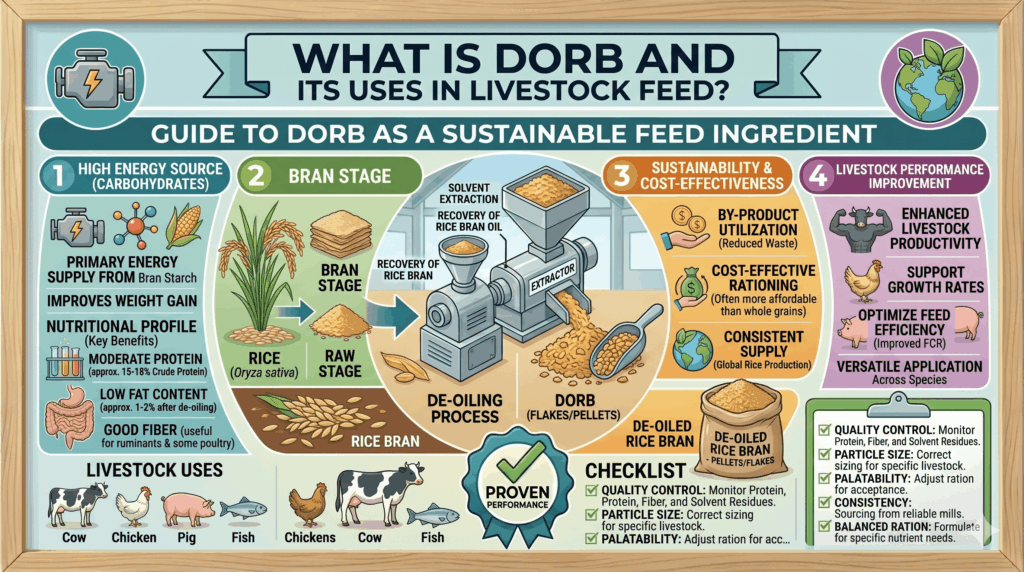
Talk to a feed miller for ten minutes, and de-oiled rice bran will come up. DORB, in trade shorthand. It’s one of those raw materials that sits quietly in half the formulations going through Indian mills, and yet buyers still write to us asking what it even is.
Fair question. So let’s go through it.
What DORB actually is?
Rice bran is the brown layer that comes off when rice gets polished. There’s oil in it quite a bit and solvent extraction plants pull that oil out to refine it into rice bran oil. Whatever’s left after the oil is gone? That’s de-oiled rice bran.
Put simply, it’s rice bran with the fat taken out. Sounds minor. It isn’t. That single change drives most of how the material behaves once it’s in a mix.
Two consequences matter:
- Full-fat rice bran goes off fast the oil oxidises, and you get rancidity. Take the oil away, and the material keeps for much longer. For a mill buying in tonnes, that shelf life is worth real money.
- With the fat gone, energy density drops, but protein, fibre and minerals make up a bigger share of what’s left.
The Nutritional Specifications!
Figures move around depending on the rice and the milling, so treat these as a working range rather than gospel:
- Crude protein: roughly 14–16%
- Crude fibre: around 11–14%
- A useful spread of B-complex vitamins
- Minerals, with phosphorus standing out
One honest caveat. A lot of that phosphorus is locked up as phytate, which means monogastrics can’t fully access it without phytase in the diet. Ruminants manage better. We flag this because formulators always ask; it’s better to build around it than get caught out.
Where Does does It Actually Go?
DORB is a flexible ingredient, and that flexibility is half the reason it’s everywhere.
- Cattle feed is its biggest home. Works nicely as fibre and energy in dairy and beef concentrate mixes, and ruminant digestion gets good value out of it.
- In poultry it covers layer and broiler diets. It is used, but in measured doses. The fibre means you add it with a bit of restraint rather than dumping it in.
- Aqua feed uses it too as a binder and a carbohydrate source for fish and shrimp rations.
- And in pelleted or compound feed it pulls double duty: nutrition plus the bulk that helps carry everything else through the pellet press.
Why do Mills keep buying it?
Price is the obvious answer. DORB gives you usable energy and fibre without bloating the cost of a formulation, and in this business margins are thin enough that this matters.
But it’s not only about being cheap:
- Available year-round, which makes sense given how much rice the country mills
- Long shelf life next to full-fat bran
- Slots into standard mill equipment without fuss
- One material covering several species, so it spans more than one product line
Good DORB versus the rest!
Here’s where sourcing experience earns its keep — and where we put most of our effort.
Lots vary. A lot. Things a serious buyer ought to check before signing off on a consignment:
- Oil content — lower residual oil usually means a more stable product
- Silica and sand — the old adulteration trick with rice bran. Excess silica quietly kills the real feeding value
- Moisture — too high and you’re inviting spoilage and caking in the godown
- Fibre level — good to pin down upfront so the formulation holds together
We’ve moved enough DORB over the years to know that consistency beats a flashy spec sheet. A material that tests brilliant one month and weak the next causes a feed manufacturer far more grief than a steady, slightly less spectacular supply ever would.
How do we see it at Brinda Foods?
Brinda Foods supplies DORB to feed millers, manufacturers and formulators — the people building the rations, not the farm at the far end. That shapes how we grade and source it. We’re chasing the same things you are: clean material, predictable composition, and lots that turn up at your plant behaving the way the last batch did.
DORB was never going to be a glamorous ingredient. It’s a workhorse. And in feed manufacturing, a steady workhorse usually beats a flashy one.
If you’re formulating around rice co-products and want a supply you can actually plan against, that’s the conversation we’re built for.

[…] De oiled rice bran: 3 to 5%, kept modest because of the fibre load […]
[…] worked with DORB before? Start with our guide on what DORB is and how it is used in livestock feed. Here, we’ll put all three side by […]