
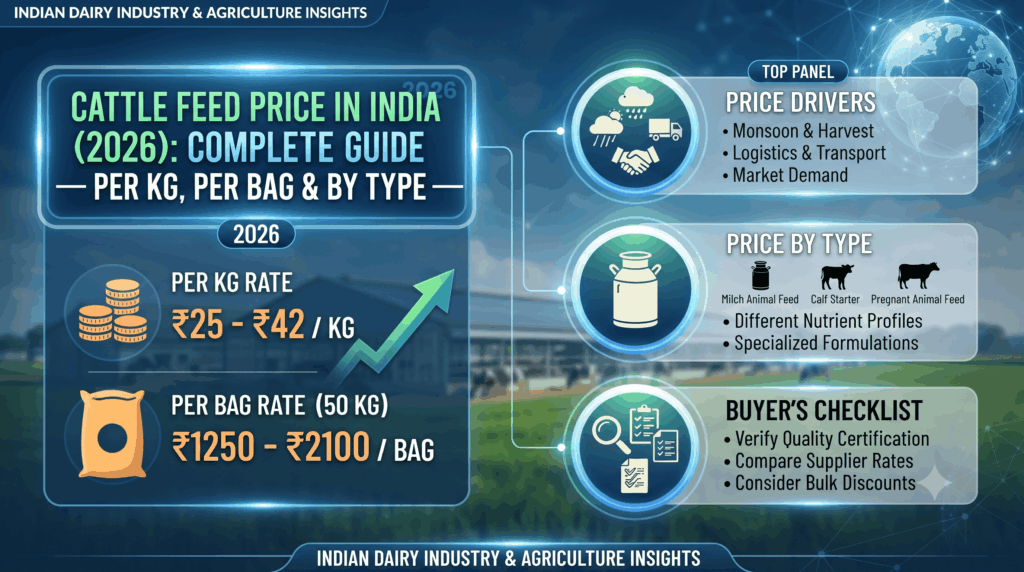
Quick answer: Branded compound cattle feed in India typically retails at ₹1,120–1,380 per 50 kg bag — roughly ₹22.4–27.6/kg — across major brands like Godrej and Amul, based on current marketplace listings. But that’s the retail branded price. Feed mills and large dairies that source raw materials directly (maize, Soya DOC, Mustard DOC, DDGS, DORB) and blend their own compound feed typically land at a meaningfully lower cost per kg — see the worked cost-build-up below. GST on cattle feed is Nil either way; see our HSN code & GST guide for the full classification breakdown. Prices vary by region, season, and lot size — confirm current rates with your supplier before ordering.
Branded Cattle Feed Price October 2026 : Per Bag and Per Kg
| Brand / Product | Bag Size | Price (Bag) | Price Per Kg |
|---|---|---|---|
| Godrej Bypro Cattle Feed | 50 kg | ₹1,380 | ₹27.6 |
| Godrej Milk More Cattle Feed | 50 kg | ₹1,200 | ₹24.0 |
| Amul Nutri Rich (BIS Type-1) | 50 kg | ₹1,180 | ₹23.6 |
| Godrej Super Cattle Feed | 50 kg | ₹1,120 | ₹22.4 |
Figures are indicative marketplace listing prices (IndiaMART, TradeIndia) as of October 2026 and vary by seller, region, and date — always confirm current pricing directly with the brand’s local dealer before budgeting a purchase.
What Actually Determines Cattle Feed Price
Since GST on cattle feed is Nil regardless of type (see below), price differences come down to three things:
1. Raw material cost. Compound cattle feed is a blend of energy and protein ingredients, and those ingredient prices are the single biggest driver of finished cost. As of October 2026: Maize runs roughly ₹22–26/kg (see our maize price guide), Mustard DOC ₹20–27/kg, Soya DOC ₹40–52/kg (elevated this year after a shorter 2025–26 soybean crop), and DORB ₹9–15/kg. Full breakdown in our raw material price comparison.
2. Formulation and brand margin. A branded 50 kg bag includes the manufacturer’s processing, packaging, distribution, and margin on top of raw material cost — which is exactly why branded retail price per kg runs noticeably higher than what a mill pays sourcing the same ingredients in bulk and blending in-house.
3. Region, season, and lot size. Freight from the sourcing hub (Punjab, Haryana, and UP dominate India’s DOC/DDGS/DORB/maize supply), monsoon-linked moisture risk, and spot versus contracted bulk buying all shift delivered price — often by more than the brand-to-brand spread shown above.
A Worked Example: What a Kilogram of Compound Feed Actually Costs to Make
Using a simplified but realistic dairy compound feed formulation and Brinda Foods’ own October 2026 raw material price ranges:
| Ingredient | Approx. share of ration | Indicative cost/kg | Contribution to blended cost |
|---|---|---|---|
| Maize | 40% | ₹24/kg | ₹9.6 |
| Soya DOC | 20% | ₹46/kg | ₹9.2 |
| Mustard DOC | 15% | ₹24/kg | ₹3.6 |
| DORB | 15% | ₹12/kg | ₹1.8 |
| Minerals, vitamins, binders | 10% | ₹60/kg (blended premix) | ₹6.0 |
| Approximate raw material cost per kg | ~₹30.2/kg |
This is a simplified illustrative formulation, not a nutritionally balanced ration — actual mills adjust ratios by species, production stage, and regional ingredient availability. The point it illustrates is structural: raw ingredient cost alone can already sit close to, or above, some branded retail prices per kg — which is exactly why large-volume buyers (dairies, integrators, feed mills) increasingly source raw materials directly and blend in-house rather than buying pre-branded bags, and why the gap between “cattle feed price” quoted from a retail bag versus a bulk raw-material buy can be substantial at scale.
Price by Cattle Feed Type
| Type | What it is | Typical positioning vs. compound feed |
|---|---|---|
| Compound feed | Complete, ready-mixed ration (pellet/mash) | Highest convenience, highest price per kg (branded retail) |
| Concentrate | Protein/energy-dense mix fed alongside fodder | Often lower cost per kg than compound feed, since it’s not a complete standalone diet |
| Mineral mixture / supplement | Small-dose micronutrient correction | Highest price per kg by weight, but fed in very small quantities so total cost impact is limited |
For the nutrition science behind formulating your own ration rather than buying pre-mixed, see our cattle feed formulation and ration-balancing guide and cattle feed ingredients and quality standards.
GST and HSN Code: Why Tax Doesn’t Move the Price
Cattle feed carries a Nil (0%) GST rate under HSN 2309 (23099010 for compound feed), and has since GST’s July 2017 introduction — so tax is not a variable in any of the price differences above. The one exception buyers often miss: feed supplements and additives frequently fall outside this exemption and attract 18% GST. Full classification breakdown, including sub-codes and sourcing, is in our Cattle Feed HSN Code & GST Rate guide.
How to Actually Reduce Your Cattle Feed Cost
The price comparisons above point to the same practical lever: buying formulated raw materials in bulk and blending your own ration costs less per kg than buying finished branded feed, provided you have the volume, storage, and formulation capability to do it. For a full breakdown of cost-reduction strategies beyond just switching suppliers — including ingredient substitution and inclusion-rate optimization — see our guide on how to reduce animal feed cost in India.
Frequently Asked Questions
What is the price of cattle feed per kg in India? Branded compound cattle feed typically runs ₹22.4–27.6/kg (₹1,120–1,380 per 50 kg bag) at retail, based on current marketplace listings for major brands. Bulk raw-material buyers blending their own feed can often achieve a lower effective cost per kg — see the worked example above.
Why is branded cattle feed more expensive than raw materials? A branded bag’s price includes the manufacturer’s processing, packaging, distribution, and margin on top of raw ingredient cost — which is why large-volume buyers sourcing maize, DOC, and DDGS directly and blending in-house can often land at a lower cost per kg than buying pre-branded feed.
Does GST affect cattle feed price? No — cattle feed under HSN 2309 carries a Nil GST rate, so tax isn’t a factor in price differences between brands, types, or sourcing routes. Feed supplements and additives are the exception and are often taxed separately. See our HSN code & GST guide for details.
What’s the difference between compound feed and concentrate pricing? Compound feed is a complete ready-mixed ration and typically carries the highest price per kg at retail. Concentrate is fed alongside fodder rather than as a standalone diet and is often priced lower per kg, since it’s one component of the total ration rather than the whole thing.
How can I get bulk cattle feed raw material pricing? Brinda Foods supplies bulk Maize, Soya DOC, Maize DDGS, Rice DDGS, Mustard DOC, and DORB from Panipat, Haryana — the core ingredients used in cattle feed formulation. Request a current bulk quote; pricing is confirmed at time of order given weekly raw material rate movement.
About Brinda Foods
Brinda Foods has supplied animal feed raw materials from Panipat, Haryana since 1987. We provide bulk supply of Soya DOC, Maize, Maize DDGS, Rice DDGS, De-Oiled Rice Bran (DORB), Mustard DOC, and other feed ingredients to mills and farms across India. ISO 9001:2015 certified.
Get today’s bulk quote: Submit an enquiry or contact our team.

[…] Quick Read : Cattle Feed Price in India […]
[…] Quick Read : Cattle Feed Price in India […]
[…] Quick Read: Cattle Feed Price in India […]
[…] Soya DOC on its own accounts for a good chunk of the story. Ingredient by ingredient, the cattle feed price breakdown works the cost through, and the ration balancing guide handles the nutrition […]
[…] Quick Read : Cattle Feed Price in India […]
[…] Sowing 2026 DDGS Price OutlookDDGS Price in IndiaLayer Feed Price in IndiaBroiler Feed Price IndiaCattle Feed Price in IndiaMaize Price Per Kg India 2026Feed Raw Material Price Comparison IndiaCorn DDGS Price India 2026Rice […]
[…] Sowing 2026 DDGS Price OutlookDDGS Price in IndiaLayer Feed Price in IndiaBroiler Feed Price IndiaCattle Feed Price in IndiaMaize Price Per Kg India 2026Feed Raw Material Price Comparison IndiaCorn DDGS Price India 2026Rice […]
[…] Sowing 2026 DDGS Price OutlookDDGS Price in IndiaLayer Feed Price in IndiaBroiler Feed Price IndiaCattle Feed Price in IndiaMaize Price Per Kg India 2026Feed Raw Material Price Comparison IndiaCorn DDGS Price India 2026Rice […]
[…] Sowing 2026 Ddgs Price OutlookDDGS Price in IndiaLayer Feed Price in IndiaBroiler Feed Price IndiaCattle Feed Price in IndiaMaize Price Per Kg India 2026Feed Raw Material Price Comparison IndiaCorn DDGS Price India 2026Rice […]