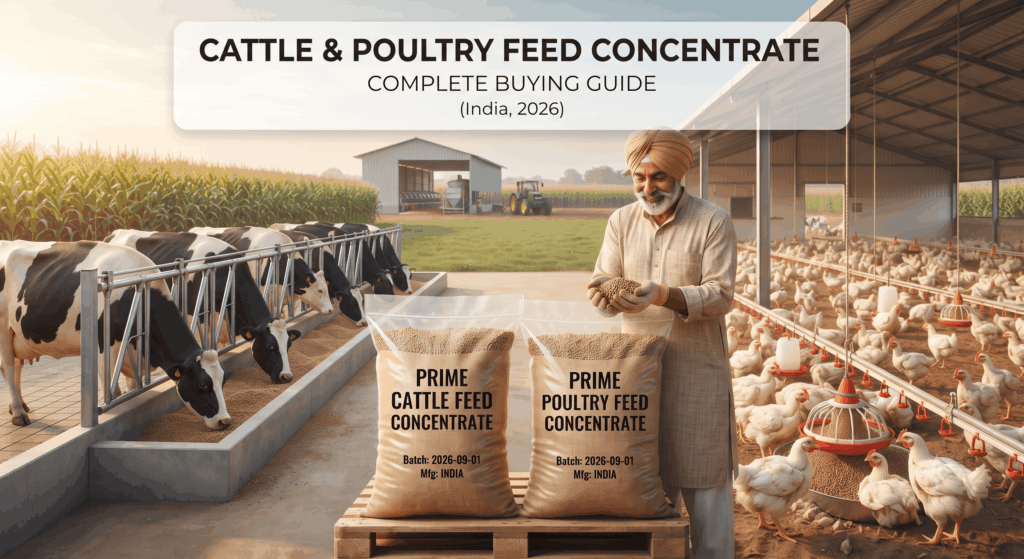
“Concentrate,” “compound feed,” and “supplement” get used almost interchangeably in conversations with farmers and even some feed mill staff — and that confusion leads to real formulation and purchasing mistakes. A dairy farmer buying a “concentrate” expecting a complete standalone feed, or a feed mill treating a concentrate premix as a bulk energy ingredient, both end up with animals underperforming against expectation.
This guide clarifies what feed concentrate actually is, what should be in a good one, how much to feed by species, and what to check before buying — whether you’re a feed mill sourcing concentrate as a raw material to build compound feed, or a farmer buying it directly to supplement home-grown roughage.
What Is Feed Concentrate?
Feed concentrate is a nutrient-dense mix — high in protein, energy, minerals, and vitamins, and low in fibre — designed to be fed alongside a basal diet (roughage, fodder, or a farm’s existing grain ration), not as a complete standalone feed on its own. Its entire purpose is to fill nutritional gaps that roughage or straight grain can’t cover: protein density, mineral balance, vitamin fortification, and, in ruminants specifically, the concentrated energy needed to support high milk yield or fast weight gain.
This distinguishes it from a compound feed (a nutritionally complete formulation meant to be fed as the entire diet, common in poultry and swine) and from a mineral/vitamin supplement (which corrects specific micronutrient gaps but contributes negligible protein or energy).
For Brinda Foods’ Feed Concentrate product line, formulations are built to complement — not replace — a farm’s existing roughage or grain base.
Feed Concentrate vs Compound Feed vs Mineral Supplement
| Parameter | Feed Concentrate | Compound Feed | Mineral/Vitamin Supplement |
|---|---|---|---|
| Purpose | Fills protein/energy/mineral gaps | Complete standalone diet | Corrects specific micronutrient deficiencies |
| Fed alongside roughage/grain? | Yes, always | Not required — nutritionally complete | Yes, in small quantities |
| Typical inclusion in total ration | 20–40% (species-dependent) | 100% | 0.5–2% |
| Protein content | High (18–24% CP typical) | Moderate, formulated to species requirement | Low/none — mineral-focused |
| Common use case | Dairy cattle, backyard poultry, mixed farms | Commercial broiler/layer/swine operations | Any species, as a top-up |
The most common buying mistake we see is a dairy farmer or small feed mill assuming concentrate can replace roughage or the farm’s base grain ration entirely. It can’t — and feeding it that way both wastes money (concentrate costs more per kg than bulk roughage or grain) and risks digestive upset in ruminants, whose systems are built around fibre fermentation.
What Goes Into a Quality Feed Concentrate
A well-formulated concentrate typically layers together ingredients from three functional categories:
Protein sources — Soya DOC as the primary amino-acid-complete protein anchor, often blended with Mustard DOC for cost efficiency in ruminant formulations. See our detailed comparison in Mustard DOC in Animal Feed: The Complete Guide.
Energy sources — Maize as the base energy ingredient, frequently supplemented with Maize DDGS or De-Oiled Rice Bran (DORB), both of which contribute residual energy alongside protein and fibre.
Minerals, vitamins, and additives — a mineral mixture (calcium, phosphorus, trace minerals), vitamin premix (A, D3, E primarily), and often a binder or anti-caking agent to maintain product consistency during storage and handling.
The ratio between these three categories — not any single ingredient — is what determines whether a concentrate is actually well-designed for its target species and production level, or just a generic mix marketed under the concentrate label.
For a deeper look at how protein-rich ingredients specifically are selected and balanced: The Role of Protein-Rich Ingredients in Animal Feed Manufacturing
Types of Feed Concentrate by Species
Dairy Cattle and Buffalo Concentrate
This is the largest use case for feed concentrate in India, particularly among smallholder and semi-commercial dairy operations that rely on farm-grown or locally sourced roughage (green fodder, dry fodder, crop residue) as the diet base.
Typical inclusion: 30–40% of total daily ration (dry matter basis), scaled to milk yield — higher-yielding animals need proportionally more concentrate to meet energy demand that roughage alone cannot supply.
A well-balanced dairy concentrate typically runs 18–22% crude protein and is formulated around the animal’s production stage — early lactation (peak demand), mid-lactation, or dry period — rather than fed at a flat rate year-round.
For the full picture of cattle nutrition and formulation, see: The Complete Guide to Cattle Feed: Raw Materials, Quality, and Formulation
Poultry Concentrate / Premix
Less common as a standalone farmer purchase than in dairy, poultry concentrate is more often used by small feed mills as a base to build complete broiler or layer feed by blending it with locally available maize and other grains — a cost-effective approach for operations without full in-house formulation capability.
Typical inclusion: 20–30% of the final blended ration, with the remaining 70–80% made up of maize and other locally sourced grain.
This route allows smaller operations to access professionally formulated protein, mineral, and vitamin balance without needing to source and balance every raw material independently.
See our Layer Feed Guide for phase-specific nutrition detail if you’re formulating complete layer diets rather than blending with concentrate.
Swine Concentrate
Used similarly to poultry concentrate — as a base for mills or larger farms to blend with maize — swine concentrate is typically higher in lysine relative to other amino acids, reflecting the pig’s specific amino acid requirements.
Typical inclusion: 20–25% of the final blended ration, adjusted by growth stage (higher concentrate proportion in starter/weaner diets, lower in finisher diets where cost efficiency matters more).
For Brinda Foods’ Swine Feed formulations, concentrate-based blending is one of two supply routes we support — complete feed or concentrate-plus-grain.
How to Choose the Right Feed Concentrate
1. Match protein and energy density to your production goal, not the cheapest option on offer. A high-yielding dairy animal fed a low-protein concentrate will underperform regardless of quantity fed — the gap shows up as reduced milk yield, not immediate visible harm, which makes it easy to miss until output data confirms it.
2. Check mineral and vitamin fortification, not just protein %. Many buyers evaluate concentrate purely on crude protein content and overlook calcium-phosphorus ratio and vitamin premix quality — both of which materially affect reproductive performance and bone health in cattle, and shell quality in layers.
3. Request batch consistency data. Concentrate quality that varies significantly batch to batch creates the same formulation drift problem as inconsistent raw materials — animals respond to what’s actually in the feed, not the label average.
4. Verify palatability, especially when switching suppliers. A nutritionally correct concentrate that animals eat less of due to poor palatability delivers less actual nutrient intake than the formulation sheet suggests. Watch intake closely in the first 1–2 weeks after any supplier change.
5. Evaluate supplier reliability alongside product quality. Concentrate is typically fed daily and continuously — supply interruptions are more disruptive here than for occasional bulk raw-material purchases. For a full framework on supplier evaluation: How to Choose the Right Feed Raw Material Supplier in India
The Economics: Is Concentrate Worth the Extra Cost?
Feed concentrate costs more per kilogram than bulk roughage or straight grain — that’s expected, given its nutrient density. The question that matters for a farm or feed mill is whether the incremental cost is justified by incremental output.
For dairy cattle specifically, the relationship is well established in Indian field conditions: animals fed an appropriately balanced concentrate alongside roughage consistently show higher milk yield and better body condition than animals fed roughage alone or with an unbalanced home-mixed ration. For a cow producing in the 10–20 litre/day range — the typical smallholder and semi-commercial band in India — the value of the additional milk yield generally outweighs the incremental concentrate cost, provided the concentrate is correctly matched to production level and not overfed relative to actual yield.
The mistake that erodes this economics is flat-rate feeding — giving every animal in a herd the same concentrate quantity regardless of individual yield, which overspends on low producers and underfeeds high producers simultaneously.
Common Mistakes in Using Feed Concentrate
- Treating concentrate as a complete feed and cutting back roughage — this both wastes the concentrate’s intended role and risks digestive issues in ruminants that depend on fibre fermentation.
- Flat-rate feeding across an entire herd regardless of individual production level, discussed above.
- Poor storage leading to nutrient degradation — concentrate mineral and vitamin premixes are sensitive to heat, humidity, and prolonged storage. Buy in quantities that will be used within the manufacturer’s recommended shelf window, typically 2–3 months.
- Switching suppliers without a transition period — abrupt changes in concentrate formulation can affect palatability and intake; a short overlap or gradual transition reduces this risk.
FAQs: Feed Concentrate for Animal Feed
What is the difference between feed concentrate and compound feed? Feed concentrate is a nutrient-dense mix meant to be fed alongside roughage or grain — it’s not nutritionally complete on its own. Compound feed is formulated to be a complete standalone diet requiring no additional roughage or grain (common in commercial broiler, layer, and swine operations). Concentrate is typically used to supplement a farm’s existing feed base rather than replace it entirely.
How much feed concentrate should I give a dairy cow? Typically 30–40% of the total daily ration on a dry matter basis, scaled to milk yield — higher-producing animals need proportionally more to meet their energy and protein requirements. Flat-rate feeding regardless of individual yield is a common and costly mistake.
Can feed concentrate replace roughage entirely? No. Concentrate is designed to supplement roughage, not replace it. Ruminants require adequate fibre intake for healthy rumen function; cutting roughage in favour of concentrate alone risks digestive upset and doesn’t deliver the intended nutritional benefit.
What is in a good feed concentrate? A well-formulated concentrate combines protein sources (typically Soya DOC and/or Mustard DOC), energy sources (maize, DDGS, or DORB), and a mineral and vitamin premix, usually run at 18–24% crude protein depending on target species and production level.
Is feed concentrate used in poultry farming? Yes, primarily by smaller feed mills and farms that blend concentrate with locally sourced maize to build a complete broiler or layer ration — typically at 20–30% concentrate to 70–80% maize/grain — rather than sourcing every individual raw material and formulating from scratch.
How long can feed concentrate be stored? Typically 2–3 months under proper dry, cool storage conditions. Mineral and vitamin premixes in particular degrade with heat and humidity exposure, so buying in quantities matched to actual usage timeline is more important for concentrate than for less nutrient-sensitive raw materials.
Conclusion
Feed concentrate earns its higher price per kilogram by doing a specific job well: closing the protein, energy, and micronutrient gaps that roughage or straight grain leave open. It works when it’s matched correctly to production level, fed alongside — not instead of — a proper roughage or grain base, and sourced from a supplier who can hold formulation consistency batch to batch.
The farms and feed mills getting the most value from concentrate aren’t the ones buying the cheapest option per kilogram — they’re the ones matching concentrate quality and inclusion rate to actual production targets, and treating supplier consistency as seriously as the ingredient list itself.
Brinda Foods supplies Feed Concentrate, Cattle Feed, Swine Feed, Layer Feed, and raw materials including Soya DOC, Mustard DOC, and Maize to feed mills and livestock farms across India. Every batch is tested and comes with nutritional specification documentation.
For bulk pricing and sourcing enquiries: Contact Us | Submit an Enquiry | Call: 9992500442 | Email: sales1@brindafoods.com