
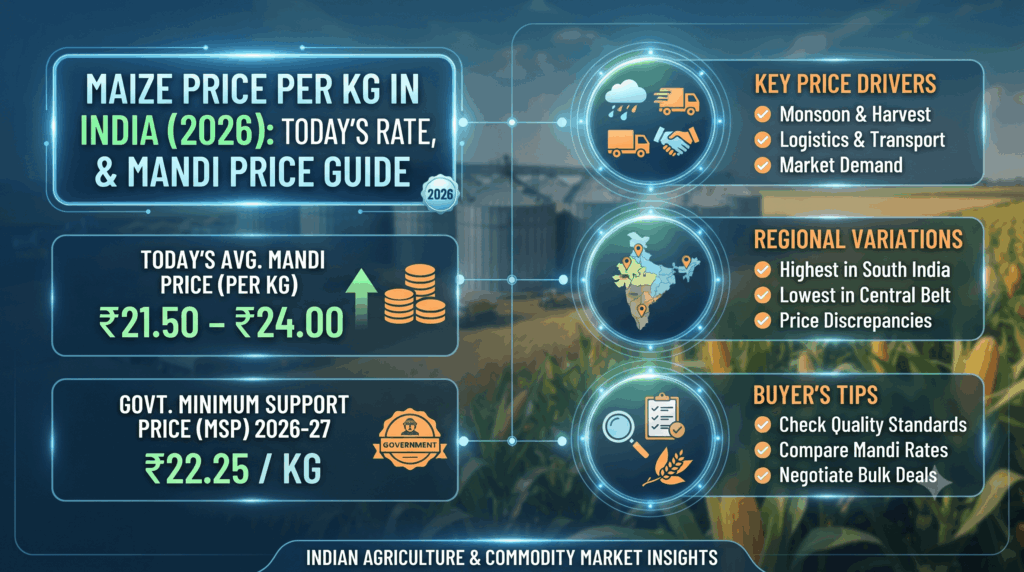
Quick answer: The Government of India has set the Maize MSP for Kharif 2026-27 at ₹2,410/quintal — ₹24.10 per kg. Actual mandi (market) rates trade both above and below that floor depending on quality and location, typically ranging ₹18.50–25.50/kg (₹1,850–2,550/quintal) nationally. Feed-grade maize bought by compound feed mills — the segment Brinda Foods supplies — has been running an indicative ₹22–26/kg through mid-2026, firming into the July–September lean season ahead of the new kharif harvest. Mandi prices move daily; treat every figure here as a directional snapshot and confirm today’s rate with your mandi or supplier before booking.
MSP vs. Mandi Price vs. Feed-Grade Price: Why “Maize Price” Means Three Different Numbers
Most confusion around “maize price per kg” comes from mixing up three genuinely different figures:
| Price type | What it means | 2026 figure |
|---|---|---|
| MSP (Minimum Support Price) | The government’s guaranteed floor price at which it will procure maize from farmers | ₹2,410/quintal = ₹24.10/kg (Kharif 2026-27) |
| Mandi (market) price | What maize actually trades for in regulated wholesale markets on a given day — can sit above or below MSP | ₹1,850–2,550/quintal = ₹18.50–25.50/kg (national range, quality-dependent) |
| Feed-grade delivered price | What a compound feed mill or bulk buyer pays for quality-checked, moisture-tested maize delivered to their facility | ₹22–26/kg indicative, North India, mid-2026 |
MSP is a policy floor, not a market price — maize routinely trades below it in mandis where government procurement infrastructure is thin, and above it where local demand (poultry belts, ethanol plants) is strong. If you’re comparing “maize price” figures from different sources and they don’t match, check which of these three numbers each source is actually quoting before assuming one is wrong.
Today’s Maize Price September 2026 : Per Kg and Per Quintal
Since most official mandi data (including on Agmarknet and state APMC boards) is quoted per quintal, here’s the same range converted to the per-kg basis buyers actually budget with:
| Metric | Per Quintal | Per Kg |
|---|---|---|
| MSP (Kharif 2026-27) | ₹2,410 | ₹24.10 |
| Mandi price — low end | ₹1,850 | ₹18.50 |
| Mandi price — high end | ₹2,550 | ₹25.50 |
| Feed-grade indicative (bulk, North India) | ₹2,200–2,600 | ₹22–26 |
Quick conversion rule: divide any quintal price by 100 to get the per-kg rate (1 quintal = 100 kg). It sounds obvious, but it’s the single most common source of pricing confusion when buyers compare a mandi board’s quintal figure against a supplier’s per-kg quote.
What Actually Moves Maize Price in India
1. Ethanol blending demand. India’s ethanol blending programme has diverted a growing share of the national maize crop into fuel-grade ethanol production over recent seasons, pulling supply away from the feed and starch industries. This is one of the most consistent structural upward pressures on feed-grade maize price — and it’s the same underlying dynamic behind Maize DDGS pricing, since DDGS is the co-product of that same ethanol process.
2. Kharif harvest timing. Maize is predominantly a kharif crop, harvested September–October, with a smaller rabi crop in Bihar and parts of the South around February–March. Prices are typically softest right after the kharif harvest floods the market and firm progressively through the lean months (July–September) as old-crop stock tightens — the window this guide is published in.
3. Poultry sector demand. Maize anchors 55–60% of most Indian poultry rations by weight (see our maize for animal feed guide for the full nutrition and inclusion-rate breakdown). Steady growth in India’s broiler and layer production translates directly into sustained baseline maize demand.
4. MSP procurement activity. When government procurement at MSP is active in a region, it puts a practical floor under local mandi prices — private buyers generally can’t source meaningfully below what farmers can get from government procurement.
5. Global corn price linkage. India is largely self-sufficient in maize, so domestic dynamics dominate. But when domestic stock tightens, international corn price levels start to influence the economics of any import consideration, creating an indirect linkage.
Seasonal Price Pattern
| Period | Typical price behaviour |
|---|---|
| October–December (post-harvest) | Softest prices of the year as new kharif crop floods mandis |
| January–March | Gradual firming as post-harvest stock gets absorbed; rabi crop arrives in some states |
| April–June | Continued firming; pre-monsoon buying activity |
| July–September (lean season) | Prices typically firmest — old-crop stock is tightest just before the new harvest |
Buyers with storage capacity generally get the best economics purchasing in the October–December window and holding stock, rather than buying reactively through the lean season — though this needs to be weighed against storage cost and moisture/aflatoxin risk over a multi-month hold.
Frequently Asked Questions
What is the maize MSP for 2026-27? The Government of India set the Kharif 2026-27 maize MSP at ₹2,410/quintal, which works out to ₹24.10 per kg.
Is mandi price the same as MSP? No. MSP is a government-guaranteed floor price; actual mandi (market) prices move independently based on local supply and demand and can trade above or below MSP depending on region, quality, and procurement activity.
What is today’s maize price per kg in India? National mandi rates have been ranging roughly ₹18.50–25.50/kg through 2026, with feed-grade maize bought by compound feed mills running an indicative ₹22–26/kg. Rates move daily — confirm with your local mandi or supplier for the current figure.
Why does maize price rise before the harvest? Old-crop stock tightens as the market waits for the new kharif harvest (September–October), which typically pushes prices to their firmest point of the year in the preceding July–September window.
How do I convert quintal price to per-kg price? Divide the quintal price by 100. For example, ₹2,410/quintal equals ₹24.10/kg (1 quintal = 100 kg).
Where can I source bulk feed-grade maize in India? Brinda Foods supplies feed-grade maize in bulk to compound feed manufacturers and integrators from Panipat, Haryana. Request a current bulk quote — pricing is confirmed at time of order given daily rate movement.
About Brinda Foods
Brinda Foods has supplied animal feed raw materials from Panipat, Haryana since 1987. We provide bulk supply of Maize, Maize DDGS, Soya DOC, Mustard DOC, and other feed ingredients to mills and farms across India. ISO 9001:2015 certified.
Get today’s bulk quote: Submit an enquiry or contact our team.

[…] Quick Read : Maize Price Per Kg in India […]
[…] Price in IndiaLayer Feed Price in IndiaBroiler Feed Price IndiaCattle Feed Price in IndiaMaize Price Per Kg India 2026Feed Raw Material Price Comparison IndiaCorn DDGS Price India 2026Rice Gluten Meal Price India […]
[…] Quick Read : Maize Price Per Kg in India […]
[…] Price in IndiaLayer Feed Price in IndiaBroiler Feed Price IndiaCattle Feed Price in IndiaMaize Price Per Kg India 2026Feed Raw Material Price Comparison IndiaCorn DDGS Price India 2026Rice Gluten Meal Price in India […]
[…] Price in IndiaLayer Feed Price in IndiaBroiler Feed Price IndiaCattle Feed Price in IndiaMaize Price Per Kg India 2026Feed Raw Material Price Comparison IndiaCorn DDGS Price India 2026Rice Gluten Meal Price India […]