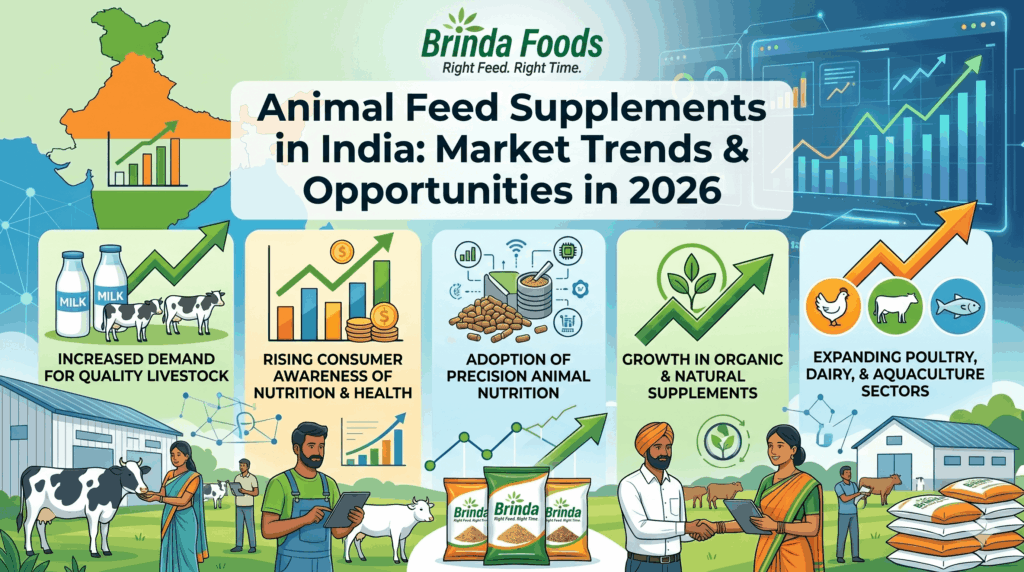
India’s animal feed supplements sector stands at an inflection point in 2026. Valued at USD 372.60 million in 2025, the market is on a trajectory to reach USD 622.59 million by 2034, expanding at a 5.87% CAGR — outpacing the broader animal feed market’s 4.36% growth rate. The delta is not coincidental: it reflects a sector-wide shift from calorie-dense bulk feed toward precision nutrition, where supplements — probiotics, enzymes, amino acids, mycotoxin binders, and phytogenics — are the primary levers for feed efficiency, animal health, and antibiotic-free production.
This article synthesizes Q2 2026 field intelligence, regulatory developments, segment-level data, and on-the-ground market dynamics to give feed manufacturers, distributors, and agri-investors an actionable picture of where the Indian feed supplement industry is heading — and where the real white spaces are.
1. Why 2026 Is a Pivotal Year for Indian Feed Supplements
Three concurrent forces are creating a structural demand surge that did not exist even three years ago:
1.1 The Post-Antibiotic Production Mandate
The FSSAI amendment effective April 2025 removed colistin, tylosin, and 14 other antibiotic growth promoters (AGPs) from over 78% of commercial feed formulations across poultry and aquaculture. This was not a phased reduction — it was a hard regulatory cutoff. Farms that had relied on sub-therapeutic antibiotics for growth promotion and disease suppression now face a biological void.
That void is being filled by probiotics, organic acids, phytogenic extracts, and immunostimulant supplements. The substitution effect alone is estimated to add ₹380–₹450 crore in incremental demand annually to the feed supplement sector through 2028.
1.2 The Delhi High Court Ruling on FSSAI Jurisdiction (April 2026)
In a landmark ruling in April 2026, the Delhi High Court declared that FSSAI does not have statutory authority to regulate animal feed under the Food Safety and Standards Act, 2006. The court struck down FSSAI’s 2019–2021 directives mandating BIS certification for commercial cattle and poultry feed, ruling these as ultra vires.
What this means for the market:
- Removes BIS-mark compliance costs for manufacturers who had been absorbing those overheads
- Creates a temporary regulatory vacuum in quality standards that responsible manufacturers can use as a competitive differentiator
- Shifts regulatory oversight back toward the Department of Animal Husbandry & Dairying (DAHD) and state-level veterinary authorities
- Signals a likely forthcoming dedicated “Animal Feed Safety Act” — a watch-item for all industry players
1.3 Government Capital Injection via NLM and PMMSY
Two central schemes are actively injecting demand-side capital:
- National Livestock Mission (NLM): Subsidized funding for livestock entrepreneurs, with a specific sub-component for entrepreneurship in feed and fodder. This is pulling micro and small feed mills into formulated supplement consumption for the first time.
- Pradhan Mantri Matsya Sampada Yojana (PMMSY): ₹20,050 crore allocated for aquaculture infrastructure. Shrimp and fish farmers receiving PMMSY support are being pushed toward scientifically formulated aquafeed — a direct catalyst for supplement demand in the aquaculture vertical.
2. Market Segmentation: Where the Growth Is Concentrated
2.1 By Product Type
| Supplement Type | 2025 Market Share | 2026–2031 CAGR | Key Driver |
|---|---|---|---|
| Amino Acids | ~40.07% | Stable-high | Poultry feed efficiency, lysine/methionine demand |
| Probiotics & Prebiotics | ~18% | 5.71% | AGP ban, gut health focus |
| Vitamins & Minerals | ~15% | Moderate | Dairy productivity, government programs |
| Enzymes | ~12% | Rising | Feed cost optimization, phytase in poultry |
| Mycotoxin Binders | ~8% | High | Monsoon crop contamination, HACCP adoption |
| Phytogenics & Botanicals | ~4% | Very high | Natural alternatives to AGPs |
| Others (Acidifiers, Antioxidants) | ~3% | Moderate | Shelf stability, oxidative stress management |
Amino acids dominate, with lysine and methionine alone accounting for 72% of all feed amino acids consumed domestically in 2022 — a proportion that has remained relatively stable through 2026 despite new product entries. The largest opportunity in this category lies in rumen-protected amino acids for dairy cattle, where adoption remains low outside organized dairy clusters.
Phytogenics represent the fastest-growing niche. Products derived from oregano, thyme, cinnamon, and turmeric extracts are being positioned as dual-purpose solutions — gut health promotion plus natural growth performance. Several European and Southeast Asian manufacturers have entered the Indian market in 2025–2026 through licensing and toll manufacturing agreements.
2.2 By Animal Species
Poultry remains the anchor at ~38% revenue share, underpinned by India’s 4.5+ million metric tonne chicken meat output and 140+ billion eggs produced in 2024. The poultry sector’s structural advantage for supplement manufacturers is integration: broiler integrators with 80%+ integration levels maintain uniform nutritional protocols, making supplement adoption scalable and predictable.
Aquaculture is the growth engine at 9.12% CAGR through 2031. India is the world’s third-largest fish producer and second-largest aquaculture nation. The shrimp sector, particularly Litopenaeus vannamei (whitefish shrimp), is the primary demand driver. Specialty supplements — immunostimulants, hepatoprotective compounds, and stress-relief formulations — are seeing rising adoption as disease pressure increases in intensified pond systems.
Dairy supplements are the underserved opportunity. India houses 75% of the world’s buffalo population and is the world’s largest milk producer. Yet, per-animal supplementation levels remain significantly below global benchmarks. The organized dairy sector (cooperatives and private dairies) is actively working to improve productivity per animal — the crossbred cattle population is particularly receptive to bypass protein, rumen buffers, and chelated mineral supplementation.
Swine and small ruminants remain niche segments, but goat farming under NLM-funded clusters is emerging as a micro-opportunity for mineral-vitamin premix suppliers targeting rural and semi-urban markets.
2.3 By Geography
India’s feed supplement demand is not uniformly distributed. The following regional clusters account for the majority of organized consumption:
- Andhra Pradesh & Telangana: Shrimp aquaculture hub; highest per-tonne supplement spend in aquafeed
- Maharashtra & Gujarat: Organized dairy belts; chelated minerals, bypass protein, and rumen buffers
- Punjab & Haryana: Poultry and dairy, with some of the highest-integration broiler operations in India
- Tamil Nadu & Karnataka: Integrated poultry and mixed livestock; emerging swine supplementation
- West Bengal & Odisha: Freshwater aquaculture corridor; rising catfish and carp supplement demand
The emerging frontier: Bihar, Jharkhand, and Chhattisgarh — states with large livestock populations but very low supplement penetration. NLM-funded entrepreneur clusters in these states represent first-entry opportunities for agri-input companies willing to invest in market development.
3. Critical Trends Shaping the 2026 Supplement Landscape
3.1 Microencapsulation Is Becoming Table Stakes
High-temperature feed pelleting (typically above 90°C) degrades heat-sensitive nutrients including vitamins B1, B9, C, and certain probiotic strains. Microencapsulation — embedding active compounds in lipid or polymer matrices — protects bioavailability through the pelleting process.
In 2024–2025, this was a premium differentiator. By mid-2026, technically savvy purchasers in integrated poultry and shrimp farms are treating microencapsulated vitamins and probiotics as a baseline requirement, not a premium add-on. Manufacturers that do not offer microencapsulated SKUs in these segments are losing listings.
3.2 The “Anti-Stress” Supplement Category Is Emerging
India’s climate creates unique livestock productivity challenges: heat stress during summer months (March–June), water-quality stress during monsoon for aquaculture, and oxidative stress in high-density poultry housing. A distinct market category — anti-stress feed supplements — is emerging around this challenge.
The India Anti-Stress Feed Supplements market is forecast to grow from USD 180–220 million in 2026 to USD 420–540 million by 2035, at a 9–11% CAGR. Products in this category include:
- Electrolyte combinations (sodium, potassium, magnesium)
- Vitamin C and E supplementation for heat stress
- Betaine for osmotic regulation in shrimp under salinity stress
- Adaptogenic plant extracts (ashwagandha, tulsi) positioned for livestock
This is a genuinely underpublicized segment with limited organized competition, particularly in the ruminant and small ruminant space.
3.3 Mycotoxin Contamination — India’s Chronic, Underestimated Problem
India’s tropical monsoon climate creates near-ideal conditions for mycotoxin-producing fungi (Aspergillus, Fusarium, Penicillium) in stored grains. Studies across major feed raw material sourcing states show aflatoxin B1 contamination rates exceeding permissible limits in 40–60% of maize samples during high-humidity seasons.
This is not a new problem, but awareness and mitigation spend are rising. Mycotoxin binder adoption — particularly smectite clay-based, HSCAS (hydrated sodium calcium aluminosilicate), and yeast cell wall-based products — is growing at double-digit rates. The category benefits from:
- Increasing HACCP and ISO 22000 adoption in organized feed mills
- Export-oriented poultry and shrimp farms facing international residue testing requirements
- Growing awareness among veterinary practitioners and feed company technical service teams
Opportunity signal: Multi-toxin binders (effective against both aflatoxins and trichothecenes) remain underrepresented in the Indian market relative to their prevalence in European and Southeast Asian markets.
3.4 Precision Nutrition and Digital Feed Management
India’s organized livestock sector is beginning to adopt precision nutrition — adjusting supplement formulations based on animal performance data, environmental conditions, and raw material nutritional variability. A handful of large integrators are piloting:
- Near-Infrared Reflectance (NIR) analysis of raw materials for real-time formulation adjustment
- Performance-linked supplement optimization linked to flock/batch monitoring software
- IoT-integrated feeding systems that adjust micronutrient delivery based on feed intake data
This is early-stage but directionally significant. Supplement companies with technical service capability and willingness to co-develop customized premix solutions for precision nutrition customers have a differentiation window before this becomes mainstream.
4. Competitive Landscape: Who Is Winning and Why
India’s feed supplement market has a layered competitive structure:
Tier 1 — Multinational Technical Leaders
Companies like DSM-Firmenich (now Aditya Birla Group joint venture), Evonik, BASF Animal Nutrition, Kemin Industries, and Novozymes hold strong positions in enzymes, amino acids, and specialty probiotics. Their advantage is technical depth, regulatory documentation, and established relationships with Tier-1 integrators.
Tier 2 — Indian Organized Players
Companies like Brinda Foods, Godrej Agrovet, Venkateshwara Hatcheries Group (VH Group), Shalimar Nutrition, and Biovet have built significant share through distribution reach, price competitiveness, and Tier 2/3 city market development. These players increasingly compete on premix customization and technical service.
Tier 3 — Regional & SME Manufacturers
The long tail of India’s supplement market. These players serve local feed mills and small integrators. Quality variance is significant. The regulatory clarity post the Delhi HC ruling creates both risk (no mandatory BIS floor) and opportunity (responsible manufacturers can differentiate on voluntary quality certification).
White spaces for new entrants:
- Certified organic/natural supplements for the niche organic dairy and poultry segment
- Sustainable aquafeed supplements for certification-conscious shrimp export markets
- Veterinary-formulated ruminant premixes for NLM-funded rural livestock clusters
- Digital-native supplement companies providing formulation advisory + product bundled as a service
5. Investment and Business Opportunities in 2026
5.1 Domestic Manufacturing of Amino Acids
India currently imports a significant proportion of its lysine and methionine from China, which creates supply chain vulnerability and price volatility. The government’s Production Linked Incentive (PLI) interest in animal nutrition inputs, combined with the China+1 diversification trend among global buyers, creates a compelling case for domestic amino acid fermentation capacity investment.
5.2 Phytogenic Supplement Manufacturing
India has an unparalleled botanical raw material advantage — curcumin from turmeric, piperine from black pepper, thymol from ajwain, allicin from garlic, and gingerols from ginger are all available domestically at globally competitive prices. The global phytogenics market is growing at 7–9% annually. India-manufactured phytogenic premixes have export potential beyond the domestic market, particularly to Southeast Asian and Middle Eastern livestock markets.
5.3 Specialized Aquafeed Supplements
The PMMSY is catalyzing shrimp and freshwater fish farming infrastructure at a pace the supplement supply chain has not yet matched. There is a clear undersupply of:
- Hepatoprotective supplements for shrimp liver health (Early Mortality Syndrome continues to cause significant losses)
- Immunostimulant beta-glucan products for disease resistance
- Phospholipid supplements for larval aquaculture
First-movers in technically-validated aquafeed supplements, backed by trial data from Indian conditions, have a meaningful advantage window.
5.4 Rural Distribution Infrastructure for Ruminant Supplements
The last mile remains the largest structural challenge in the Indian feed supplement market. Branded mineral-vitamin premixes for cattle and small ruminants have high awareness at the veterinarian and extension worker level but very low retail penetration in Tier 3 and rural markets. Companies that invest in rural distribution infrastructure — through agri-input dealer networks, veterinary pharmacy partnerships, or direct-to-farmer digital ordering — can capture disproportionate market share in the ruminant supplement space over the next 3–5 years.
6. Challenges to Navigate
Regulatory Ambiguity Post-Delhi HC Ruling: The absence of a clear central regulatory framework for animal feed quality and safety is both an opportunity and a risk. Without mandatory standards, the market risks commoditization in the short term. Industry associations — particularly the Compound Livestock Feed Manufacturers Association of India (CLFMA) — are actively engaging with DAHD for a dedicated regulatory framework. Monitor this space closely.
Raw Material Price Volatility: Maize and soybean — the primary base ingredients that drive supplement formulation decisions — have experienced 20–35% price swings in 2024–2025 due to monsoon variability, global commodity trends, and procurement policy shifts. Feed mills under margin pressure sometimes reduce supplement inclusion rates, creating demand volatility for additive manufacturers.
Counterfeit and Substandard Products: An estimated 20–25% of the feed supplement market (by volume) comprises products with mislabeled inclusion rates or substituted active ingredients. This is both a threat to legitimate players and an argument for voluntary quality certification as a market differentiator.
Technical Service Gap: The Indian feed supplement market remains significantly undersupported in technical service relative to mature markets. Farmers and small feed millers often lack the technical knowledge to optimize supplement selection and inclusion rates, leading to suboptimal results and reduced repeat purchase. Companies that invest in veterinary and nutritionist-led technical service teams will build stronger customer retention than product-led competitors.
7. Key Metrics to Watch in 2026–2027
| Metric | Significance |
|---|---|
| DAHD’s draft Animal Feed Safety regulations | Will define the new regulatory architecture post-FSSAI HC ruling |
| India’s shrimp export volumes | Direct demand signal for aquafeed supplement segment |
| Domestic maize production forecast | Determines raw material availability and feed cost, affecting supplement budget allocation |
| AGP ban enforcement effectiveness | Determines actual versus formal demand shift toward probiotic/phytogenic alternatives |
| PLI scheme extension to animal nutrition inputs | Could catalyze domestic amino acid and enzyme manufacturing investment |
8. Conclusion: The Supplement Sector’s Structural Advantage
The Indian animal feed supplements market is not simply growing — it is structurally upgrading. The shift from commodity inputs to performance nutrition is being driven by integrators who measure cost-per-kilogram-of-gain and cost-per-litre-of-milk, not just feed cost per tonne. In that performance-oriented world, well-formulated, technically validated supplements justify their price premium through measurable outcomes.
For manufacturers, the companies that will lead India’s supplement market by 2030 are already investing in three capabilities today: technical validation (local efficacy trial data from Indian conditions), distribution depth (Tier 2/3 city and rural market access), and regulatory preparedness (voluntary certifications and documentation that will be mandatory when the new animal feed safety framework arrives).
The opportunity is large, the market is structurally supported, and the window for first-mover advantage in multiple niches — phytogenics, aquafeed specialty supplements, anti-stress products, and rural ruminant nutrition — remains genuinely open in 2026.
Frequently Asked Questions
Q: What is the current market size of the animal feed supplements industry in India?
A: The India animal feed supplements market was valued at USD 372.60 million in 2025 and is projected to reach USD 622.59 million by 2034, growing at a CAGR of 5.87%.
Q: Which animal species drives the highest demand for feed supplements in India?
A: Poultry — broiler and layer production — accounts for approximately 38% of total feed supplement market revenue. Aquaculture is the fastest-growing species segment at 9.12% CAGR through 2031.
Q: What impact did the FSSAI AGP ban have on the Indian feed supplement market?
A: The FSSAI amendment effective April 2025 removed antibiotic growth promoters from over 78% of commercial feed formulas, creating immediate substitution demand for probiotics, phytogenics, organic acids, and enzymes.
Q: Which feed supplement type holds the largest market share in India?
A: Amino acids — predominantly lysine and methionine — hold approximately 40% market share. These two amino acids alone represent 72% of all feed amino acid consumption in India.
Q: What is the regulatory status of animal feed in India after the Delhi HC ruling in 2026?
A: In April 2026, the Delhi High Court ruled that FSSAI lacks jurisdiction to regulate animal feed under the Food Safety and Standards Act 2006. Regulatory oversight now sits with DAHD and state animal husbandry departments, pending a dedicated central animal feed safety legislation.