Poultry feed economics in 2026 have made every protein and energy decision sharper. Soya DOC has stayed expensive through the season, maize demand from ethanol distilleries has firmed up grain prices, and margins in broiler and layer operations have not stretched to absorb all of it.
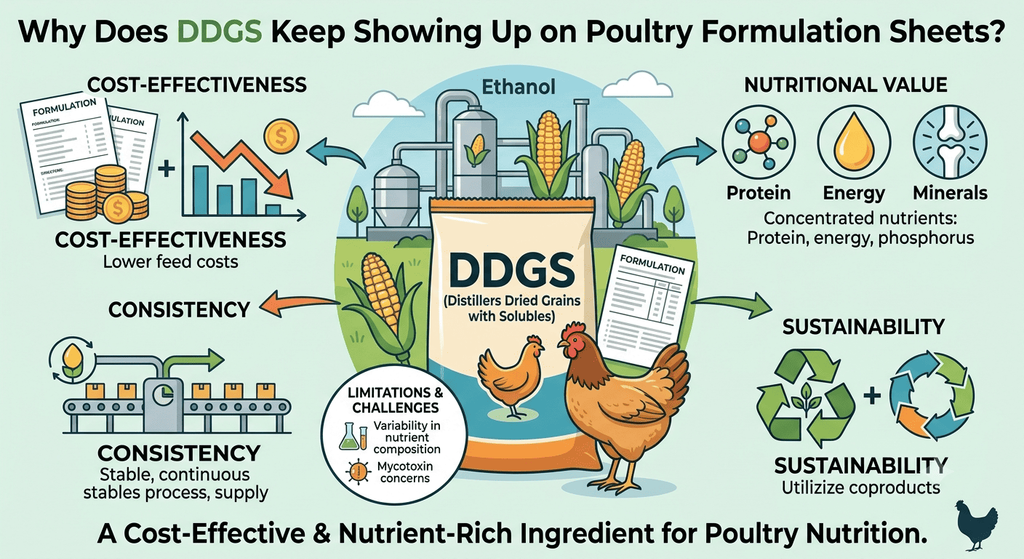
DDGS sits in an unusual spot here. It carries protein and energy in one material, so it can take pressure off two line items at once. That is the main reason inclusion levels in Indian poultry feed have crept upward each year rather than staying flat.
If you want the broader picture of what the material is and how it is produced, our guide on what DDGS is and its benefits in animal feed covers the fundamentals. This article stays with poultry.
What Are You Actually Buying for a Poultry Ration?
Maize DDGS is the version most poultry nutritionists in India work with, and these are the figures that matter on a poultry spec sheet.
| Parameter | Typical Maize DDGS | Why It Matters in Poultry |
| Crude protein | 26 to 32% | Useful, but digestible amino acids decide the real value. |
| Crude fat | 8 to 12% | Contributes meaningful metabolisable energy |
| Metabolisable energy | Roughly 2,600 to 2,800 kcal/kg | Varies with residual oil, so confirm per source |
| Digestible lysine | Variable, heat-sensitive | First limiting amino acid, the single biggest formulation watchpoint |
| Available phosphorus | Higher than in raw maize | Allows a cut in inorganic phosphate |
| Xanthophylls | Around three times maize levels | Supports yolk pigmentation in layer rations |
| Crude fibre / NDF | High | Sets the practical ceiling on inclusion |
Rice DDGS behaves differently in poultry diets. Protein, fibre and energy vary far more between plants, and it does not bring the same pigment contribution as maize DDGS, which matters if yolk colour is part of your buyer specification. Our Rice DDGS and Maize DDGS comparison for feed millers sets out where each one fits.
Practical DDGS Inclusion Rates in Poultry Feed!
These are working ranges, not hard limits. Mills with tight amino acid control and enzyme programmes routinely sit at the top of each band or above it.
| Bird Class | Conservative Inclusion | With Digestible AA Formulation | Notes |
| Broiler starter (0 to 10 days) | 0 to 5% | Up to 6% | Keep it low. Young birds handle fibre poorly and pellet quality is easier to protect |
| Broiler grower | 5 to 8% | 10 to 15% | The phase where DDGS earns its place |
| Broiler finisher | 5 to 10% | 12 to 15% | Watch fat quality in the carcass at the upper end |
| Commercial layers | 5 to 10% | 15%, with trial data supporting more | Research has run to 20 and 25% without losses in egg production when diets were balanced |
| Growing pullets | 3 to 5% | Up to 8% | Bulk density and intake capacity are the limiting factors |
| Breeders | 5% | 8% | Most mills stay conservative here by choice |
A useful rule from the trial work: performance problems attributed to DDGS almost always trace back to formulation shortcuts rather than the ingredient. When diets were rebalanced for energy, digestible lysine and methionine, higher inclusion levels held up well.
Quick Price Check
DDGS Price in India
Corn DDGS Price India 2026
Rice Gluten Meal Price India
Maize DDGS Price India
Rice DDGS Price India
Soya Doc Price in India
The Benefits Worth Counting!
- One ingredient, two jobs. DDGS delivers protein and energy together, so it can displace a share of both maize and soya in the same formulation move. That simplifies the mix and reduces the number of separate materials you need to store and manage.
- The cost per unit of nutrient is strong. With soya meal trading well above DDGS on a per kilogram of protein basis through 2026, the savings show up quickly at commercial volumes. Current rates are tracked in our Maize DDGS price guide for India, and you can see how the finish limitations are in the broiler feed price guide.
- Phosphorus you do not have to buy twice. A good share of the phosphorus in DDGS is available to the bird, which usually allows a reduction in supplemental inorganic phosphate. That is a quiet saving most formulations capture straight away.
- Yolk colour comes along for free in layer diets. The xanthophyll content of maize DDGS runs around three times that of maize itself, and trials have consistently shown yolk pigmentation improving as inclusion rises. For layer operations selling into colour-conscious markets, that is a genuine bonus rather than a side effect.
- It brings useful sulphur amino acids. Methionine and cystine levels in DDGS are respectable, which softens the supplementation load even as lysine needs topping up.
The Limitations and How Mills Work Around Them
Being straight about the constraints is what makes DDGS work well in practice.
- Lysine is the weak point. Drying temperature during processing affects lysine availability, and two loads with identical crude protein can differ meaningfully in digestible lysine. The fix is standard practice rather than anything exotic. Formulate on digestible amino acid values, supplement synthetic lysine, and set minimums for tryptophan and arginine as well.
- Fibre sets the ceiling. The high fibre fraction dilutes energy density and adds bulk. In young birds especially, intake capacity runs out before nutrient requirements are met. This is why starter inclusion stays low and why NSP enzyme programmes are common at higher inclusion rates.
- Batch variability is the real operational challenge. DDGS quality reflects a fermentation process rather than a controlled agricultural standard, so composition shifts between plants and between batches. Mills that buy on a recurring contract from a consistent source deal with this far more easily than those buying spot from rotating suppliers.
- Unsaturated fat affects carcass fat firmness. At high finisher inclusion, the fatty acid profile of DDGS can soften carcass fat. Most operations manage this by trimming inclusion in the final phase rather than avoiding DDGS altogether.
- Pellet quality needs attention. Higher fat and fibre change how the mash behaves through the die. Conditioning temperature and die specification usually need a small adjustment when you move up a band in inclusion.
- Mycotoxin risk carries through. Because the starch is removed, anything present in the original grain is concentrated in the co-product. Aflatoxin testing on every load is not optional, particularly for material stored through monsoon months.
What to Check Before You Accept a Load?
- Crude protein, fat, fibre and moisture tested on your batch, not the general spec sheet
- Digestible lysine, or at minimum a source you can benchmark against past loads
- Aflatoxin and broader mycotoxin screening with documentation
- Colour and smell. Golden to amber is what you want. A scorched or dark appearance suggests heat damage and lower lysine availability
- Consistency across deliveries, which is the difference between a formulation you can leave alone and one you keep adjusting
Frequently Asked Questions
- How much DDGS can I add to broiler feed?Most Indian mills run 5 to 10% across grower and finisher phases. With digestible amino acid formulation and enzyme support, 12 to 15% is well established, and research trials have gone higher without performance losses when diets were correctly balanced. Keep starter diets at or below 5%.
- Does DDGS affect egg production in layers?Trial work has shown no negative effect on feed intake, egg production or egg weight at inclusion levels up to 15%, and in some studies up to 25%, provided lysine and methionine were held at target levels. Yolk colour generally improved as inclusion rose.
- Is DDGS cheaper than soya for poultry feed?On a cost per kilogram of protein delivered, DDGS has held a clear advantage through 2026. It is not a straight one-for-one swap, though, because the amino acid balance is weaker, so factor the synthetic amino acid cost into the comparison. Our comparison of DDGS, Soya DOC, Mustard DOC and DORB works through the trade-offs.
- Should I use maize DDGS or rice DDGS in poultry rations?Maize DDGS is the safer default for poultry because the nutrient profile is better characterised and it contributes yolk pigment. Rice DDGS can work at moderate inclusion where the specification is verified batch by batch.
- Do I need enzymes with DDGS?
Not at low inclusion. Once you move past roughly 10%, NSP enzyme programmes help recover energy from the fibre fraction and are common practice in mills running at the higher end.
About Brinda Foods!
Brinda Foods has supplied animal feed raw materials from Panipat, Haryana since 1987. We supply bulk Maize DDGS and Rice DDGS to poultry feed manufacturers and compound feed producers across India, with lab verified specification documentation on every batch. ISO 9001:2015 certified.
Consistent specs, clear documentation and a supply you can plan your formulation around.
Get today’s bulk quote: Submit an enquiry or contact our team.