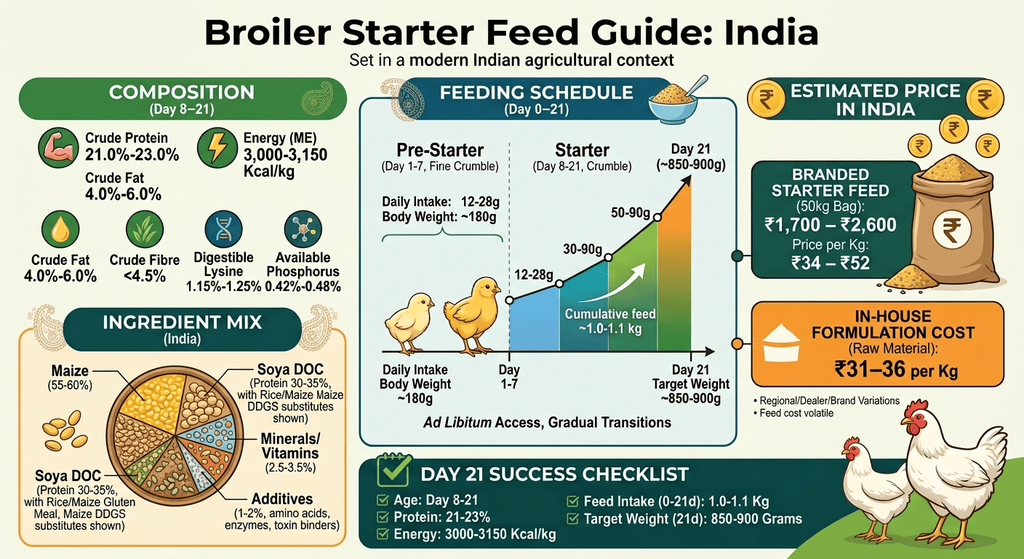
Quick answer: Broiler starter feed is the high-protein ration fed from about day 7–10 through day 21. It carries 21–23% crude protein and 3,000–3,150 kcal/kg ME. Branded starter currently sells at ₹34–52 per kg, or ₹1,700–2,600 for a 50 kg bag, going by marketplace listings this September.
That sits at the top half of the broiler feed range, and there is a straightforward reason for it: starter is the most protein-dense ration in the whole programme. Each bird puts away roughly 1.0–1.1 kg of feed by day 21, so the starter phase works out to about ₹37–47 per bird at branded rates. GST is Nil under HSN 2309, so whatever spread you see between brands is coming from raw material mix, not tax.
Quick Price Check
DDGS Price in India
Corn DDGS Price India 2026
Rice Gluten Meal Price India
Maize DDGS Price India
Rice DDGS Price India
Soya Doc Price in India
Why the Starter Phase Punches Above Its Weight
Two weeks. That’s really all it is. But those two weeks decide a lot about how the batch closes out on day 42.
Birds are building frame and muscle faster now than at any other point in the cycle, and their gut is still catching up to the job. So the feed has to be dense and it has to be digestible. There isn’t much room for a ration that’s merely adequate.
That’s the reason starter looks so different from what follows it. Amino acid density peaks here. Particle size is kept fine and even. Ingredient quality gets scrutinised harder than it will in the finisher phase. And if something slips in the formulation during this window, you usually find out about it through FCR a month later, when nothing can be done.
Most Indian programmes split the early period in two: a pre-starter for the first week to ten days, then starter through day 21. Plenty of operations run a single starter across the full 0–21 stretch instead. Neither is wrong. The call tends to come down to mill capacity and batch size rather than nutrition.
Broiler Starter Feed Nutrient Specification
| Parameter | Pre-starter (0–7/10 days) | Starter (7/10–21 days) |
| Crude protein | 22–24% | 21–23% |
| Metabolisable energy (ME) | 3,000–3,100 kcal/kg | 3,000–3,150 kcal/kg |
| Digestible lysine | 1.25–1.35% | 1.15–1.25% |
| Methionine + cystine | 0.92–0.98% | 0.85–0.95% |
| Threonine | 0.82–0.88% | 0.75–0.82% |
| Calcium | 0.95–1.05% | 0.90–1.00% |
| Available phosphorus | 0.45–0.50% | 0.42–0.48% |
| Crude fat | 4–6% | 4–6% |
| Crude fibre | 4% max | 5% max |
| Salt | 0.30–0.40% | 0.30–0.40% |
| Moisture | 11% max | 12% max |
Look at the energy row for a second, because it catches people out. Starter is not the highest-energy ration in the programme. Finisher typically runs higher, at 3,100–3,200 kcal/kg. What starter holds is the highest protein-to-energy ratio, and that ratio is the whole point of the phase. Lift energy without lifting amino acid density alongside it and you get fat where you wanted frame. The bill for that arrives later, in FCR.
Our broiler feed nutrition and FCR guide has the grower and finisher targets if you want the full programme in one place.
What Goes Into a Starter Ration
Below is how a 21–23% CP starter usually comes together in an Indian mill. Inclusions move around with ingredient pricing and what’s actually available that month, so read it as a working structure, not a recipe to copy.
| Ingredient | Typical inclusion | Role in the formula |
| Maize | 50–56% | Primary energy base, highly digestible starch |
| Soya DOC | 28–34% | Amino acid balanced protein backbone |
| Maize Gluten / Rice Gluten | 3–6% | Concentrated protein, partial soya offset |
| Maize DDGS | 3–5% | Combined protein and energy contribution |
| Vegetable oil / fat | 1.5–3% | Energy density and crumble quality |
| Dicalcium phosphate | 1.5–2.0% | Phosphorus and calcium |
| Limestone powder | 1.0–1.5% | Calcium |
| DL-Methionine | 0.20–0.30% | First limiting amino acid top-up |
| L-Lysine | 0.15–0.25% | Amino acid balance |
| Salt | 0.30–0.40% | Electrolyte balance |
| Vitamin-mineral premix | 0.25–0.50% | Micronutrient supply |
| Enzymes, toxin binder | 0.10–0.20% | Digestibility and storage protection |
Soya DOC is carrying most of the amino acid load in that table, and this year that has become an expensive place to lean. Millers have responded by pushing maize gluten meal and rice gluten meal in harder, holding the protein number while trimming cost, then correcting the amino acid profile with synthetic methionine and lysine. It works. The caveat is that the correction has to be calculated properly, not eyeballed, because gluten meals and soya are not interchangeable on lysine.
DDGS stays modest here, and deliberately so. It brings genuinely useful protein and energy, but the fibre load and the weaker amino acid quality suit grower and finisher rations better, once digestive capacity has caught up. Inclusion limits by species and stage are laid out in our DDGS guide.
The Feeding Schedule, Day by Day
Feed form shifts along with the ration. Pre-starter goes out as a fine crumble, starter as something slightly coarser, and pellets usually arrive at the grower transition. Screening matters more than it gets credit for. Give birds a crumble full of fines and they’ll pick the good bits and leave the rest, which quietly pulls your effective ration away from the one you formulated.
| Age (days) | Feed type & form | Intake per bird per day | Cumulative intake per bird |
| 1–7 | Pre-starter, fine crumble | 13–27 g | ~130–150 g |
| 8–14 | Starter, crumble | 33–55 g | ~430–460 g |
| 15–21 | Starter, crumble | 62–90 g | ~1.00–1.08 kg |
| 22 onward | Transition to grower/finisher pellet | 95 g and rising | Phase complete |
Four things that come up again and again in conversations with mill customers:
Transition slowly. Blending starter into grower over two or three days holds intake far better than flipping the ration overnight.
In week one, feed little and often. Several fresh presentations a day beat one big fill, every time.
Track cumulative intake against the plan rather than eyeballing the feeders. If a batch is running under the curve by day 14, that’s early enough to look at formulation or crumble quality and still fix it.
And keep an eye on storage through the monsoon. Starter is fattier and denser than anything else you’ll store, which makes it the least forgiving bag in the godown. Our note on monsoon mycotoxin and aflatoxin risk covers the testing and rotation side properly.
Broiler Starter Feed Price in India (September 2026)
| Feed stage | Crude protein | Price per kg | Price per 50 kg bag |
| Pre-starter | 22–24% | ₹40–46 | ₹2,000–2,300 |
| Starter | 21–23% | ₹34–52 | ₹1,700–2,600 |
| Finisher | 18–20% | ₹19–40 | ₹950–2,000 |
Current listings put a 50 kg pre-starter crumb around ₹1,700, a mainstream branded starter near ₹2,100, and premium lines at ₹2,600. These are indicative marketplace listing prices (IndiaMART, TradeIndia) sampled in September 2026. They move with seller, region and date, so check with your dealer before you budget against them.
2. What do the raw materials actually cost?
If you’re formulating in-house, bag price is the less interesting number. Ingredient cost is the one that tells you something.
Run the composition table above against current September rates and a 21–23% CP starter comes to roughly ₹31–36 per kg in raw material cost, before processing, packaging and distribution get added on top.
Against branded starter at ₹34–52, that gap is real, and it stretches wider the further up the branded range you go. Which is exactly why the larger integrators buy maize, Soya DOC, gluten meals and DDGS direct and formulate to their own spec rather than buying finished bags.
3. Cost per bird through the starter phase
At 1.0–1.1 kg of cumulative intake by day 21:
Branded feed at ₹34–52/kg works out to roughly ₹37–47 per bird. In-house formulation at ₹31–36/kg brings that to roughly ₹33–38 per bird.
Starter accounts for only about a quarter of lifetime feed intake, but a good deal more than a quarter of lifetime feed cost, because it’s the densest ration you’ll mix. That’s what makes it the phase where sourcing discipline pays back fastest.
Before You Buy Starter Raw Materials in Bulk!
Protein and amino acids should be lab-verified on your batch, not lifted off a general spec sheet.
Moisture wants to stay under 12% across DOC and gluten meals. Starter ingredients sit at higher nutrient density and turn faster than the rest of your intake.
Aflatoxin testing on every maize and by-product delivery is not negotiable. Young birds are the most sensitive group in the shed, and this is the phase where testing discipline earns back what it costs.
Check particle size and uniformity in the finished crumble, for the selective feeding reasons above.
Batch-to-batch consistency matters most if you’re running a continuous line that shouldn’t need re-tuning on every delivery.
On traceability, BIS, GMP, ISO 9001:2015, GAFTA and FOSFA are a reasonable floor to ask for.
Frequently Asked Questions!
- What is broiler starter feed?
It’s the high-protein ration fed from roughly day 7–10 to day 21, formulated at 21–23% crude protein and 3,000–3,150 kcal/kg ME to carry birds through their fastest growth phase. Many programmes run a pre-starter at 22–24% CP ahead of it for the first week.
- What protein percentage should broiler starter feed have?
21–23% crude protein, with digestible lysine around 1.15–1.25% and methionine plus cystine around 0.85–0.95%. Pre-starter goes a little higher at 22–24%.
- How long should broiler starter feed be given?
Usually to day 21, then transitioned into grower or finisher over two to three days. Some programmes stretch starters a few days further depending on target market weight.
- How much starter feed does one broiler eat?
Around 1.0–1.1 kg per bird cumulatively by day 21, counting both pre-starter and starter.
- What is the price of broiler starter feed in India?
Branded starter runs ₹34–52 per kg, or ₹1,700–2,600 for a 50 kg bag, on September 2026 listings. The stage-wise breakdown is in our broiler feed price guide.
- Why does starter cost more than finisher?
Starter needs 21–23% crude protein against finisher’s 18–20%, and that extra protein comes from pricier ingredients like Soya DOC and gluten meals. Finisher leans harder on cheaper maize for energy.
- Does GST apply to broiler starter feed?
No. Broiler feed sits under HSN 2309 at a Nil rate. Feed supplements and additives are classified separately and usually attract 18%.
- Where can I source bulk raw materials for broiler starter feed?
Brinda Foods supplies Maize, Soya DOC, Maize DDGS, Rice DDGS, Maize Gluten and Rice Gluten in bulk to broiler feed manufacturers from Panipat, Haryana. Submit an enquiry for current pricing.
About Brinda Foods
Brinda Foods has supplied animal feed raw materials from Panipat, Haryana since 1987. We provide bulk supply of Maize, Soya DOC, Maize DDGS, Rice DDGS, Maize Gluten, Rice Gluten and De-Oiled Rice Bran (DORB) to broiler feed manufacturers across India. Every batch is scientifically sampled and lab-tested against the nutrient matrix before dispatch, with FIFO-managed storage protecting quality all the way through. ISO 9001:2015 certified.
Get today’s bulk quote: Submit an enquiry or contact our team.