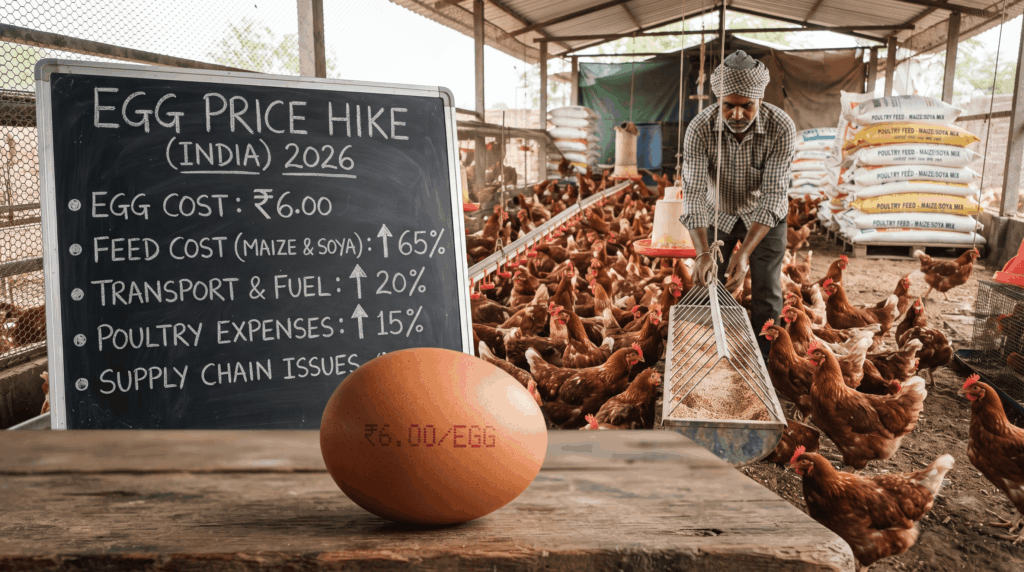
Quick summary: If egg prices feel like they keep climbing in 2026, it’s not your imagination — and it isn’t a demand story. Punjab’s poultry farmers association reported retail egg prices at ₹7 per egg as of September 2, 2026, up from ₹6 before the monsoon, and national coverage has flagged retail prices touching ₹14 apiece in some markets. Two feed-cost pressures are compounding at the same time: the soybean meal shortage that’s been building since mid-2026, and a newer, faster-moving factor — maize demand from India’s ethanol blending programme, which is now pulling on the same grain that anchors most poultry rations.
Correcting the Record on Namakkal Rates
An earlier version of this article cited a Namakkal wholesale rate of ₹8 per egg as a September 2026 record. Checking against live NECC-benchmark trackers as of September 1–2, 2026, that figure isn’t supported by current data — Namakkal wholesale rates are actually sitting around ₹5.20 per egg, roughly flat to slightly down from ₹5.40 in mid-August. The real story in September 2026 isn’t a single dramatic record at the traditional benchmark hub — it’s a broader, feed-cost-driven price creep showing up unevenly across states, with some regions (like Punjab) seeing sharper, more immediate increases than others. We’ve corrected the figures below to reflect verified, dated sources rather than repeat an unconfirmed number.
It Still Starts With What Hens Eat, Not What Consumers Buy
A layer hen’s feed bill remains the single biggest input cost in egg production — typically 65–75% of total production cost — and within that feed bill, maize and soybean meal dominate, together making up the bulk of a standard layer ration. When either ingredient spikes, egg rates tend to follow within days to weeks, because feed conversion ratios are essentially fixed in the short term and farmers have very little buffer to absorb a sharp cost increase without passing it through.
What’s changed since this article was first published in July 2026 is that two feed-cost pressures are now active at once, rather than one.
Driver One: The Soybean Meal Crisis (Still Active)
India’s 2025–26 soybean crop came in around 12.7 million tonnes — a 17% drop from the previous year — tightening supply of soybean meal, the primary protein source in layer rations. Soybean meal prices responded by climbing more than 40% to roughly ₹65–66/kg, a multi-year high, per CLFMA data. This piece of the story hasn’t resolved; we cover the full mechanics, including the GM-import policy debate, in our soybean meal crisis deep dive.
Driver Two: Maize Demand From India’s Ethanol Programme (New, and Accelerating)
This is the development that’s genuinely new since mid-2026. Punjab’s Progressive Poultry Farmers Association reported on September 2, 2026 that maize prices have jumped from ₹2,000 to ₹2,500 per quintal, with association chairman Mohinder Arora directly linking the spike to rising demand for maize as an ethanol feedstock. Pearl millet (bajra), another poultry ration component, has also risen to around ₹2,350/quintal. Association president Jasmeet Dango put current production cost at nearly ₹5.50 per egg — leaving very little margin before further cost increases have to reach the consumer.
This tracks with the structural shift we detailed in our E20 ethanol and Maize DDGS supply piece: maize now supplies roughly 35% of India’s ethanol production, and maize allocated to the Ethanol Blended Petrol programme has grown from 8.3 lakh tonnes in 2022–23 to 125.75 lakh tonnes in 2024–25 — a more than fifteen-fold increase in two years, per figures reported alongside national egg-price coverage in late August 2026. That’s maize being pulled out of the feed-grain pool at a scale that wasn’t a factor when this article was first written.
Why this matters more than a single price data point: the soybean meal crisis was a supply-shock story — a bad harvest that could, in principle, resolve with the next good crop. Ethanol-linked maize demand is a structural, policy-driven shift that isn’t going to reverse with one good monsoon. Poultry feed formulators are now facing cost pressure on both their major ration components — protein (soybean meal) and energy (maize) — from two different causes at the same time.
Quick Price Check
Maize Kharif Sowing 2026 DDGS Price Outlook
DDGS Price in India
Layer Feed Price in India
Broiler Feed Price India
Cattle Feed Price in India
Maize Price Per Kg India 2026
Feed Raw Material Price Comparison India
Corn DDGS Price India 2026
Rice Gluten Meal Price in India 2026
Dorb Price in India 2026
Maize Gluten Meal Price India 2026
Soya Doc Price India 2026
Maize DDGS Price India 2026
Mustard Doc Price India 2026
Maize Animal Feed Price Nutrition Guide India 2026
Rice DDGS Price India 2026
Regional Variation: Why the Number You See Depends on Where You Look
“Egg prices” aren’t a single national figure — they’re a patchwork of state and city markets, each exposed to the same underlying feed-cost pressure but showing it at different speeds:
- Punjab: Farm-gate/retail rates at ₹7/egg as of Sept 2, 2026, up from ₹6 pre-monsoon, per the state poultry farmers association.
- National retail (select markets): Reports of prices touching ₹14 apiece in some markets and online platforms, reflecting the widest gap between farm-gate and consumer-facing pricing.
- Namakkal, Tamil Nadu (the traditional wholesale benchmark): Around ₹5.20/egg as of early September 2026 — comparatively contained so far, though this hub remains the one to watch since it sets pricing expectations for much of southern and central India, and Kerala in particular, which depends heavily on Namakkal supply.
Is This Temporary or the New Normal?
With two active cost drivers instead of one, the near-term outlook has gotten more complicated, not less:
If the soybean meal shortage eases with improved domestic supply or approved imports, that removes one leg of the cost pressure — but the ethanol-linked maize demand shift is a policy commitment, not a weather event, and isn’t likely to unwind on a similar timeline.
If both pressures persist through the festive season (see our coverage of why milk prices are also rising this September for the parallel dynamic playing out in dairy), expect egg prices to keep climbing unevenly across states rather than resolving quickly.
Structurally, feed cost volatility is becoming the norm rather than the exception — driven by weather-dependent kharif yields, monsoon-linked mycotoxin risk (see our monsoon mycotoxin guide), shifting GM-import policy, and now a fast-growing ethanol programme competing for the same grain. Farmers and integrators who diversify protein and energy sourcing rather than relying on a narrow maize-soymeal formula are better insulated against the next shock.
What Poultry Farmers Can Do About Rising Feed Costs
- Evaluate mustard DOC inclusion in layer rations — typically ₹8–12/kg cheaper than soya DOC. See our mustard DOC guide.
- Review DORB and Maize DDGS inclusion on the energy side of the ration — DDGS in particular is worth a fresh look given the price gap detailed in our Maize DDGS price guide, and current DORB pricing.
- Avoid locking into single-supplier contracts for either maize or soymeal at spot-crisis prices; diversified sourcing reduces exposure when either ingredient spikes independently.
- Track both policy threads closely — the GM soybean meal import decision, and any signal on how the ethanol programme’s maize allocation evolves into the 2026–27 season — since either could move feed costs meaningfully within weeks.
Frequently Asked Questions
Why are egg prices rising in India in 2026? Two feed-cost pressures are compounding: an ongoing soybean meal shortage following a 17% drop in India’s 2025–26 soybean crop, and a newer factor — rising maize prices driven by demand from India’s ethanol blending programme, which now consumes maize at more than fifteen times its 2022–23 volume.
Is the ₹8 Namakkal egg price figure accurate? No — checked against live NECC-benchmark data as of September 1–2, 2026, Namakkal wholesale rates are around ₹5.20/egg, not ₹8. An earlier version of this article carried an unverified figure; this update corrects it against current, dated sources.
How does the ethanol programme affect egg prices? Maize is a core poultry feed ingredient. As more of India’s maize crop is allocated to ethanol production under the Ethanol Blended Petrol programme (up from 8.3 lakh tonnes in 2022–23 to 125.75 lakh tonnes in 2024–25), less is available for feed at the same price, pushing up poultry ration costs — and with feed at 65–75% of egg production cost, that pressure passes through quickly.
Which regions are seeing the sharpest egg price increases? Punjab has reported farm-gate/retail increases to ₹7/egg as of early September 2026, and national coverage has flagged retail prices touching ₹14 in some markets. Namakkal, the traditional wholesale benchmark, has been comparatively more contained so far.
How can poultry farmers manage rising feed costs? Diversifying protein and energy sourcing — mustard DOC and DORB as partial substitutes, and Maize DDGS as a dual protein-energy option — reduces exposure to any single ingredient’s price spike. See our feed cost reduction guide for the full set of levers.
The Bottom Line
The egg price story changed between July and September 2026. What started as a single-driver soybean meal shortage is now a two-front feed cost squeeze, with maize demand from India’s ethanol programme adding pressure that isn’t tied to weather or harvest cycles and isn’t likely to ease quickly. For poultry farmers, that makes ration diversification — not waiting out the cycle — the more urgent response.
For current alternative-ingredient pricing, see our guides on Mustard DOC, Maize DDGS, and DORB, and for the full soybean meal crisis and ethanol-maize context, read Soybean Meal Crisis in India (2026) and India’s E20 Ethanol Push.
About the Author: Dr. Rishabh Chugh is a veterinary doctor, animal nutrition specialist, and Director at Brinda Foods Private Limited, Panipat.
About Brinda Foods
Brinda Foods has supplied animal feed raw materials from Panipat, Haryana since 1987. We provide bulk supply of Maize, Maize DDGS, Soya DOC, Mustard DOC, and DORB to poultry farms and feed mills across India. ISO 9001:2015 certified.
Get today’s bulk quote: Submit an enquiry or contact our team.