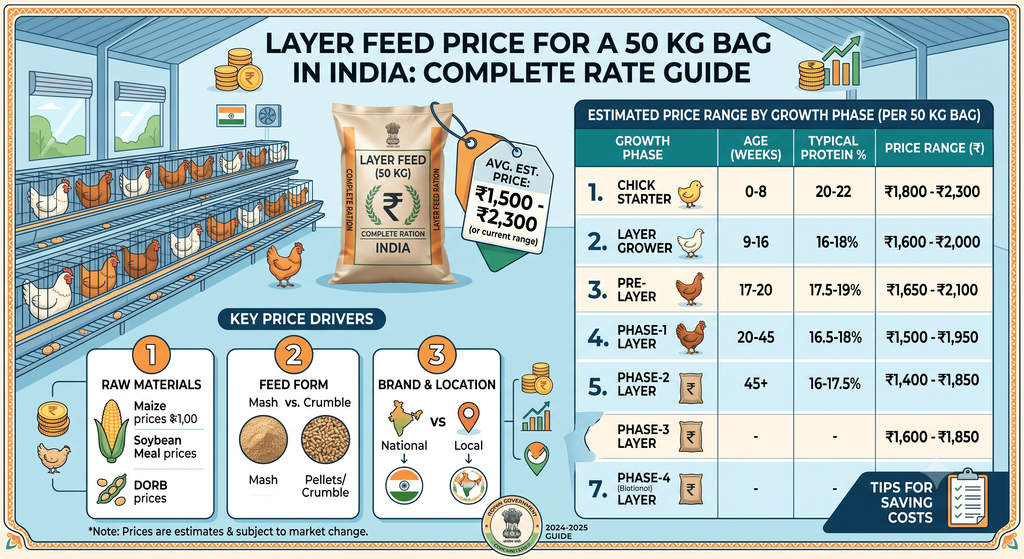
Quick answer: ₹1,250 to ₹2,300 for a 50kg bag, with the real market clustered at ₹1,500 to ₹1,900. That’s ₹30 to ₹38 a kg. Phase-specific bags reach ₹2,500. The spread has almost nothing to do with branding and almost everything to do with what maize and Soya DOC cost on the morning the batch was mixed.
Today’s Rates
September 2026, from marketplace listings and what mills are quoting directly.
| Segment | Per kg | Per bag | What you’re buying |
| Economy | ₹25 to ₹29 | ₹1,250 to ₹1,450 | Lower protein, more fibre filler, local reach only |
| Mainstream | ₹30 to ₹38 | ₹1,500 to ₹1,900 | Where most organised farms actually buy |
| Premium | ₹40 to ₹50 | ₹2,000 to ₹2,500 | Tighter spec, phase-matched calcium, fuller premix |
| Concentrate | ₹55 to ₹80 | ₹2,750 to ₹4,000 | You dilute this with your own grain |
Ignore that last row when comparing. A concentrate bag looks brutal next to a complete feed bag until you remember you’re blending it with maize you already own. Compare the finished ration, not the sack.
Quick Price Check
DDGS Price in India
Corn DDGS Price India 2026
Rice Gluten Meal Price India
Maize DDGS Price India
Rice DDGS Price India
Soya Doc Price in India
The Cost of Sitting Inside the Bag!
Every rupee on that price tag traces back to seven ingredients. Here’s a layer phase 1 ration at today’s rates. Your inclusions will differ, but the shape won’t.
| Ingredient | Share | Quantity | Rate | Cost |
| Maize | 55% | 27.5 kg | ₹23.50/kg | ₹646 |
| Soya DOC | 18% | 9 kg | ₹43/kg | ₹387 |
| De-Oiled Rice Bran | 8% | 4 kg | ₹14/kg | ₹56 |
| Maize DDGS | 5% | 2.5 kg | ₹14/kg | ₹35 |
| Mustard DOC | 4% | 2 kg | ₹17/kg | ₹34 |
| Limestone / shell grit | 8% | 4 kg | ₹5/kg | ₹20 |
| Premix, salt, additives | 2% | 1 kg | ₹90/kg | ₹90 |
| Total | 50 kg | ₹1,268 |
Add ₹80 to ₹120 for grinding, mixing and bagging. Add freight. Add the channel’s cut. You land on ₹1,500 to ₹1,900, which is exactly where the shelf price sits. No mystery in it.
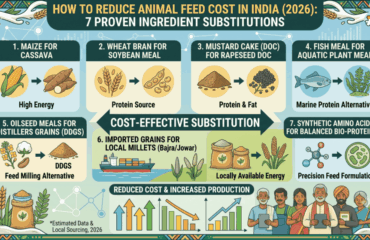
The useful conclusion is where your leverage is. Maize and Soya DOC are 80% of the ingredient cost, and a one-rupee move in maize shifts the bag by ₹27. But you can’t cut maize, you need the energy. The flexibility lives entirely on the protein side, which is where DDGS and Mustard DOC earn their place.
Why Does One Bag Cost ₹600 More Than Another?
Protein spec accounts for most of it. A 17% CP bag cannot cost what a 15% CP bag costs, and anyone quoting both at one price is telling you something about one of them.
Phase matters next. Peak lay rations carry far more calcium than pre-layer rations, and a bag labelled simply “layer feed” may not match the age of the birds eating it.
Then sourcing. A mill holding contracted maize and a mill buying off the mandi this week will quote very differently on the same Tuesday, and neither is cheating you. After that it’s freight, order size and whether you want pellets, which add a rupee or two per kg.
Bag Price by Phase!
| Phase | Bird age | CP | Bag price |
| Chick / starter | 0 to 8 weeks | 20% to 21% | ₹1,900 to ₹2,400 |
| Grower | 9 to 17 weeks | 16% to 17% | ₹1,550 to ₹1,850 |
| Pre-layer | 17 to 19 weeks | 16% to 17% | ₹1,600 to ₹1,900 |
| Layer phase 1 | 20 to 45 weeks | 17% to 18% | ₹1,600 to ₹1,950 |
| Layer phase 2 | 46 weeks on | 15% to 16% | ₹1,450 to ₹1,800 |
The starter is the priciest bag and the one you finish fastest. Phase 2 is cheaper per bag and swallows most of your annual spend. Negotiate there.
What a Bag Buys?
A layer eats about 110 g a day. One bag runs 100 birds for four and a half days, or one hen for roughly fifteen months.
At ₹32 a kg, that’s ₹3.50 per bird per day. At 85% lay, a shade over ₹4 of feed per egg. With the NECC national average around ₹5.74, the spread is tight enough that ₹100 on a bag is not noise. Across 5,000 birds, it’s close to ₹1.1 lakh a year. Feed is 65% to 70% of your cost of producing an egg, and nothing else on the sheet comes near it.
Bags or Self-Mixing!
| Branded bag | Self-mixed | |
| Cost per 50kg | ₹1,500 to ₹1,900 | ₹1,280 to ₹1,450 |
| Consistency | Mill-controlled | Your mixer, your QC |
| Working capital | Low | Higher, you hold stock |
| Flexibility | Fixed | Adjusts to mandi rates |
| Minimum scale | Any | Around 5,000 birds |
The ₹200 to ₹450 saving is real, and it disappears fast without three things: a mixer that mixes rather than tumbles, storage that stays dry through August, and a supplier whose second consignment matches the first. Below 5,000 birds, the bag usually wins, not on price but on the hours you get back.
Six Checks Before You Pay!
Manufacturing date first, before anything else. Premix-carrying feed is best used within 30 to 45 days, and a bag sitting in a godown since May is not the product it was in May.
Read the tag, not the brand. CP, crude fibre, calcium, available phosphorus, moisture. Without those printed, the price is unpriceable.
Watch moisture above 11%. You’re paying feed rates for water and buying a shorter shelf life right as the monsoon lands.
Weigh a bag occasionally. A “50 kg” sack arriving at 48.5 is a 3% price rise nobody mentioned.
Compare per kg of protein. A ₹1,450 bag at 15% CP is dearer than a ₹1,650 bag at 18%. Do the division before switching to save ₹200.
Ask what’s in the quote. Freight, loading, and GST treatment in writing.
Where We Fit?
We don’t sell finished layer feed bags. We supply what goes inside them, which is the part of the stack that decides what any bag costs.
Out of Panipat since 1987, we ship Maize DDGS at 28% to 32% CP, Rice DDGS at 40% to 45%, and Soya DOC at 44% to 48%, along with mustard DOC, DORB, maize and gluten meals, all from one facility. Lab-confirmed COA on every batch, ISO 9001:2015, and details on the certifications page.
Mixing your own and wanting this week’s landed rates? Send an enquiry.
FAQs
- What does a 50kg bag cost today?
₹1,250 to ₹2,300, mainstream band ₹1,500 to ₹1,900, premium up to ₹2,500.
- How long does one bag last?
Four and a half days for 100 layers at 110 g per bird per day. About fifteen months for a single hen.
- Why have prices risen in 2026?
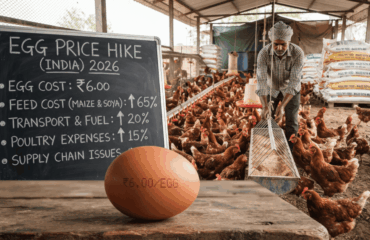
Soya, mostly. Soybean meal crossed ₹65/kg on weaker production and cancelled exports, pulling Soya DOC to multi-year highs, while ethanol demand for maize kept grain firm. The export halt analysis covers the protein side.
- Is self-mixing cheaper?
By ₹200 to ₹450 per 50 kg equivalent, if you have the mixer, the storage and a consistent supplier. Under 5,000 birds, it rarely pays for the extra work.
- Is there GST on layer feed?
No. HSN 2309 carries a nil rate and has been since 2017. Detail in the HSN and GST guide.
- Can DDGS lower my bag cost?
Yes, partially replacing soya on the protein side, since maize and rice DDGS both price below soya DOC per unit of protein. Inclusion limits apply, and the ration needs rebalancing, so run it past your nutritionist first.
- Where do I get current bulk rates?
Rates are confirmed at the time of order, because these markets move weekly.
Mixing your own layer ration? Send an enquiry for this week’s rates on Soya DOC, Maize DDGS, Rice DDGS, Mustard DOC and DORB.