The UAE’s animal feed market is valued at roughly $1.26 billion, moving close to 3 million tonnes of feed a year to sustain a livestock population of over 2.2 million head — cattle, camels, sheep, and goats — plus a growing poultry sector anchored by producers like Agthia and Al Ghurair Foods. What makes this market structurally different from most: the UAE’s arid climate means there is almost no domestic grain or oilseed production to fall back on. Over 90% of key raw materials like corn and soybean meal are imported, with Brazil, Argentina, and India already established as core source countries. (GlobeNewswire)
For UAE feed manufacturers, that makes supplier reliability — not just price — the deciding factor. A missed shipment isn’t a formulation inconvenience; it’s a production stoppage. This guide covers where Indian DDGS and Soya DOC fit into UAE feed formulations, and what to verify before committing to a supplier.
Why UAE Feed Manufacturers Import Nearly Everything
- No domestic grain base. Without meaningful local corn, soybean, or oilseed cultivation, UAE feed mills are import-dependent for energy and protein raw materials by default, not by strategic choice — which makes supply chain resilience the single biggest operational risk in the business.
- A growing, diversifying livestock base. The national livestock population has grown past 2.2 million head, and poultry feed production is scaling alongside it (facilities like Agthia and Al Ghurair Foods produce roughly 10,000 MT of poultry feed annually), which means raw material demand is rising, not flat.
- National food-security programs. UAE policy increasingly favors diversified, dependable import relationships over single-origin sourcing, as part of broader food self-reliance initiatives — a tailwind for suppliers who can demonstrate consistency and documentation discipline over suppliers competing purely on price.
- India is already a trusted source. Because India is an established origin for UAE feed raw material imports, Indian exporters aren’t asking UAE buyers to take on new-market risk — the trade lane, customs familiarity, and shipping routes already exist.
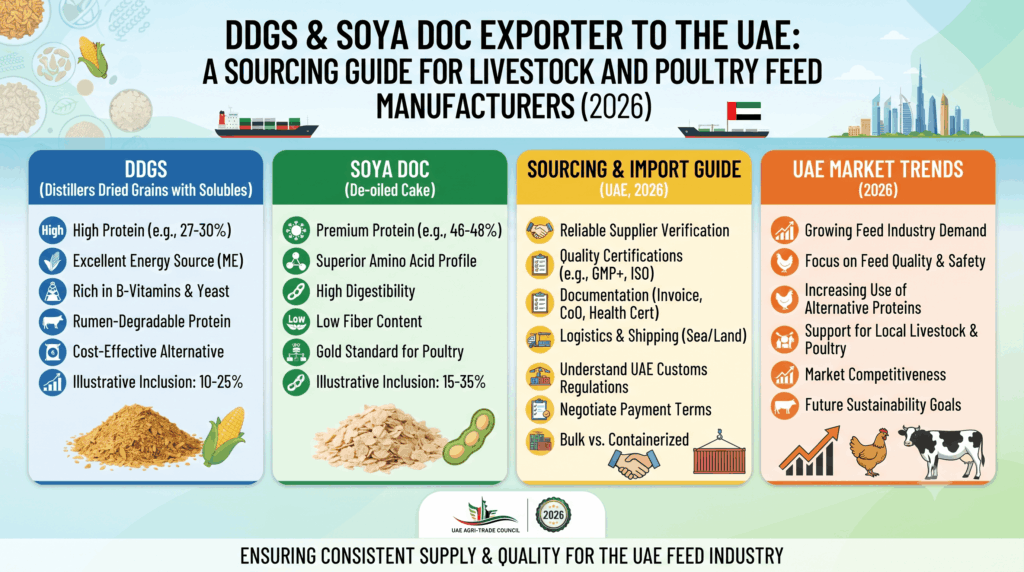
Where Indian DDGS and Soya DOC Fit UAE Feed Formulations
| Ingredient | Crude protein | Typical use in UAE feed | Fit |
|---|---|---|---|
| Maize DDGS | 28–32% | Poultry, cattle, and camel feed as a protein-energy supplement | Consistent amino acid profile; complements existing corn-based rations |
| Soya DOC | 44–48% | Primary plant protein in poultry and dairy cattle diets | Direct fit alongside imported soybean meal in existing formulations |
| De-Oiled Rice Bran (DORB) | Moderate protein, high energy/fibre | Dairy cattle and sheep/goat rations | Cost-effective bulking and energy component for ruminant diets |
These ingredients don’t replace UAE feed mills’ existing South American soybean meal relationships outright — they diversify the supply base, which is precisely the resilience UAE buyers are already being pushed toward.
What to Check Before Choosing an Export Supplier
| Checklist item | Why it matters |
|---|---|
| GAFTA/FOSFA compliance | The trade-standard documentation UAE customs, ports, and financing institutions expect for bulk grain and feed shipments |
| Certificate of Analysis (COA) per shipment | Batch-level protein, moisture, and quality data lets UAE QA teams clear containers without delay |
| Phytosanitary certification and export paperwork owned by the supplier | Faster port clearance when the exporter — not the buyer — manages documentation |
| ISO/HACCP certification | Baseline process-control evidence, particularly relevant given the region’s food-security scrutiny on imported inputs |
| Established India-origin export history | Suppliers with a demonstrated export track record reduce first-shipment risk for UAE buyers |
| Single-supplier product range | Sourcing DDGS, DOC, and DORB from one exporter simplifies vendor management for feed mills blending multiple raw materials |
Why Feed Manufacturers Source From Brinda Foods
Brinda Foods has supplied feed-grade raw material to Indian manufacturers since 1987, and exports to 25+ countries including the UAE, Vietnam, and Thailand. Against the checklist above:
- ISO 9001:2015 certified, with HACCP and CLFMA membership
- GAFTA and FOSFA compliant exports, with a Certificate of Analysis (COA) provided on every shipment
- Full export documentation handled end-to-end — phytosanitary certificates, COAs, and compliance paperwork
- One supplier for Maize DDGS, Rice DDGS, Soya DOC, Mustard DOC, and De-Oiled Rice Bran, reducing the number of vendor relationships UAE feed mills need to manage
- Technical oversight from Dr. Rishabh Chugh (BVSc/MVSc, NDRI Karnal), Director, giving formulation-level credibility beyond a pure commodity trading relationship
FAQ
Does Brinda Foods export DDGS and Soya DOC to the UAE? Yes. Brinda Foods exports to 25+ countries including the UAE, Vietnam, and Thailand, with full export documentation — phytosanitary certificates, Certificates of Analysis, and compliance paperwork — handled for every shipment.
Why does the UAE import most of its animal feed raw material? The UAE’s arid climate supports very limited domestic grain and oilseed cultivation, so feed manufacturers rely on imports — primarily from Brazil, Argentina, and India — for over 90% of key raw materials like corn and soybean meal.
What certifications does Brinda Foods hold for export? Brinda Foods is ISO 9001:2015 certified, HACCP compliant, a CLFMA member, and exports in line with GAFTA and FOSFA international trade standards.
What is the crude protein content of Brinda Foods’ Maize DDGS and Soya DOC? Maize DDGS contains 28–32% crude protein; Soya DOC runs 44–48%. Exact batch values are confirmed via the Certificate of Analysis provided with each shipment.
How do I request a bulk export quote for UAE delivery? Submit a request through the enquiry page with your required product, volume, and destination port, and the Brinda Foods export team will respond with pricing and documentation timelines.