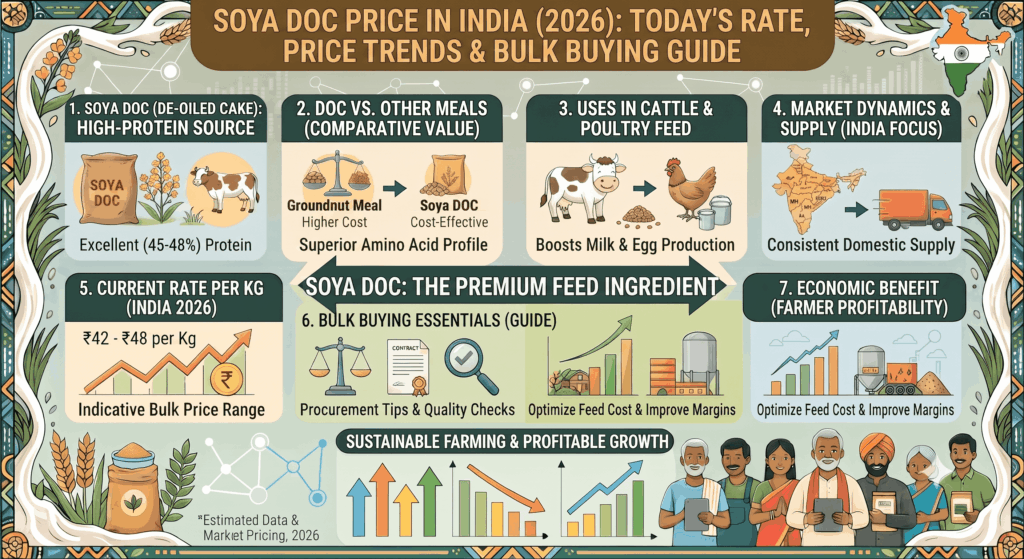
Quick answer: As of September 2026, Soya DOC (Soybean De-Oiled Cake) is trading between ₹40–46/kg (₹40,000–46,000/tonne) for standard 44–46% protein feed-grade material, with premium 48–50% protein lots running higher. Ex-factory wholesale rates for solvent-extracted soymeal at Indore — India’s largest crushing hub — touched ₹57,000–60,500/MT (₹57–60.5/kg) through the second half of July before easing slightly to ₹57,000–57,500/MT by month-end, per SOPA market data. Rates vary by region, protein content, and order volume — mandi and retail listings elsewhere on the web range from ₹42–62/kg, largely reflecting smaller-lot, non-bulk pricing. For bulk (multi-tonne) procurement, expect meaningfully better rates than retail listings show.
Rates move daily with the soybean crush cycle, so treat the numbers below as a directional guide and confirm today’s rate directly with your supplier before booking.
Current Soya DOC Price (September 2026)
| Grade / Protein | Typical Price Range | Best Suited For |
|---|---|---|
| Standard Soya DOC, 44–46% CP | ₹40–46/kg | Cattle, buffalo, general poultry rations |
| High-protein Soya DOC, 48–50% CP | ₹46–52/kg | Broiler starter feed, layer feed, premium poultry formulas |
| Small-lot / retail (under 1 tonne) | ₹42–62/kg | Individual farmers, small feed shops |
| Bulk / mill-direct (multi-tonne, contract) | Below listed retail rates — negotiated | Feed mills, integrators, large dairy/poultry operations |
Prices are indicative for North and Central India (Haryana, Punjab, UP, Rajasthan, MP) and can shift by ₹1–3/kg between regions depending on proximity to crushing plants. Coastal and southern markets often carry a freight premium.
Why Soya DOC Prices Have Risen in 2026
Soya DOC is the backbone protein source for most Indian feed formulations, and its price has climbed sharply over the past 18+ months — from roughly ₹35–38/kg in early 2025 to ₹40–46/kg by September 2026, a rise of roughly 25–30%. Three structural factors are driving this:
Tighter domestic soybean supply. India’s 2025–26 soybean crop came in at roughly 12.7 million tonnes, down from 15.1 million tonnes the year before — a 17% drop driven by weaker kharif yields. Less soybean crushed domestically means less Soya DOC produced as a byproduct — and DOC output is a fixed ratio of the crush, not something processors can simply scale up. Compound Livestock Feed Manufacturers Association of India (CLFMA) data showed soymeal spiking over 40% in a matter of weeks at the height of the shortage.
Rising international soybean meal prices. International soybean meal moved sharply higher earlier in the year, pulling Indian prices up in step since Soya DOC competes with export demand — though global soybean and meal futures have traded somewhat softer through July even as Indian domestic rates stayed elevated on local supply tightness.
Sustained feed-sector demand. Poultry, dairy, and aquaculture demand for protein continues to grow 5–7% annually in India, keeping pressure on Soya DOC even as supply tightens.
No new-crop relief yet. The 2026-27 kharif soybean crop is still being sown, and industry body SOPA expects meaningful supply relief only once the new crop starts reaching crushing plants from September–October, with fuller effects visible by November–December. See our soybean sowing 2026 outlook for the latest acreage and monsoon data. Until then, buyers should not expect a near-term price break.
The net effect: feed cost as a share of total livestock production has risen, since feed already accounts for 65–70% of total production cost in most operations, and protein is the most expensive line item in the ration.
What Determines the Price You Actually Pay
Two buyers looking at “Soya DOC price” can see very different numbers because of a few variables that matter more than the headline rate:
Protein content. Every 2% jump in crude protein (44% → 46% → 48%) typically adds ₹1.50–3/kg to the price. Always confirm the CP guarantee and, ideally, request a lab certificate rather than relying on the label.
Moisture and fibre. Feed-grade Soya DOC should carry under 12% moisture and under 7% crude fibre. Higher-moisture lots are cheaper per kg but deliver less actual protein per bag and carry mould/aflatoxin risk in storage.
Order volume. Retail and single-bag pricing (as seen on marketplace listings) runs well above what mills and large farms pay on multi-tonne contract orders. If your operation is sourcing more than a few tonnes a month, you should not be paying retail rates.
Region and freight. Soya DOC prices are lowest near major crushing hubs (Indore, Madhya Pradesh is India’s largest processing centre) and rise with distance. A Haryana or Punjab buyer sourcing from a regional supplier with established logistics avoids the freight markup that comes with sourcing from MP directly.
Contract vs. spot. Locking in a supply contract during a price dip protects against the kind of month-to-month volatility seen in 2026, where international soybean meal jumped 25% in a single month.
Soya DOC vs. Alternative Protein Sources: A Quick Cost Comparison
With Soya DOC at a five-year price high, many Indian feed millers are blending in lower-cost domestic alternatives rather than replacing it outright.
| Ingredient | Typical Price (September 2026) | Crude Protein | Cost per kg of Protein vs. Soya DOC | |—|—|—| | Soya DOC (44–46% CP) | ₹40–46/kg | 44–46% | Baseline | | Mustard DOC | ₹19–25/kg | 35–40% | ₹8–12/kg protein cheaper | | Rice DDGS | ₹28–32/kg | 38–42% | ₹10–14/kg protein cheaper | | Maize DDGS | ₹30–34/kg | 26–30% | Moderately cheaper, lower protein density |
Quick Price Check
Maize Kharif Sowing 2026 DDGS Price Outlook
DDGS Price in India
Layer Feed Price in India
Broiler Feed Price India
Cattle Feed Price in India
Maize Price Per Kg India 2026
Feed Raw Material Price Comparison India
Corn DDGS Price India 2026
Rice Gluten Meal Price India 2026
Dorb Price In India 2026
Maize Gluten Meal Price India 2026
Maize DDGS Price India 2026
Mustard DOC Price India 2026
Maize Animal Feed Price Nutrition Guide India 2026
Rice DDGS Price India 2026
Most Indian mills are not fully replacing Soya DOC — they’re partially substituting 15–35% of it with Mustard DOC or DDGS to bring blended protein cost down while keeping amino acid balance intact. The full substitution logic, inclusion rates by species, and formulation guardrails are covered in our guide on how to reduce animal feed cost in India.
How to Buy Soya DOC in Bulk Without Overpaying
1. Ask for the CP guarantee in writing, not just the label claim. A 2% shortfall in protein on a 20-tonne order is a meaningful loss in actual nutritive value delivered.
2. Compare price per unit of protein, not just price per kg. A 48% CP lot at ₹47/kg can be cheaper per unit of protein than a 44% CP lot at ₹42/kg. Run the math before comparing quotes.
3. Check moisture and FFA (free fatty acid) specs before confirming. These affect both nutritive value and shelf life in storage — critical if you’re buying ahead of a price rise.
4. Lock in volume-based contracts if you’re a regular buyer. Feed mills and larger dairy/poultry operations that commit to monthly or quarterly volumes typically secure meaningfully better rates than spot, single-order buyers.
5. Source from a supplier with consistent grading, not just the lowest quoted price. Inconsistent protein content between deliveries forces constant reformulation — the hidden cost of “cheap” DOC that doesn’t show up in the invoice.
Frequently Asked Questions
What is the current Soya DOC price per kg in India? As of September 2026, standard 44–46% protein Soya DOC is trading between ₹40–46/kg for bulk orders, with premium 48–50% CP grades running ₹46–52/kg. Retail and small-lot listings can run higher, up to ₹55–62/kg, and ex-factory wholesale rates for solvent-extracted soymeal at Indore have touched ₹57–60.5/kg on some days in recent weeks. Rates shift with the soybean crush cycle, so confirm the current rate directly with your supplier.
Why is Soya DOC so expensive in 2026? Prices have risen roughly 25–30% since early 2025 due to a tighter domestic soybean crop (about 12.7 million tonnes vs. 15.1 million tonnes the year before, a 17% drop), rising international soybean meal prices earlier in the year, and sustained 5–7% annual growth in Indian feed-sector demand. Industry body SOPA expects little relief before the new kharif crop reaches crushing plants from September–October 2026.
What’s the difference between Soya DOC and soybean meal? In the Indian market, the terms are largely used interchangeably for the solvent-extracted, de-oiled residue of soybean processing. “Soya DOC” (De-Oiled Cake) is the more common trade term domestically; “soybean meal” is more common in international and export contexts. Both refer to the same core product, though grading conventions can differ slightly by market.
Is it cheaper to partially replace Soya DOC with Mustard DOC or DDGS? Yes, for most ruminant and general poultry diets. Mustard DOC typically runs ₹8–12/kg cheaper per unit of protein, and Rice DDGS ₹10–14/kg cheaper, though both carry inclusion-rate limits and require formulation adjustments. See our feed cost reduction guide for species-specific substitution rates.
Where can I get a bulk quote for Soya DOC? Brinda Foods supplies Soya DOC in bulk from Panipat, Haryana, to feed mills and farms across North and Central India. Request a current bulk quote — pricing is confirmed at time of order given daily rate movement.
About Brinda Foods
Brinda Foods has supplied animal feed raw materials from Panipat, Haryana since 1987. We provide bulk supply of Soya DOC, Mustard DOC, De-Oiled Rice Bran (DORB), Maize DDGS, Rice DDGS, and other feed ingredients to mills and farms across North and Central India. ISO 9001:2015 certified.
Get today’s bulk quote: brindafoods.com/soya-doc | Call: [9992500442]

[…] Quick Read : Soya DOC Price in India […]
[…] Quick Read : Soya DOC Price in India […]
[…] useful conclusion is where your leverage is. Maize and Soya DOC are 80% of the ingredient cost, and a one-rupee move in maize shifts the bag by ₹27. But you […]
[…] DDGS Price in IndiaCorn DDGS Price India 2026Rice Gluten Meal Price IndiaMaize DDGS Price IndiaRice DDGS Price IndiaSoya Doc Price in India […]
[…] DDGS Price in IndiaCorn DDGS Price India 2026Rice Gluten Meal Price IndiaMaize DDGS Price IndiaRice DDGS Price IndiaSoya Doc Price in India […]
[…] region and order size all move your number. The full grade-wise table is in our Soya DOC price guide, and the background to the spike sits in our soybean meal crisis […]