If you’ve been watching your feed bill climb and someone mentioned DDGS as a way to cut costs, you’re probably asking the same question every dairy farmer asks: how much DDGS can I actually put in my cows’ ration without messing up milk production?
Good news — there’s a solid answer backed by years of university research. The short version is 15–20% of diet dry matter for lactating cows. But the full picture matters a lot, especially if you want to avoid the pitfalls that catch farmers off guard when they first start feeding DDGS.
Let’s walk through everything you need to know.
What Is DDGS, and Why Should You Care?
DDGS — Distillers Dried Grains with Solubles — is what’s left over after corn or wheat gets fermented to make ethanol. The starch gets turned into alcohol. Everything else — the protein, fat, and fiber — stays behind and gets concentrated.
The fermentation process basically triples the nutrient density compared to the original grain. So what you end up with is a feed ingredient that’s high in bypass protein, reasonably energy-dense, and a lot cheaper than soybean meal most of the time.
Here’s what corn DDGS typically looks like nutritionally (dry matter basis):
| Nutrient | Corn DDGS | Wheat DDGS |
|---|---|---|
| Crude Protein | ~28–32% | ~38–42% |
| Crude Fat | ~10–12% | ~4–6% |
| NDF (Fiber) | ~38–42% | ~40–46% |
| Sulfur | ~0.4–0.8% | ~0.4–0.6% |
One thing worth knowing upfront: the numbers above are averages. DDGS composition swings quite a bit depending on which ethanol plant it came from and even which load. Always get a lab test on your specific batch before you start plugging numbers into a ration.
How Much DDGS to Include in Dairy Cattle Feed by Animal Class
Lactating Dairy Cows — 15 to 20% of Diet DM
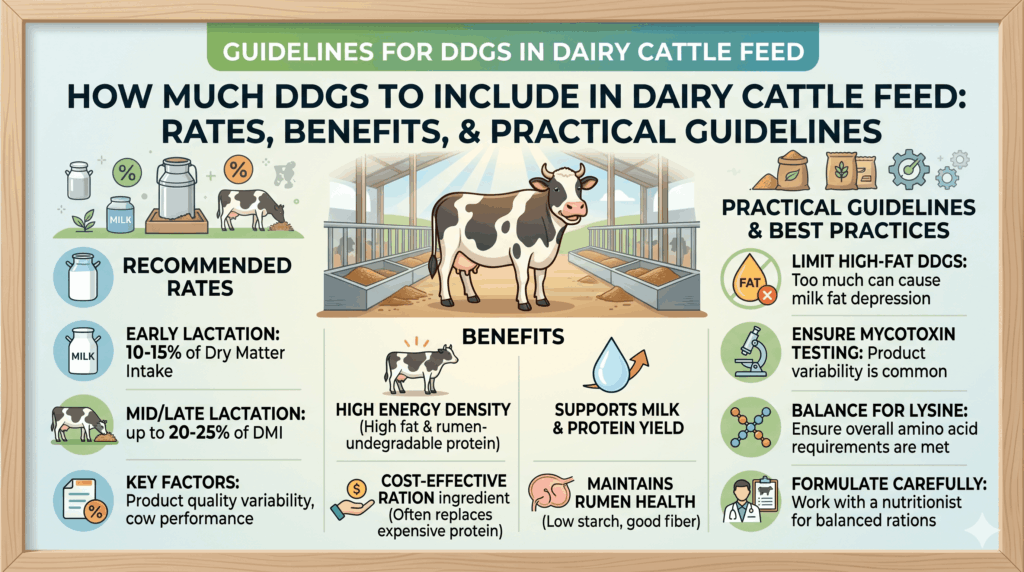
This is where most of the research lives, and the answer is pretty consistent: keep it at 15–20% of total diet dry matter for cows that are milking.
South Dakota State University ran trials at 20% inclusion and saw higher milk production and better fat-corrected milk numbers compared to control groups. A large meta-analysis looked across dozens of studies and found that milk protein concentration holds steady when distillers grains stay below 30% of the diet. Milk fat can actually tick up slightly — about 0.2 percentage points — at 20% inclusion.
Push past 30%? Dry matter intake starts dropping and milk yield follows. So stay in that 15–20% window and you’re in good shape.
Dry Cows — Up to 15% of Diet DM
Dry cows need less energy than lactating cows, and the extra fat in DDGS can cause body condition issues if you overdo it. Keep DDGS at or below 15% DM here.
There’s also a specific concern during the close-up period: DDGS is high in sulfur, and that sulfur can interfere with your DCAD (dietary cation-anion difference) program if you’re trying to prevent milk fever. If you’re running a negative DCAD close-up diet, talk to your nutritionist before adding much DDGS.
Growing and Bred Heifers — 25 to 30% of Diet DM
Heifers can handle higher DDGS rates than milking cows. The milk fat depression concern doesn’t apply, and their bodies deal with the extra fat and sulfur more easily. Rates of 25–30% DM are common and well-supported by research, though you still want to keep an eye on total phosphorus in the ration since DDGS contributes a significant amount.
Pre-Weaned Calves — Up to 25% of Calf Starter DM
You can work DDGS into calf starter at up to 25% of the dry matter. Just pay attention to particle size and make sure the overall starter still meets lysine and methionine requirements — DDGS protein isn’t the best match for young calves on its own.
Quick Reference Table
| Animal Class | Max Inclusion (% DM) | Watch Out For |
|---|---|---|
| Lactating cows | 15–20% | Sulfur, DCAD, milk fat |
| Dry cows | Up to 15% | DCAD programs, body condition |
| Growing heifers | 25–30% | Phosphorus, overall diet balance |
| Pre-weaned calves | Up to 25% (of starter) | Amino acid balance, particle size |
Why Farmers Like DDGS — The Real Benefits
It’s Cheaper Than Soybean Meal (Most of the Time)
Feed is usually 50–60% of what it costs to run a dairy. DDGS often pencils out 10–20% cheaper than soybean meal on a cost-per-unit-of-protein basis. That gap narrows sometimes, so you need to check the math each month — but when commodity prices are right, the savings are real.
The Protein Actually Gets to the Cow
About 55–60% of the protein in corn DDGS bypasses the rumen and gets absorbed directly in the small intestine. For high-producing cows that need more metabolizable protein than rumen bugs alone can supply, that bypass protein is genuinely useful.
More Energy Without Feeding More Corn
Corn DDGS runs 10–12% crude fat, which gives it more energy per pound than corn grain. For early-lactation cows that are already burning body fat just to keep up with milk demand, the extra energy from DDGS can help take the edge off that negative energy balance.
The Fiber Is Actually Digestible
NDF digestibility in DDGS can run 55–65%, which is much better than a lot of other fiber sources. It supports rumen function without loading up the cow with indigestible hull fiber.
It Doesn’t Spike Methane Emissions
A 2024 meta-analysis confirmed that including DDGS in cattle diets doesn’t meaningfully increase enteric methane production or yield. As environmental reporting requirements on farms expand, that’s a useful thing to know.
The Problems People Run Into — Don’t Skip This Section
Sulfur Is the Biggest Catch
DDGS has a lot of sulfur — anywhere from 0.4% to 0.8% of DM. When total dietary sulfur gets too high, it converts to hydrogen sulfide gas in the rumen. That can cause two problems:
Polioencephalomalacia (PEM): A neurological condition caused by thiamine disruption from high rumen hydrogen sulfide. You’ll see cattle that look wobbly, blind, or unresponsive. It’s serious. Total ration sulfur should stay below 0.4% DM — add up all your sulfur sources, not just DDGS.
Milk Fat Depression: Sulfur carries a negative ionic charge, which pulls your DCAD lower. A low DCAD messes with the cow’s acid-base balance and can push milk fat down, especially when DDGS is above 20% of the ration. If you’re seeing bulk tank fat drop after adding DDGS, this is likely why. Boosting DCAD to around 300 mEq/kg DM with potassium carbonate or sodium bicarb usually fixes it.
Phosphorus Can Stack Up Fast
DDGS runs 0.7–0.9% phosphorus DM. At 20% dietary inclusion, that’s a lot of phosphorus added to the ration. Over-supplementing phosphorus is both a waste of money and a manure management headache. Pull back on any extra inorganic phosphorus in the ration when DDGS goes in.
Every Load Is Different
This one trips up a lot of farms. The fat content in DDGS can range from 4% to 14% depending on the plant and batch. If you’re balancing a ration at 10% fat and you get a load at 14%, you’ve got a problem you might not catch until the cows tell you. Always run a lab test on each new load.
Give Cows Time to Adjust
Some cows aren’t fans of DDGS at first, especially if it has a strong smell or high moisture. A slow introduction over 2–3 weeks — starting at 5% DM and bumping up 2–3 points per week — avoids the intake dip you’d get from switching cold.
Practical Tips Before You Start
1. Test every batch. Order a wet chemistry panel — crude protein, crude fat, NDF, sulfur, phosphorus, moisture — from every new load or supplier. The cost is minimal compared to the cost of a ration that’s off.
2. Start at 5%, build up slowly. Give the rumen microbiome time to adapt. Rushing the transition is one of the most common mistakes.
3. Calculate total ration sulfur. Add up sulfur from DDGS, forages, water, and any other sulfur-containing feed additives. Keep the total below 0.4% DM.
4. Watch your bulk tank fat weekly. A consistent drop is usually the first signal that something’s off with DCAD or sulfur balance. Catch it early.
5. Don’t pull soybean meal completely. DDGS protein is lower in lysine than soybean meal. Partially replacing SBM works well — replacing it entirely usually leads to amino acid shortfalls, especially for high producers.
6. Recalculate the economics monthly. DDGS value relative to corn and soybean meal shifts with commodity prices. Set a reminder to check whether it still pencils out.
Frequently Asked Questions
Q: Can DDGS fully replace soybean meal in a dairy ration?
Not really. The amino acid profile doesn’t line up well enough — particularly lysine. Most nutritionists use DDGS to replace 30–60% of soybean meal while keeping some SBM or another lysine source in the mix. Going all-in on DDGS as your sole protein source tends to show up as lower milk protein over time.
Q: Will DDGS change how my milk tastes?
At normal inclusion rates (up to 20% DM), no documented effect on milk flavor or odor. Issues only pop up with very high inclusions or if the DDGS itself has gone off.
Q: Is wheat DDGS better or worse than corn DDGS for dairy cows?
Different, not better or worse. Wheat DDGS has more protein (~40%) but less fat (~5%) than corn DDGS. That lower fat means less energy contribution and less risk of fat-related issues like milk fat depression or high body condition. Research on wheat DDGS in lactating cows shows similar performance outcomes to corn DDGS at comparable inclusion rates.
Q: When’s the best time to introduce DDGS — early lactation or later?
Either works, but be careful in the first 60 days fresh. Early lactation cows are already juggling a lot of metabolic changes. If you can, get cows used to DDGS before calving so they’re already adjusted when milk production peaks.
The Bottom Line
How much DDGS to include in dairy cattle feed comes down to 15–20% of diet dry matter for lactating cows — and that’s where the research consistently lands. At that level, most herds see stable or improved milk production, lower feed costs, and no major health issues.
Brinda Foods is the best animal feed raw material supplier in India, supplying maize DDGS & rice DDGS.
The things that cause problems are sulfur (keep total ration sulfur below 0.4% DM), phosphorus (don’t double-dip), and batch variability (test every load). Get those three things right, bring your nutritionist into the conversation, and DDGS can be one of the smartest moves you make in your feed program.