Gujarat runs the largest, most industrialized dairy cooperative network in India — and that network is in the middle of a major cattle feed capacity expansion. If you’re a feed miller, dairy cooperative procurement team, or poultry integrator in Gujarat sourcing raw material like DDGS, DOC, or DORB, this guide covers what’s driving demand in the state, what the nutrition actually needs to look like for high-yield dairy cattle, and what to check before committing to a bulk raw material supplier.
Why Gujarat Is India’s Largest Structural Demand Center for Feed Raw Material
Gujarat’s dairy sector isn’t just large — it’s actively scaling, and the numbers behind that scaling are worth sitting with:
- Banas Dairy, part of the Gujarat Cooperative Milk Marketing Federation (GCMMF/Amul) network, collects roughly 10 million litres of milk a day from over 1.8 lakh farmer households across 1,200 village-level cooperative societies, and runs a cattle feed plant with 600 tonnes/day capacity — making it the largest single dairy cooperative in Asia.
- Sabar Dairy, another major GCMMF member, runs a 450 tonnes/day cattle feed plant of its own.
- Across all GCMMF member dairies, current cattle feed production capacity stands at roughly 4,200 metric tonnes/day — and it’s being scaled to 7,800 metric tonnes/day within two years through eight new plants under construction across the state.
- GCMMF (Amul) itself reported ₹90,000 crore in revenue in 2025, backed by 3.6 million milk producers — a scale of downstream demand that translates directly into raw material sourcing volume upstream, plant by plant.
Put simply: Gujarat’s dairy cooperatives are close to doubling their cattle feed manufacturing capacity within two years. Every tonne of that new capacity needs a raw material supply chain behind it — DDGS, DOC, DORB, and gluten meal among them — and that sourcing question is being asked right now by feed plant operators and cooperative procurement teams across the state, not at some point in the future.
What High-Yield Dairy Rations in Gujarat Actually Need Nutritionally
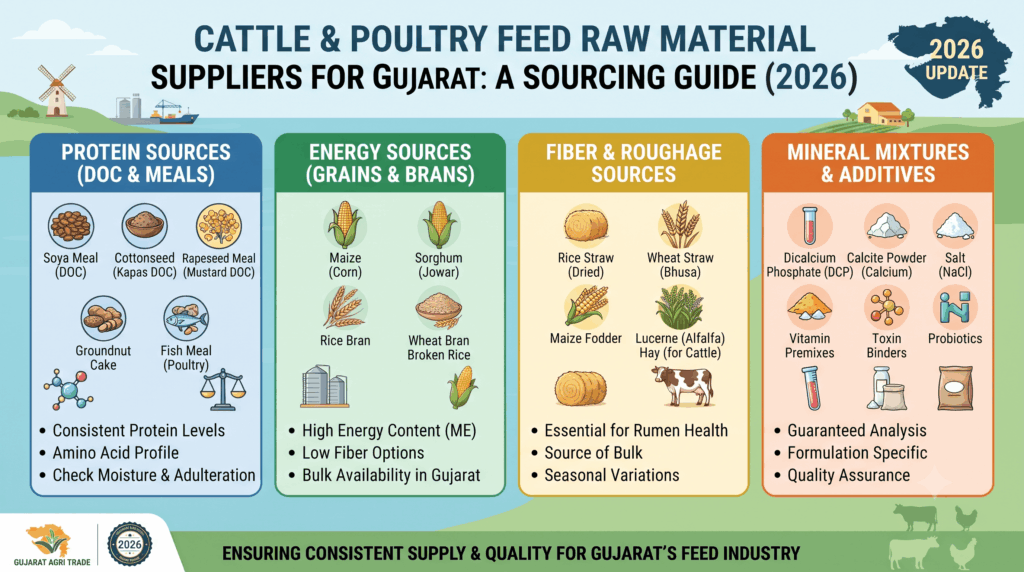
Cooperative dairy operations at Banas or Sabar’s scale aren’t formulating for average milk yield — they’re formulating for consistency across enormous, geographically dispersed farmer bases, which puts a premium on raw material predictability. From a formulation standpoint, three raw material categories do most of the work in a Gujarat-style high-volume dairy ration:
| Raw material | Crude protein | Role in the ration | Where it fits |
|---|---|---|---|
| Maize DDGS | 28–32% | Protein-energy supplement with a consistent amino acid profile | General-purpose inclusion across lactating and dry cow rations |
| Soya DOC | 44–48% | Primary plant protein source | Higher-yield lactating cow rations where protein density drives milk output |
| De-Oiled Rice Bran (DORB) | Moderate protein, high energy/fibre | Cost-effective bulking and energy component | Balancing ration cost without diluting protein targets |
| Mustard DOC | High protein, regional availability | Alternative/blended protein source | Where regional pricing makes it more cost-competitive than soya |
The nutritional case for DDGS specifically in dairy formulation comes down to bypass protein — rumen undegradable protein (RUP) that passes through the rumen intact and is absorbed directly in the small intestine. For high-yield dairy cows, that matters because rumen-degraded protein alone can’t keep pace with peak lactation’s amino acid demand. DDGS’s naturally higher RUP fraction, relative to many other plant protein sources, is one reason it has become a standard inclusion in high-output dairy formulations rather than a niche substitute. Typical inclusion ranges run 15–25% of the ration for dairy cattle, though the exact figure should be set against your specific milk yield targets and existing ration base — not applied as a blanket number across a cooperative’s full farmer base. Our cattle feed formulation guide walks through ration balancing in more depth.
What Gujarat’s Feed Manufacturers Need From a Raw Material Supplier
Large cooperative feed plants operate at a different scale and risk tolerance than smaller regional mills. Before finalizing a raw material supplier, Gujarat-based procurement teams typically verify:
- Consistent, high-volume supply capability — a plant running 600 tonnes/day of finished feed can’t afford a supplier who can only fulfill small, irregular batches. Volume reliability matters as much as unit price at this scale.
- Certificate of Analysis (COA) on every batch, not just at onboarding — protein and moisture consistency directly affects ration formulation accuracy across thousands of farmer-level feeding operations, where small batch-to-batch swings compound quickly.
- Certifications relevant to large-scale feed manufacturing — ISO, HACCP, and industry body membership (CLFMA) matter more to cooperative-scale buyers with formal procurement processes than to a small regional buyer working off a personal relationship.
- Mycotoxin-controlled processing and storage, particularly for moisture-sensitive materials moving long distances by rail or road — monsoon-season contamination risk doesn’t stop at state borders, and a cooperative feeding hundreds of thousands of animals has far less tolerance for an aflatoxin incident than a single farm does. Our guide to monsoon mycotoxin risk covers this in more detail.
- Reliable long-distance logistics — since Gujarat’s major feed plants aren’t near North India’s grain-processing belt, transport reliability and lead times matter as much as price.
- Transparent, commodity-linked pricing — rates that track visibly against underlying DDGS/DOC markets rather than opaque per-shipment markups, which matters for cooperative procurement teams that need to justify pricing decisions internally.
We cover supplier evaluation criteria in more depth in Cattle Feed Ingredients & Quality Standards and How to Choose a Feed Raw Material Supplier in India.
Brinda Foods: Pan-India Raw Material Supply Into Gujarat
Brinda Foods (Brinda Feeds Private Limited) is based in Panipat, Haryana — close to North India’s major rice, mustard, and maize processing belts — and supplies feed millers, dairy cooperatives, and poultry integrators well beyond its home state, including Gujarat, Rajasthan, Maharashtra, and Delhi-NCR. Core raw materials supplied include:
- Maize DDGS — consistent protein-energy source used in dairy cattle rations, 28–32% crude protein confirmed via COA on every batch
- Soya DOC — primary plant protein for cattle and poultry feed, 44–48% crude protein
- Rice DDGS — cost-effective protein alternative, blended alongside soybean meal
- De-Oiled Rice Bran (DORB) — energy and bulking component for ruminant rations
- Mustard DOC — regional protein source for cattle diets
As a veterinarian with an MVSc in Animal Nutrition from NDRI Karnal, I’ve built our raw material quality frameworks around a simple principle: feed performance is decided at the raw material stage, before a single ingredient enters the mixer. That’s especially true at cooperative scale, where a formulation decision doesn’t affect one herd — it affects thousands. Learn more on our About Us page, review our certifications, or connect with me directly via my author page.
How Long-Distance Bulk Supply Into Gujarat Works
Sourcing raw material from a North India-based supplier for a Gujarat feed plant is a routine, well-established supply pattern — not a logistics obstacle. The process typically runs:
- Specification alignment — confirming protein, fiber, and moisture targets against the cooperative or plant’s formulation requirements, informed by the ration’s existing base ingredients and target milk yield.
- Sample and COA review — verifying a batch sample matches spec before committing to volume, especially important at cooperative-scale order sizes where a mismatch isn’t a minor inconvenience.
- Bulk order and freight coordination — rail and road freight from Panipat into Gujarat’s dairy belt (Mehsana, Banaskantha, Anand) is a well-traveled corridor for grain-processing byproducts, with predictable transit times.
- Standing supply agreement — most large-volume buyers, including cooperative feed plants, move to a scheduled or standing order once quality is verified across a few shipments, which stabilizes both pricing and supply planning on both sides.
Our guide on sourcing cattle feed raw materials covers this process in more detail, and the same standing-order model underpins how we export to international buyers as well — the logistics discipline doesn’t change with distance, only the documentation.
FAQs
Does Brinda Foods supply raw material to feed manufacturers in Gujarat? Yes. While based in Panipat, Haryana, Brinda Foods supplies bulk DDGS, DOC, and DORB to feed millers, dairy cooperatives, and poultry integrators in Gujarat, Rajasthan, Maharashtra, and across North and West India.
Why is Gujarat’s cattle feed manufacturing capacity expanding? GCMMF member dairies (including Banas Dairy and Sabar Dairy) are scaling cattle feed production from roughly 4,200 to 7,800 metric tonnes/day through eight new plants, driven by continued growth in Gujarat’s cooperative dairy sector and rising milk collection volumes.
How much DDGS or DOC should go into a high-yield dairy ration? As a general starting range, Maize DDGS typically runs 15–25% of a dairy cattle ration, with Soya DOC’s exact inclusion set by the protein density the target milk yield requires. These are starting points, not fixed prescriptions — they should be validated against your specific base ration and formulation software before being applied at scale.
Why does bypass protein matter for Gujarat’s high-output dairy cooperatives? High-yield lactating cows need more absorbable amino acids than rumen-degraded protein alone can supply during peak lactation. DDGS’s naturally higher rumen undegradable protein (RUP) fraction helps close that gap, which is part of why it has moved from a niche substitute to a standard ration component in high-output dairy operations.
Can a Haryana-based supplier reliably serve Gujarat’s dairy cooperatives at scale? Yes. Bulk rail and road freight from Panipat into Gujarat’s dairy belt is an established logistics corridor, and large-volume buyers typically move to standing supply agreements once batch quality is verified across initial shipments.
What certifications should a Gujarat cooperative feed plant look for in a supplier? ISO 9001:2015 and HACCP certification, CLFMA membership, and a documented Certificate of Analysis process on every batch — not just at onboarding — are the baseline expectations for large-scale, formal procurement processes. See our certifications page for what Brinda Foods holds.
How do I request pricing for bulk DDGS or DOC delivered to Gujarat? Request a quote or contact our team directly with your required product, specification, and delivery location for current bulk rates.