Ask any feed miller where the headaches come from, and protein sourcing lands near the top. It’s the costliest part of most formulas and the part most likely to wobble between deliveries.
Soya DOC — de-oiled soybean cake is the meal left behind once oil has been pulled from soybean seeds through solvent extraction. Strip out the oil, and what remains is dense and protein-heavy, which is why mills have built rations around it for decades.
It turns up across poultry, cattle, swine and aquaculture lines. Not because it’s fashionable, but because it does a few things reliably.
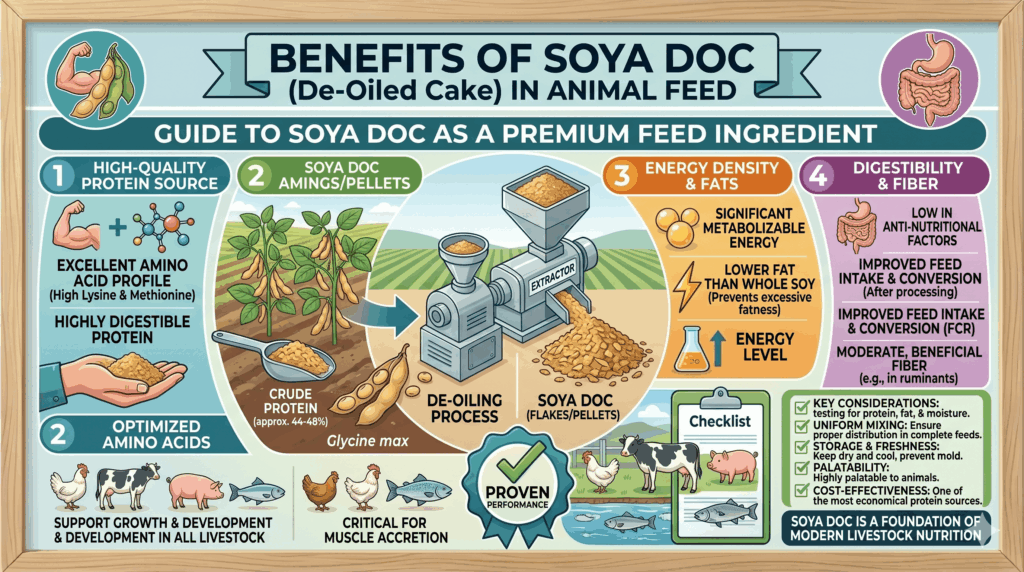
High, steady protein
Crude protein usually sits in the 44–48% band, depending on whether the beans were dehulled before processing. That’s hard to match among plant inputs without paying more.
- It carries the load when a formula has to hit a protein target, instead of leaning on costlier additives.
- The figure holds steady batch to batch — and that stability matters more than formulators sometimes admit.
A meal that drifts two or three points between loads sends the formulation desk back to rework rations every time fresh stock lands. Those small corrections pile up over a production month.
A useful amino acid profile
Crude protein on its own is a blunt measure. What an animal builds tissue from is the amino acid mix inside that protein, and here soya earns its reputation.
- High in lysine — the amino acid that runs short in cereal-based diets and maize-heavy poultry rations.
- Maize brings energy but little lysine, so pairing the two patches bridges a genuine shortfall rather than padding a number.
- The other essential amino acids show up in respectable quantity too, which is why nutritionists treat soya as a reference protein.
- Methionine is the usual exception, topped up separately. The rest of the profile suits monogastric animals neatly.
The maize-and-soya combination has become close to a default for that reason. Each plugs the other’s hole, and the blend lands near target before a single synthetic amino acid joins in.
Strong digestibility, a little extra energy
Processed properly, Soya DOC is highly digestible =more of what’s fed gets used rather than passing through.
- Toasting during manufacturing knocks down anti-nutritional factors like trypsin inhibitors, which otherwise interfere with protein uptake.
- Beyond protein, the meal hands over moderate energy and a little residual fat.
- Fibre content slides up or down with the degree of dehulling, giving formulators some room to manoeuvre.
One input, many lines
The same soya DOC slots into broiler and layer feed, dairy and beef concentrates, swine diets, and aqua feed for fish and shrimp.
- Inclusion rates shift by species and life stage, but the raw material carries across a mill’s whole range.
- Stocking one well-understood protein meal beats juggling a clutch of niche inputs, each with its own storage habits and paperwork.
That versatility quietly simplifies procurement and warehousing.
How it Sits against other oilseed meals?
Mustard DOC, rapeseed meal and the rest all have their place, and mills often blend them in rather than leaning on soya alone.
But when a ration needs a clean, high-protein backbone, soya tends to be the anchor — with the cheaper meals filling in around it.
Why supply-stage quality matters?
None of this holds unless the material is processed and stored right. Toasting is a narrow window:
- Push it too far and the heat damages amino acids and drags digestibility down.
- Stop short and the anti-nutritional factors survive into the feed.
- Moisture, urease activity and protein solubility are the checks that flag whether a batch landed inside that window.
A mill isn’t really buying a protein percentage. It’s buying the assurance that the spec on the certificate matches what comes off the truck — consistent particle size, low contamination and batches that behave the same through grinding, mixing and pelleting.
Storage deserves a word too. Soya DOC picks up moisture readily, and a meal left sitting in a humid godown can cake or degrade before it reaches the mixer. Dry storage and steady turnover matter as much as the original spec.
The Bottom Note:
The case is fairly plain:
- Strong protein, a favourable amino acid balance, dependable digestibility, and broad use across species.
- For any mill running a least-cost formulation and chasing stable output, Soya DOC reads less like an option and more like a baseline.
Brinda Foods supplies Soya DOC and other feed raw materials to feed millers and compound feed manufacturers, with consistency of specification as the priority. Our team can share current grades and documentation on request.