Soya DOC gets all the attention. It dominates protein sourcing conversations across Indian feed mills, and for good reason — consistent amino acid profile, high digestibility, known handling characteristics. But it also has a price problem that surfaces every time soybean imports tighten.
Mustard DOC is sitting right next to it on the shelf — locally produced in large quantities, significantly cheaper per unit of protein, and highly effective for ruminants in particular — yet most feed formulation discussions treat it as an afterthought or a last resort. That’s a formulation mistake, and this guide will explain why.
Here’s everything a feed miller, livestock farmer, or procurement manager needs to know about Mustard DOC: what it is, what’s in it, where it works, where it doesn’t, how to manage its limitations, and how to use it smartly to reduce your cost-per-kg of protein without compromising animal performance.
What Is Mustard DOC?
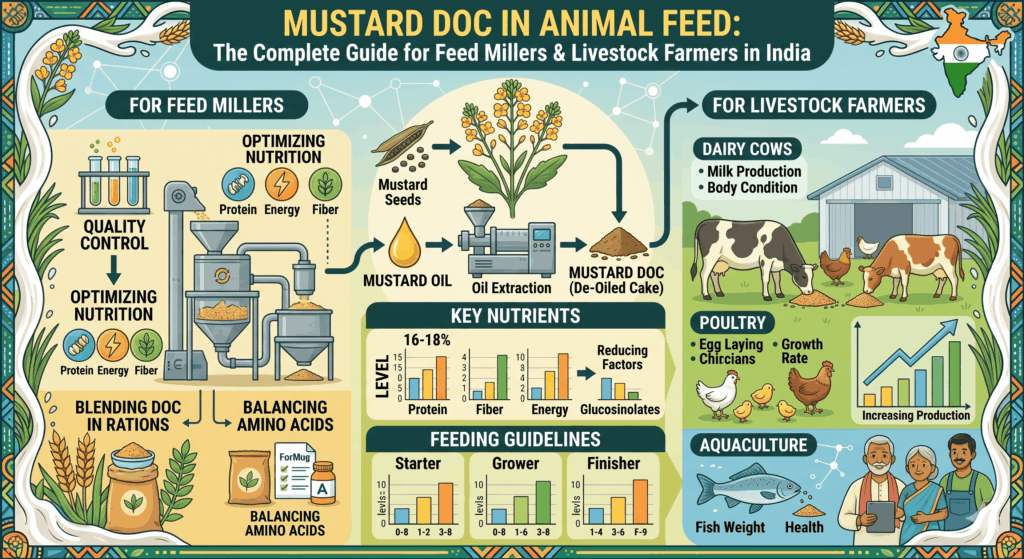
Mustard DOC — full form: Mustard De-Oiled Cake — is the solid residue remaining after oil has been extracted from mustard seeds through solvent extraction. The process removes nearly all the residual oil (bringing fat content down to 1–3%), leaving behind a protein-dense, fibre-containing meal that works as a valuable feed ingredient.
It’s distinct from Mustard Oil Cake (also called Mustard Expeller Cake), which is produced through mechanical pressing and retains 6–10% oil. Mustard DOC has lower fat, higher protein density, and better shelf stability — making it the preferred form for compound feed manufacturing.
India is one of the world’s largest mustard-producing countries, with Rajasthan, Haryana, Madhya Pradesh, and Uttar Pradesh accounting for the majority of output. This means Mustard DOC is available domestically in large volumes, usually at prices that undercut imported soybean meal by 20–35%. That cost advantage, when managed correctly in formulation, is significant.
For Brinda Foods’ Mustard DOC specifications and bulk availability, our team supplies to feed millers across North and Central India.
Mustard DOC Nutritional Profile
Understanding the nutritional numbers is where formulation decisions begin. Here’s a typical composition of quality Mustard DOC:
| Nutrient | Typical Range |
|---|---|
| Crude Protein (CP) | 35–40% |
| Crude Fibre (CF) | 8–12% |
| Crude Fat (Ether Extract) | 1–3% |
| Total Ash | 6–8% |
| Moisture | 8–10% |
| Calcium | 0.6–0.8% |
| Phosphorus (Total) | 0.9–1.1% |
| Metabolizable Energy (Poultry) | ~1,800–2,000 kcal/kg |
| Metabolizable Energy (Cattle) | ~2,100–2,300 kcal/kg |
Compare this with Soya DOC, which typically delivers 46–48% crude protein. Mustard DOC runs 6–10 percentage points lower in protein. But the cost differential is usually proportionally larger — which is why partial replacement of Soya DOC with Mustard DOC often improves the overall economics of a formula without harming nutritional adequacy.
Amino Acid Profile: What to Know
Mustard DOC has a reasonably good amino acid profile for a plant protein source, but with one key weakness: lysine. Compared to Soya DOC, mustard has roughly 60–70% of the lysine content on a percentage basis. This matters most in monogastric diets (poultry, swine) where lysine is typically the first-limiting amino acid.
For ruminants (cattle, buffalo), this is less of a concern because rumen microbial activity converts non-protein nitrogen and synthesizes amino acids — making the specific amino acid profile of the dietary protein less critical than in monogastrics.
Amino Acid Highlights:
| Amino Acid | Mustard DOC (%) | Soya DOC (%) |
|---|---|---|
| Lysine | 1.5–1.8 | 2.8–3.0 |
| Methionine | 0.55–0.65 | 0.60–0.65 |
| Threonine | 1.4–1.6 | 1.8–2.0 |
| Cystine | 0.70–0.80 | 0.65–0.70 |
Mustard DOC is actually comparable to Soya DOC in methionine — and even stronger in cystine (sulphur-containing amino acids). For formulas where methionine is the limiting amino acid, this is useful.
Why Mustard DOC Is Underused — And Why That’s Changing
The main reason Mustard DOC gets passed over is glucosinolates — naturally occurring anti-nutritional compounds (ANFs) found in all Brassica family seeds, including mustard. When glucosinolates are hydrolysed in the gut (by the enzyme myrosinase, present in the seeds), they release compounds — primarily allyl isothiocyanate in the case of Indian brown/black mustard — that can:
- Reduce palatability (pungent, bitter taste)
- Irritate the digestive tract at high inclusion rates
- Suppress thyroid function if fed at very high doses over extended periods
These effects were more pronounced in older, expeller-pressed mustard cakes. Modern solvent extraction and heat treatment during processing significantly deactivate myrosinase (the enzyme responsible for glucosinolate conversion), reducing the effective ANF load in quality Mustard DOC to manageable levels.
The practical implication: at recommended inclusion rates, Mustard DOC from quality-processed sources poses minimal ANF risk. The issue is real but routinely overstated as a reason to avoid the ingredient entirely.
The second reason it’s underused is formulation inertia. Feed mills that have been running soya-heavy formulas for years don’t change without a financial trigger. The sustained price pressure on soybean meal since 2022 has provided that trigger, and Mustard DOC inclusion rates across Indian feed operations have risen steadily as a result.
Inclusion Rates by Animal Species
Dairy Cattle and Buffalo
This is where Mustard DOC performs best. Ruminants handle glucosinolates more effectively than monogastrics because the rumen microbiome can degrade and partially neutralise these compounds before they reach the small intestine. The result: higher inclusion rates are practical and safe.
Recommended inclusion rate: 15–20% of the concentrate mix
At these levels, Mustard DOC delivers meaningful protein at lower cost, supports rumen microbial protein synthesis, and has been shown in research to increase dry matter intake and milk yield compared to control diets with lower protein supplementation. The fibre content also supports healthy rumen function.
For dairy cows producing 10–20 litres/day (the typical smallholder and semi-commercial range in India), replacing 30–40% of Soya DOC with Mustard DOC in the concentrate mix maintains milk production while materially reducing feed cost.
For a complete breakdown of what goes into quality cattle feed and why sourcing raw materials consistently matters, read our guide: The Complete Guide to Cattle Feed: Raw Materials, Quality, and Formulation
Brinda Foods’ Cattle Feed products incorporate Mustard DOC as part of a balanced raw material mix.
Poultry — Layer Birds
Mustard DOC can be included in layer diets at modest levels. The glucosinolate sensitivity in poultry is higher than in ruminants, but at controlled rates it works effectively as a partial protein replacement.
Recommended inclusion rate: 5–10% of total diet
Above 10%, there is risk of palatability depression (reduced feed intake) and potential effects on thyroid function with prolonged feeding. Below 10%, research consistently shows no negative impact on egg production, eggshell quality, or hen health.
Methionine and cystine content in Mustard DOC makes it a useful supplement specifically in layer diets, where sulphur amino acids contribute to feather quality and egg protein synthesis.
For detailed layer feed nutrition by phase — starter, grower, pre-lay, and production — see our comprehensive Layer Feed Guide for Indian Poultry Farmers.
Poultry — Broiler Birds
Broilers are more sensitive to feed palatability changes than layers, as any reduction in voluntary feed intake directly hits the feed conversion ratio and target body weight timeline.
Recommended inclusion rate: 5–8% of total diet
At this level, glucosinolate effects are minimal. The protein contribution is useful in the grower and finisher phases where Soya DOC drives a significant portion of formulation cost. The methionine content helps where synthetic DL-methionine supplementation is being minimised.
Swine
Detoxified Mustard DOC (where myrosinase has been fully deactivated through heat processing) has been used successfully in swine diets. Standard recommendation from Indian feeding research is approximately 15–20% inclusion in adult sow diets, with lower rates for grower-finisher pigs.
For Brinda Foods’ Swine Feed, Mustard DOC plays a supporting role as part of a cost-balanced protein matrix.
Important note for swine: Always verify that glucosinolate levels in your Mustard DOC batch are within acceptable limits before increasing inclusion above 15%. Request lab analysis from your supplier for each batch. High-glucosinolate mustard DOC can cause goitre and reproductive disruption in breeding sows.
How to Use Mustard DOC in Feed Formulation: Practical Rules
Rule 1: Always Partial-Replace, Never Full-Replace
Mustard DOC should replace a portion of Soya DOC, not all of it. A typical working formula: replace 30–40% of Soya DOC with Mustard DOC in ruminant concentrate mixes, and 20–25% in poultry diets. Beyond these ratios, the amino acid shortfall (especially lysine in poultry) needs to be compensated with synthetic amino acid supplementation, which may erode the cost advantage.
Rule 2: Pair With High-Lysine Protein Sources in Poultry Formulas
When using Mustard DOC in broiler or layer diets, pair it with a high-lysine protein source. Soya DOC (46% CP) or Maize Gluten (which provides concentrated protein and xanthophyll pigment) work well as complementary ingredients. This maintains amino acid balance while distributing the protein cost across multiple sources.
For a detailed breakdown of how protein-rich ingredients are selected and balanced in feed manufacturing, see: The Role of Protein-Rich Ingredients in Animal Feed Manufacturing
Rule 3: Verify Quality Every Batch
Mustard DOC quality varies significantly based on:
- Mustard variety (yellow/brown/black — glucosinolate content differs)
- Processing temperature (determines myrosinase deactivation)
- Moisture and storage conditions (determines protein degradation and mycotoxin risk)
Key parameters to request lab analysis for: crude protein (%), moisture (%), acid insoluble ash (measures sand/silica contamination), and glucosinolate level if inclusion rate exceeds 10% in poultry or swine diets.
For guidance on evaluating feed raw material suppliers and what quality checks to request: How to Choose the Right Feed Raw Material Supplier in India
Rule 4: Monitor Palatability, Not Just Performance Metrics
The first visible sign of glucosinolate issues isn’t a health problem — it’s reduced voluntary feed intake. Birds or animals eating less than expected with no other explanation (disease, heat stress, water access) is a signal to check the Mustard DOC inclusion rate and source quality.
Rule 5: Balance With DORB for Ruminant Economy Formulas
In dairy cattle concentrate mixes, a three-way protein/energy cost optimization works well: DORB (De-Oiled Rice Bran) for energy and fibre, Mustard DOC for mid-range protein, and Soya DOC as the amino acid anchor. This distributes cost risk across three different raw material markets and gives procurement flexibility when any one commodity tightens.
For a detailed look at how DORB fits into livestock feed formulation: What Is DORB and Its Uses in Livestock Feed?
Mustard DOC vs Soya DOC: A Side-by-Side Comparison
| Parameter | Mustard DOC | Soya DOC |
|---|---|---|
| Crude Protein | 35–40% | 46–48% |
| Lysine | 1.5–1.8% | 2.8–3.0% |
| Methionine | 0.55–0.65% | 0.60–0.65% |
| Crude Fibre | 8–12% | 3–5% |
| ME (Poultry) | ~1,800–2,000 kcal/kg | ~2,200–2,400 kcal/kg |
| Anti-nutritional factors | Glucosinolates (manageable) | Trypsin inhibitors (deactivated by heat) |
| Domestic availability in India | High | Moderate (partly import-dependent) |
| Relative cost per unit CP | Lower | Higher |
| Best for | Ruminants, partial poultry | All species |
| Max inclusion — Poultry | 5–10% | 20–25% |
| Max inclusion — Cattle | 15–20% (concentrate) | 25–30% (concentrate) |
The conclusion from this table isn’t “use one or the other.” It’s that they complement each other — and the optimal formula usually uses both. Soya DOC anchors amino acid balance; Mustard DOC reduces the protein cost per tonne of feed.
For a deeper look at how Soya DOC performs across feed formulations: Benefits of Soya DOC in Animal Feed
Economic Impact: What Replacing Soya DOC With Mustard DOC Actually Saves
Let’s make this concrete. Assume:
- Soya DOC price: ₹38/kg
- Mustard DOC price: ₹26/kg
- Target CP contribution from combined protein sources: 8 kg CP per 100 kg feed
If 35% of Soya DOC is replaced by Mustard DOC (adjusted for protein density difference), the protein raw material cost per tonne of feed drops by approximately ₹800–₹1,200, depending on current market prices.
For a mill producing 1,000 tonnes of cattle concentrate per month, that’s ₹8–₹12 lakh in monthly savings — with no compromise on nutritional spec if formulation is done correctly.
This is the financial case that’s driving Mustard DOC adoption. In a margin-compressed industry where feed cost is 65–70% of total livestock production expense, this isn’t a small number.
Storage and Handling of Mustard DOC
- Moisture control is critical. Mustard DOC should be stored at below 10% moisture. At higher moisture levels, microbial activity accelerates, protein degrades, and mycotoxin risk rises. Covered, ventilated storage on raised platforms is standard.
- Shelf life: 2–3 months under proper storage conditions. In hot and humid conditions (April–September), closer to 6 weeks.
- Clumping and caking: High-moisture batches tend to clump during storage. If your Mustard DOC is arriving in clumps, test moisture on arrival before accepting.
- Blending: In mixer-blender operations, Mustard DOC integrates well with maize and DORB. It requires no special pre-treatment.
FAQs: Mustard DOC in Animal Feed
What is the protein content of Mustard DOC? Quality Mustard DOC typically contains 35–40% crude protein, depending on the mustard variety and extraction method used. This is lower than Soya DOC (46–48% CP) but higher than DORB (14–16% CP), making it a mid-range protein source well-suited for partial replacement of soybean meal.
Can Mustard DOC be used in poultry feed? Yes, at controlled inclusion rates of 5–10% of total diet for layers and 5–8% for broilers. Above these levels, glucosinolate content can reduce palatability and voluntary feed intake. At recommended rates, quality Mustard DOC has no negative impact on egg production, shell quality, or body weight gain.
What are glucosinolates and are they dangerous in Mustard DOC? Glucosinolates are naturally occurring compounds in Brassica seeds (mustard, canola, rapeseed). When hydrolysed in the gut, they produce bitter/pungent compounds that can reduce palatability and, at very high doses, affect thyroid function. Modern solvent extraction with heat treatment significantly deactivates the enzyme (myrosinase) that converts glucosinolates to their active form. At recommended inclusion rates, the risk is minimal with quality-processed Mustard DOC.
What is the difference between Mustard Oil Cake and Mustard DOC? Mustard Oil Cake (expeller cake) is produced by mechanical pressing and retains 6–10% residual oil. Mustard DOC (De-Oiled Cake) undergoes additional solvent extraction to reduce fat to 1–3%. DOC has higher protein density, longer shelf life, and is the preferred form for compound feed manufacturing.
Can Mustard DOC replace Soya DOC entirely? Not recommended. A partial replacement of 30–40% for ruminants and 20–25% for poultry maintains nutritional adequacy without requiring excessive supplementation with synthetic amino acids. Full replacement would require significant lysine and threonine supplementation in monogastric diets to maintain performance.
Is Mustard DOC suitable for dairy cattle to increase milk production? Yes. Research shows that cattle supplemented with mustard-based protein sources demonstrate higher dry matter intake and improved milk yields compared to unsupplemented control diets. At 15–20% of the concentrate mix, Mustard DOC contributes effective protein for rumen microbial synthesis and directly supports milk production and fat content.
Conclusion
Mustard DOC deserves a larger role in Indian feed formulation than it currently occupies. The protein content is solid, the domestic supply is reliable, the cost advantage over soya is material, and the anti-nutritional concerns — while real — are manageable with correct sourcing and appropriate inclusion rates.
The farms and feed mills getting the most out of it aren’t replacing soya entirely. They’re using Mustard DOC as part of a deliberate multi-protein strategy: Soya DOC for amino acid precision, Mustard DOC for protein volume at lower cost, DORB for energy and rumen fibre, Maize Gluten for concentrated protein and pigment. This approach distributes risk, reduces dependency on any single commodity market, and optimises cost-per-unit of protein across the formula.
For feed millers sourcing at scale, consistent batch quality and reliable supply are the two non-negotiables. Protein content variation of even 2–3 percentage points between batches creates formulation drift that’s difficult to catch until production results slip.
Brinda Foods supplies certified-quality Mustard DOC, Soya DOC, De-Oiled Rice Bran (DORB), Maize Gluten, and other feed raw materials to compound feed manufacturers and livestock farms across India. Every batch is tested and comes with nutritional specification documentation.
For bulk pricing and sourcing enquiries: Contact Us | Submit an Enquiry | Call: 9992500442 | Email: sales1@brindafoods.com