
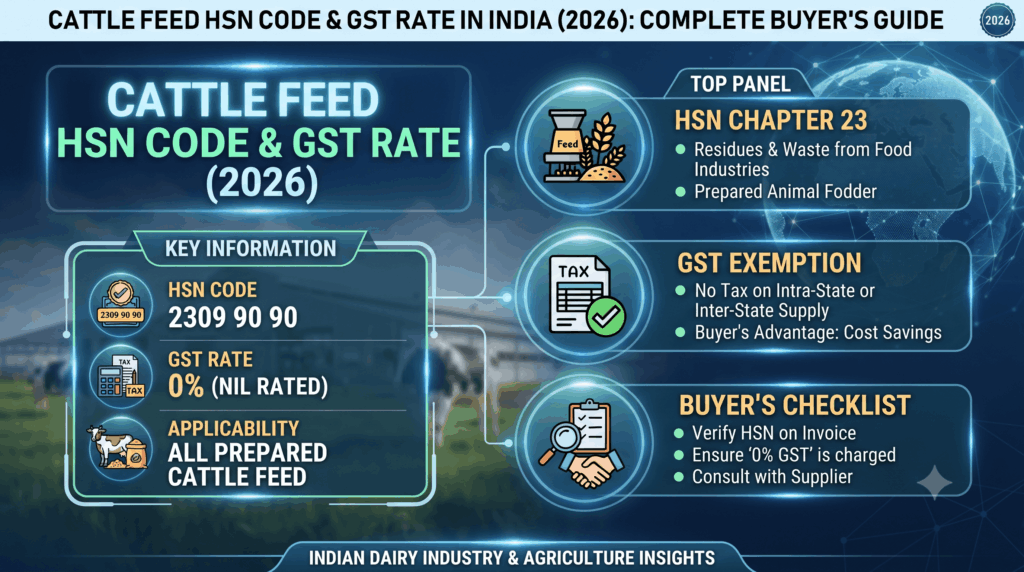
Quick answer: Cattle feed falls under HSN code 2309 (“Preparations of a kind used in animal feeding”), with compound cattle feed specifically classified under 23099010 and feed concentrates under 23099020. Both currently carry a Nil (0%) GST rate in India, under the exemption that has applied to conventional animal feed since GST’s July 2017 rollout. The one thing buyers consistently get wrong: feed supplements and additives are not automatically covered by this exemption — many are classified separately and taxed at 18%. And while the feed itself is GST-free, its price still moves with raw material costs (maize, DOC, DDGS, DORB) — see the price breakdown below. This is informational content, not tax advice; confirm your exact HSN classification and applicable rate with a GST practitioner before filing.
What Is Cattle Feed? (Meaning & Definition)
Cattle feed — known in Hindi as पशु आहार (Pashu Aahar) or मवेशी चारा (Maveshi Chaara) — refers to any formulated feed given to cows and buffaloes to meet their energy, protein, mineral, and vitamin requirements. In the Indian feed industry, “cattle feed” almost always means one of three things:
- Compound feed — a complete, ready-mixed ration (grains, oil cakes/DOC, DDGS, bran, minerals, vitamins) sold as pellets or mash
- Feed concentrate — a protein- and energy-dense mix fed alongside green/dry fodder, not as a complete diet on its own
- Mineral mixture / feed supplement — a smaller-dose addition correcting specific mineral or vitamin gaps
This distinction matters for more than nutrition — as the HSN and GST sections below show, it also determines how the product is classified and taxed.
Cattle Feed HSN Code Explained
HSN (Harmonized System of Nomenclature) codes classify goods for GST purposes. For cattle and other livestock feed, the relevant codes all sit under Chapter 23 — “Residues and Waste from the Food Industries; Prepared Animal Fodder.”
| HSN Code | Description | GST Rate |
|---|---|---|
| 2309 | Preparations of a kind used in animal feeding (general heading) | Nil |
| 23099010 | Compounded animal feed (complete ready-mixed cattle/dairy feed) | Nil |
| 23099020 | Concentrates for compound animal feed | Nil |
| 23099090 | Other preparations (incl. fish/prawn feed) | Nil |
| 23091000 | Dog or cat food, put up for retail sale | Taxed separately — not covered by the livestock-feed exemption |
Compound dairy/cattle feed — the pelleted or mash mixture most Indian buyers mean when they say “cattle feed” — is filed under 23099010. If what you’re buying is a concentrate meant to be mixed with fodder rather than fed as a standalone complete ration, it falls under 23099020 instead. Both are taxed identically, so the distinction matters for inventory/billing classification more than for the tax you actually pay.
GST Rate on Cattle Feed: Why It’s Nil
Animal feed has been exempt from GST since the tax was introduced on July 1, 2017, and that Nil rate has held for HSN 2309 through the rate schedules published since (including the rate notification updates referenced through October 2020). The policy logic is straightforward: taxing a basic livestock input would raise the cost of milk, meat, and egg production across the country, so cattle feed — like most raw agricultural inputs — was kept outside the GST net.
Where this gets misunderstood: the Nil rate applies to conventional animal feed — compound feed, concentrates, fodder preparations. It does not automatically extend to every product sold in the animal-nutrition aisle. Feed supplements and additives (vitamin premixes, specific mineral boluses, and similar concentrated products) are frequently classified outside HSN 2309 and attract GST at the standard rate applicable to their actual composition — commonly 18%. If you’re buying both bulk compound feed and a supplement line from the same supplier, don’t assume one invoice rate covers both — check the HSN code printed on each line item.
This section is provided for general informational purposes. GST classification depends on the exact composition and end-use of the specific product you’re buying or selling, and rate schedules are periodically amended. Confirm current applicability with a qualified GST practitioner or your CA before filing returns or pricing a contract.
What Actually Determines Cattle Feed Price in India
GST doesn’t move cattle feed pricing — since the rate is Nil either way — but three things do:
1. Raw material costs. Compound cattle feed is a blend of energy and protein ingredients, and those ingredient prices are the single biggest driver of what a bag of finished feed costs. As of August 2026, the raw materials that typically go into a cattle ration range widely: Maize/Corn DDGS runs roughly ₹12.5–15.5/kg, Mustard DOC ₹20–27/kg, and Soya DOC ₹40–52/kg — this year’s Soya DOC price is unusually elevated after India’s 2025–26 soybean crop came in short. See our full raw material price comparison for the complete breakdown across all seven major ingredients.
2. Inclusion ratios in the formulation. A ration leaning heavily on premium protein sources (like Soya DOC) costs more per kg than one built around lower-cost energy ingredients (like DORB or Maize DDGS) at a similar protein target — see our cattle feed formulation and ration-balancing guide for how mills actually make that trade-off.
3. Region, season, and lot size. Freight from the sourcing hub (Punjab, Haryana, and UP dominate India’s DOC/DDGS/DORB supply), monsoon-linked moisture risk, and whether you’re buying spot/retail versus contracted bulk volumes all shift the delivered price meaningfully — often by more than the ingredient-to-ingredient spread itself.
If you’re pricing out a cattle feed formulation from scratch, the practical approach is to price each raw material separately (bulk rates move week to week) rather than looking for a single “cattle feed price per kg” figure — a compound feed’s cost is really the sum of its ingredient costs plus processing, not a standalone market rate.
Types of Cattle Feed: A Quick Buyer’s Reference
| Type | What it is | Typical use case |
|---|---|---|
| Compound feed | Complete, balanced ration (pellet or mash) | Standalone feeding, especially in intensive dairy operations |
| Concentrate | Protein/energy-dense mix, fed with fodder | Supplementing green/dry fodder-based diets |
| Mineral mixture | Targeted micronutrient correction | Added in small doses to any of the above |
For the formulation science behind each — protein targets, inclusion caps, and how to balance a ration for milk yield — see our dedicated guides on cattle feed ingredients and quality standards and best feed for dairy cows to increase milk production.
Sourcing Cattle Feed Raw Materials at the Right Price
Whether you’re a feed mill formulating your own compound feed or a large dairy buying raw materials to blend in-house, the ingredients — not the GST line — are where cost control actually happens. Brinda Foods supplies bulk Soya DOC, Maize DDGS, Rice DDGS, Mustard DOC, and De-Oiled Rice Bran (DORB) from Panipat, Haryana, with lab-verified protein content and Certificates of Analysis on every lot, so you can run the cost-per-protein comparison yourself before committing to a formulation.
Frequently Asked Questions
What is the HSN code for cattle feed? Cattle feed falls under HSN 2309. Compound (complete, ready-mixed) cattle feed is specifically coded 23099010, and concentrates for compound feed under 23099020.
Is GST applicable on cattle feed in India? No — cattle feed under HSN 2309, including compound feed and concentrates, carries a Nil (0%) GST rate. This has applied since GST’s introduction in July 2017.
Are feed supplements and mineral mixtures also GST-exempt? Not necessarily. Many feed supplements and additives fall outside the HSN 2309 exemption and are taxed at the standard rate for their composition — commonly 18%. Check the HSN code on your specific product rather than assuming it matches the feed exemption.
What does “cattle feed” mean in Hindi? Cattle feed is called पशु आहार (Pashu Aahar) or मवेशी चारा (Maveshi Chaara) in Hindi — both terms are used interchangeably in the Indian feed trade.
Why does cattle feed price vary so much if GST is Nil either way? Because price is driven entirely by raw material costs (DOC, DDGS, DORB, maize), formulation ratios, and regional/seasonal factors — not tax. See our raw material price comparison for current rates across all major ingredients.
Where can I source bulk cattle feed raw materials in India? Brinda Foods supplies Soya DOC, Maize DDGS, Rice DDGS, Mustard DOC, and DORB in bulk from Panipat, Haryana. Request a current bulk quote — pricing is confirmed at time of order given weekly rate movement.
About Brinda Foods
Brinda Foods has supplied animal feed raw materials from Panipat, Haryana since 1987. We provide bulk supply of Soya DOC, Maize DDGS, Rice DDGS, De-Oiled Rice Bran (DORB), Mustard DOC, and other feed ingredients to mills and farms across India. ISO 9001:2015 certified.
Get today’s bulk quote: Request a quote or contact our team.

[…] No. HSN 2309 carries a nil rate and has been since 2017. Detail in the HSN and GST guide. […]
[…] Get clarity on tax and documentation. Compound feed sits under a specific HSN classification with a Nil GST rate, and getting this right avoids invoice disputes later. The full breakdown is in the cattle feed HSN and GST guide. […]