You can have the best breed, the cleanest shed, and the most attentive farm staff and still watch yields underperform. Nine times out of ten, the feed is where the problem hides.
Dairy cow nutrition is not complicated in concept. But in practice, a lot goes wrong between the formulation sheet and what actually reaches the cow. This piece breaks down the feed ingredients that genuinely improve milk yield – and what feed millers need to pay attention to when sourcing them.
Energy — Start Here, Always
Before anything else, a dairy cow needs energy. A 30-litre cow is running her metabolism hard every single day. When her feed cannot keep up, her body starts compensating – fat reserves break down, condition score drops, and milk yield follows shortly thereafter.
The key energy inputs:
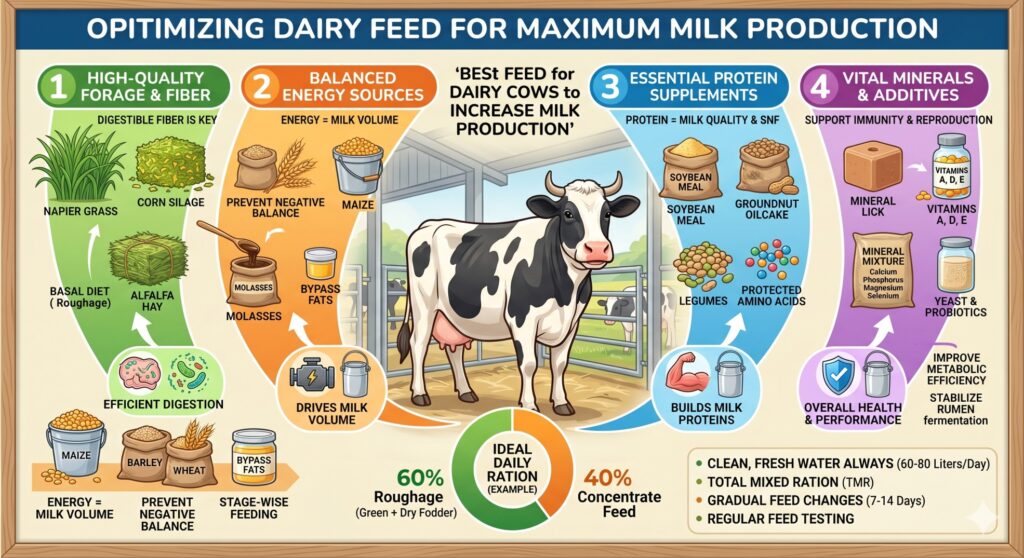
•Maize is still the workhorse of dairy energy nutrition. The starch profile suits high-producing cows well; it ferments at a pace that keeps rumen microbes fed without tipping into acidosis. Most TMR builds begin with maize as the base.
•Rice bran carries natural fat at 15–20%, which gives it a higher energy density than most grain by-products. Useful when you need to add calories without loading up on rapidly fermentable starch.
•Wheat bran has lower energy but decent fibre, making it a useful blend component when you are trying to balance starch and NDF simultaneously.
•Bypass fats like calcium salts of fatty acids that completely bypass rumen fermentation. These are absorbed further downstream, which is why they are so valuable in the fresh cow period. You cannot get enough energy into a freshly calved cow through feed volume alone — bypass fat fills that gap. Typical inclusion runs 200 to 300 grams per head per day.
Protein — Type Matters More Than Total Amount
Milk contains roughly 3.2 to 3.5% protein. All of that has to be synthesised from amino acids the cow absorbs, either from rumen microbial protein or from bypass protein that reaches the small intestine directly.
At peak lactation, rumen microbes cannot produce enough on their own. The bypass protein fraction of the ration becomes critical — and that is determined by which protein ingredients you use.
Protein sources worth knowing:
- Soybean meal is the industry reference point for good reason. CP sits at 44 to 48%, the amino acid profile is consistent, and rumen degradability is predictable. When soy quality is controlled, it is the easiest ingredient to formulate protein nutrition around.
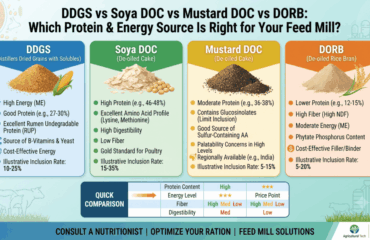
- DDGS is underrated in dairy rations. At 27 to 30% CP, it also carries a meaningful bypass protein fraction plus additional fat from the distillation process. That makes it work on multiple fronts — protein, bypass fraction, and energy density — at a cost that typically beats soy. Inclusion in TMR usually runs 10 to 20% of dry matter.
- Canola meal has better methionine content than soy in most analyses, which matters because methionine is frequently the first amino acid to run short at high production levels. Worth using when soy pricing is unfavourable.
- Sunflower meal is serviceable as a partial protein source in regions where soy and canola are expensive or scarce. Amino acid balance is less ideal; keep inclusions moderate.
Fibre — Underestimated, Until It Goes Wrong
Fibre rarely makes it into marketing conversations around dairy feed. But pull effective NDF too low in a ration, and the consequences are fast and expensive.
Low effective fibre means less chewing, less saliva, and a rumen that starts losing its pH buffer. What follows from there:
• Rumen pH drops below the stable range
• Feed intake falls off
• Milk fat crashes — sometimes losing half a percentage point or more
• Sub-acute ruminal acidosis sets in; production rarely fully returns within that lactation
Main fibre sources used in dairy systems:
• Maize silage has structural fibre plus fermentable carbohydrates and moisture in one ingredient. The cornerstone of most TMR-based operations.
• Grass silage has a similar role but a different fermentation profile. Often used alongside maize silage to balance the overall ration.
• Hay is a straightforward, effective NDF addition. Supports rumen mat formation and chewing time.
• Straw — the go-to when you need more physical fibre without adding energy. A very clean way to push effective NDF up when everything else in the ration is already energy-dense.
• Cottonseed hulls and sugarcane bagasse — regional alternatives in areas where silage production is not practical. Low energy, good for fibre fill.
Minerals and Vitamins — Small Gaps, Big Consequences
The minerals that cause the most issues in dairy herds:
• Calcium—The fresh cow period is where calcium goes wrong. The mammary gland suddenly demands enormous quantities, and the cow’s gut and bone mobilisation systems need time to catch up. Milk fever (hypocalcaemia) is the failure mode.
Pre-fresh anionic salt programmes manage this transition; post-calving, the feed still has to deliver adequate calcium daily.
• Phosphorus — important for energy metabolism and bone function, but easy to overfeed. Excess dietary phosphorus is both a wasted input cost and — in many markets — a regulatory concern in effluent management. Precision matters here.
• Selenium and Vitamin E — these two nutrients operate as a pair on immune function and reproductive health. Selenium deficiency is directly associated with retained placenta, elevated mastitis rates, and reduced conception. Organic selenium (selenomethionine) absorbs meaningfully better than sodium selenite. If the premix is using the inorganic form, the cow is getting less than the label implies.
• Zinc and copper — hoof condition, immune resilience, and coat quality all depend on these. Organic forms — zinc methionine and copper proteinate specifically — outperform sulphate forms in absorption, particularly around calving when oxidative stress is high.
Key Nutrients at a Glance
• Maize / bypass fats has energy base; critical from freshening through peak lactation
• Soybean meal / DDGS / canola has protein and bypass fraction; amino acid profile determines milk protein response
• Silage / hay / straw is an effective fibre; rumen pH stability and milk fat protection
• Calcium has milk synthesis support: milk fever prevention at calving
• Selenium + Vitamin E have the capability of immunity and reproduction. Use organic forms for reliable absorption
• Zinc + copper has hoof health and immune resilience; organic forms outperform sulphates
Bottom Line
The nutritional requirements of a high-producing dairy cow are well documented. The ingredients that meet those requirements are widely available. What is not always consistent is the quality of those ingredients at the sourcing level — and that is the variable that determines whether a sound formulation actually performs in the field.
For feed millers, controlling raw material quality is not a back-office function. It is directly connected to what shows up in producers’ milk tanks every morning.