India’s compounded animal feed market is one of the few agri-input categories still growing at 7–9% a year, driven by the world’s largest bovine herd, an expanding organized dairy sector, and poultry integrators pushing feed quality further down the supply chain to contract farmers. That growth is pulling in a steady stream of new entrants — dairy cooperatives setting up their own feed units, poultry integrators building captive feed mills, and independent entrepreneurs betting on regional demand that larger national brands haven’t fully served.
What trips up most new entrants isn’t the manufacturing itself — it’s underestimating the licensing timeline, misjudging the raw material cost structure (which runs 55–65% of the finished feed price), or locking into a single supplier before understanding how volatile ingredient markets like soybean meal actually are. This guide walks through what’s actually required to set up a compliant, cost-efficient cattle or poultry feed manufacturing operation in India in 2026.
Step 1: Choose Your Feed Category and Scale
Before anything else, decide what you’re manufacturing and at what scale — this determines almost everything downstream, from licensing to machinery to raw material sourcing.
| Category | Typical Entry Scale | Capital Intensity | Notes |
|---|---|---|---|
| Cattle/dairy feed (mash or pellet) | 5–20 MT/day | Moderate | Largest addressable market; strong cooperative and organized-dairy demand |
| Poultry feed (broiler/layer) | 10–50 MT/day | Moderate–High | Requires tighter quality control; often tied to integrator contracts |
| Feed concentrate (mineral/protein supplement, not full ration) | 2–10 MT/day | Lower | Lower capex entry point; sold to farmers who mix their own base ration |
| Swine feed | 5–15 MT/day | Moderate | Smaller, regionally concentrated market (Punjab, Northeast, parts of South India) |
Most first-time entrants in North India start with cattle feed or a concentrate/supplement line — the capital requirement is lower, the customer base (dairy farmers and cooperatives) is large and less consolidated than poultry, and the raw material base overlaps heavily with other feed categories, making it easier to expand into poultry or swine feed later without rebuilding sourcing relationships from scratch.
Step 2: Licensing — FSSAI and BIS Are Both Mandatory
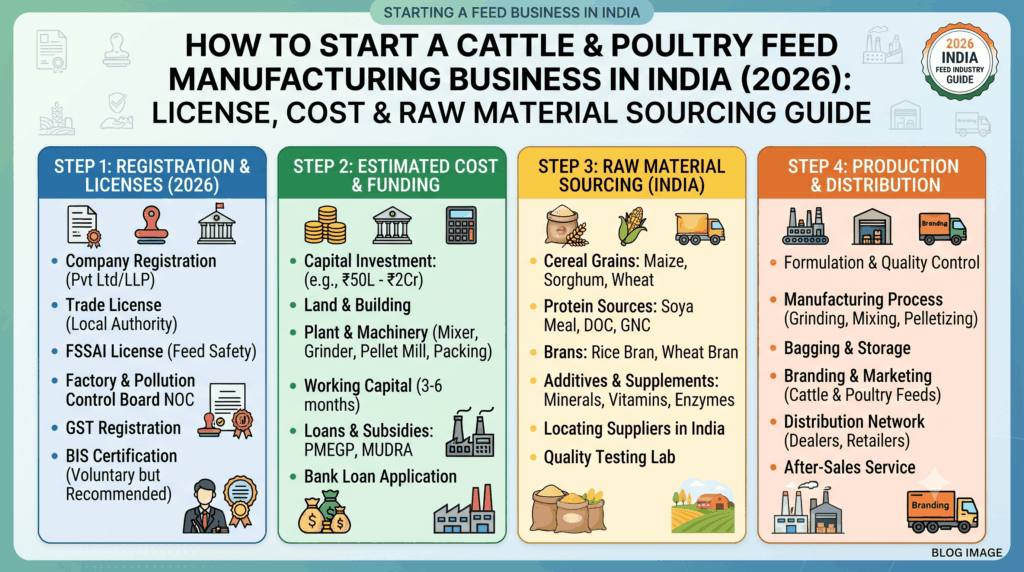
This is the step most new entrants underestimate on timeline. Two separate approvals are required before you can legally manufacture and sell compounded feed in India.
FSSAI Feed Manufacturing License
Animal feed manufacturing falls under the Food Safety and Standards Authority of India’s licensing framework. Depending on production capacity, you’ll need either an FSSAI State License (smaller/mid-scale units) or a Central License (larger-capacity or multi-state operations). Required documentation typically includes:
- Proof of business constitution (proprietorship/partnership/company registration)
- Site/factory layout plan
- List of machinery and equipment
- Water testing report
- Food safety management plan
BIS Certification (Mandatory Since 2019)
Since December 2019, FSSAI has made it mandatory that commercial compounded feed comply with the relevant Bureau of Indian Standards specification and carry the BIS Certification Mark — this isn’t optional or a “nice to have” for premium positioning; it’s a legal requirement to manufacture and sell.
- IS 2052 governs compounded feed for cattle (dairy cattle feed specifications — ingredient limits, crude protein/fibre thresholds, moisture content, mineral content, and labelling requirements)
- IS 3062 and related standards govern poultry feed specifications by category (broiler, layer, starter/grower)
The BIS certification process runs through four stages: application filing, document scrutiny, product testing (samples sent to a BIS-approved lab against the relevant IS standard), and a factory audit where BIS inspectors assess your production process, quality control setup, and manufacturing infrastructure before issuing the license.
Realistic timeline: Budget 3–5 months for FSSAI and BIS approvals combined, run in parallel rather than sequentially where possible. Trying to compress this timeline by starting production before certification is a common and costly mistake — non-compliant feed manufactured or sold without BIS marking is a direct regulatory violation, not a grey area.
Step 3: Understand the Cost Structure Before You Commit Capital
The single most important number to internalize before setting up a feed mill: raw materials typically account for 55–65% of the finished feed price, and 80–85% of total operating expenses for mid-scale operations. This has two direct implications.
First, your margin is a sourcing problem, not a manufacturing problem. A feed mill with efficient machinery but an unreliable or overpriced raw material supply chain will consistently underperform one with average machinery and a strong sourcing relationship. Gross margins in the industry typically run 15–25%, with net margins of 5–12% — thin enough that a 3–5% swing in raw material cost has an outsized effect on profitability.
Second, don’t underestimate working capital. New entrants often budget capex (land, machinery, licensing) carefully but underestimate the working capital needed to hold 30–60 days of raw material inventory — particularly important given how volatile ingredient markets have been recently (soybean meal prices, for instance, saw sharp swings through 2026 driven by import policy and domestic sowing patterns).
For context on how much raw material price volatility can move your input costs: Soybean Meal Crisis in India (2026): Why Prices Jumped 40%+
| Cost Component | Typical Share |
|---|---|
| Raw materials | 55–65% of finished feed price |
| Machinery & plant (one-time capex) | Varies by scale — largest single upfront cost |
| Utilities (power, fuel) | 5–10% of OpEx |
| Labour | Remainder of OpEx |
| Gross margin | 15–25% |
| Net margin | 5–12% |
Step 4: Raw Material Sourcing — The Decision That Determines Your Margin
This is where most of the long-term competitive advantage in feed manufacturing actually gets built or lost. New feed mills typically need a working combination of energy sources, protein sources, and fibre/bulk ingredients, sourced consistently enough to avoid formulation drift between batches.
Energy Sources
Maize is the dominant energy ingredient across almost every Indian feed category — cattle, poultry, and swine alike — typically 35–65% of the formula depending on species. Maize DDGS and Rice DDGS offer a useful energy-plus-protein alternative, particularly valuable when maize prices spike.
Protein Sources
Soya DOC is the benchmark protein source for poultry and swine formulations because of its amino acid profile, but it’s also the most price-volatile ingredient in most Indian feed mills’ cost structure. Mustard DOC is the practical, regionally-available alternative for cattle and small-ruminant feed, and increasingly used as a partial soya DOC replacement across species as mills look to de-risk from soybean meal volatility.
Fibre, Bulk, and Secondary Protein
De-Oiled Rice Bran (DORB), Maize Gluten, and Rice Gluten round out most formulations — adding fibre, bulk, and secondary protein density at a lower cost per kilogram than the primary ingredients.
The sourcing decision new mills consistently get wrong: treating raw material procurement as a series of one-off spot purchases rather than building 2–3 reliable, quality-tested supplier relationships before production starts. Feed quality consistency — and therefore customer retention — depends far more on ingredient consistency (moisture, protein, aflatoxin levels within spec, batch to batch) than on formulation sophistication.
For a deeper look at evaluating raw material suppliers specifically: How to Choose a Feed Raw Material Supplier in India
For practical cost-reduction levers once you’re operating: How to Reduce Animal Feed Cost in India: 7 Proven Ingredient Substitutions
Step 5: Quality Control Systems From Day One
BIS certification requires demonstrated quality control capability, but the deeper reason to build real QC processes from day one is commercial, not just regulatory: a single bad batch — high moisture triggering mould, undetected aflatoxin contamination, or an out-of-spec protein level — can cost a new mill a customer relationship that took months to build.
Minimum QC checkpoints for a new mill:
- Incoming raw material testing: moisture, crude protein, and aflatoxin/mycotoxin screening on every batch, not just periodic sampling
- In-process moisture control during mixing and pelleting
- Finished product testing against the relevant BIS specification before dispatch
- Batch traceability — the ability to trace a customer complaint back to specific incoming raw material lots
This is also where new entrants can differentiate against unorganized, non-compliant competitors — a meaningful share of the Indian feed market still runs without formal BIS certification or consistent QC, and dairy cooperatives and integrators increasingly prefer suppliers who can provide test documentation with every batch.
Common Mistakes New Feed Manufacturing Entrants Make
1. Starting production before certification is complete This is the single most common and most costly mistake. Both the FSSAI license and BIS certification take real time; producing and selling before approval is a compliance violation, not a shortcut.
2. Underestimating working capital for raw material inventory Capex budgets for land and machinery are usually well-researched; the working capital needed to hold 30–60 days of raw material stock, especially through a price-volatile period, is frequently underestimated.
3. Single-supplier dependency Relying on one raw material supplier — even a good one — leaves a new mill exposed to a single point of failure during a supply disruption or price spike. Building relationships with 2–3 tested suppliers per key ingredient is standard risk management, not overcaution.
4. Ignoring regional demand patterns Cattle feed demand is strongest where organized dairy and cooperative structures (Haryana, Punjab, Gujarat, parts of UP) are established; poultry feed demand clusters around integrator hubs. Building capacity without validating regional demand first is a common cause of underutilized plant capacity in year one.
5. Under-investing in quality control to save early capex QC equipment and testing (even basic moisture meters and aflatoxin test kits) feel like a deferrable cost when capital is tight — but a single contaminated batch reaching a customer, or failing BIS renewal testing, costs far more than the equipment would have.
Frequently Asked Questions
What licenses are required to start a cattle or poultry feed manufacturing business in India? Two are mandatory: an FSSAI Feed Manufacturing License (State or Central, depending on scale) and BIS certification against the relevant Indian Standard (IS 2052 for compounded cattle feed, with corresponding standards for poultry feed categories). Since December 2019, BIS certification has been a legal requirement, not optional.
How long does it take to get FSSAI and BIS approval for a feed mill? Budget realistically for 3–5 months when both are pursued in parallel. BIS certification alone involves application filing, document scrutiny, product testing at an approved lab, and a factory audit — each stage takes real time and shouldn’t be compressed by starting production early.
What percentage of feed manufacturing costs go to raw materials? Raw materials typically account for 55–65% of the finished feed price and 80–85% of total operating expenses for mid-scale operations. This makes raw material sourcing the primary lever for profitability, more so than manufacturing efficiency alone.
Should a new feed mill start with cattle feed or poultry feed? For most first-time entrants, especially in North India, cattle/dairy feed or a feed concentrate line is a lower-capital entry point with a larger, less consolidated customer base than poultry feed, which often requires integrator relationships and tighter quality control from the outset. Many mills expand into poultry or swine feed after establishing cattle feed operations, reusing the same raw material sourcing base.
What are typical profit margins in Indian feed manufacturing? Gross margins typically run 15–25%, with net margins of 5–12% — thin enough that raw material cost management and supplier reliability matter more to overall profitability than most first-time entrants expect going in.
Conclusion
Setting up a compliant, profitable cattle or poultry feed manufacturing business in India in 2026 comes down to three things done right, in order: securing FSSAI and BIS approval before producing a single batch, building 2–3 reliable raw material supplier relationships rather than sourcing opportunistically, and putting real quality control in place from day one rather than treating it as a cost to defer. The market growth is real — but it rewards operators who treat sourcing and compliance as the core of the business, not the paperwork around it.
Brinda Foods supplies certified-quality Maize, Maize DDGS, Rice DDGS, Soya DOC, Mustard DOC, De-Oiled Rice Bran (DORB), Maize Gluten, and Rice Gluten to new and established feed mills across India — with tested specifications and consistent supply built for mills that can’t afford formulation drift between batches.
For bulk sourcing enquiries or to discuss a supply relationship for a new or expanding feed mill: Contact Us | Submit an Enquiry | Call: 9992500442 | Email: sales1@brindafoods.com