Broiler profitability comes down to one number more than any other: feed conversion ratio. And FCR, in turn, comes down almost entirely to what’s in the feed and how well it’s matched to each growth phase. With raw material costs volatile through 2026 — soybean meal prices up sharply, maize under pressure from ethanol blending demand — getting broiler feed formulation right matters more than ever for margins.
This guide covers the three-phase broiler feeding programme, protein and energy benchmarks by stage, FCR targets, and the raw materials that go into a well-formulated broiler ration.
The Three Phases of Broiler Feeding
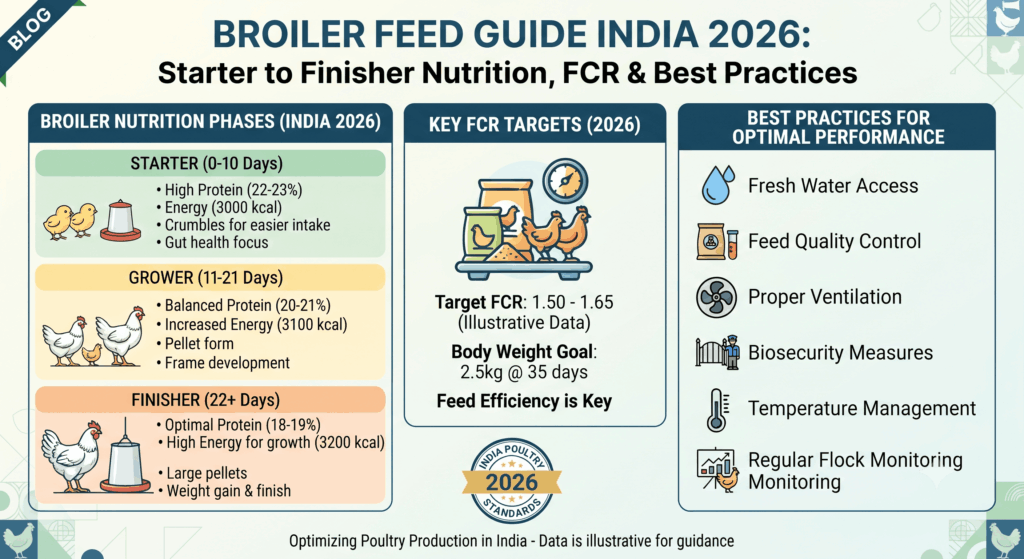
Commercial broiler production in India is generally structured around three (sometimes four, with a pre-starter phase) feeding stages, each with a distinct nutrient specification:
| Phase | Age | Crude Protein | Energy (ME, kcal/kg) | Purpose |
|---|---|---|---|---|
| Pre-starter | 0–7/10 days | 22–24% | 3,000–3,100 | Rapid early gut and skeletal development |
| Starter | 7/10–21 days | 21–23% | 3,000–3,150 | High-protein growth foundation |
| Finisher | 21–35/42 days | 18–20% | 3,100–3,200 | Efficient weight gain to market size |
The general principle: protein density is highest early, when the chick’s digestive and skeletal systems are developing fastest, and gradually eases off as birds mature and their digestive efficiency improves — allowing formulators to lean more on energy-dense, cost-effective ingredients in the finisher phase without sacrificing growth.
FCR Benchmarks Feed Millers Should Know
Feed conversion ratio — kilograms of feed consumed per kilogram of live weight gained — is the single clearest signal of formulation quality.
| Body Weight | Target FCR |
|---|---|
| ~0.5 kg | 1.0–1.1 |
| ~1 kg | 1.25–1.40 |
| ~2 kg | 1.4–1.55 |
| Market weight (day 42) | 1.55–1.70 (commercial target) |
An FCR that consistently drifts above these benchmarks usually points to one of three things: protein or amino acid shortfall, energy density mismatch, or raw material quality issues (moisture, aflatoxin, or inconsistent batch specification) rather than genetics or management alone.
Key Raw Materials in Broiler Feed Formulation
A well-formulated broiler ration blends energy sources, protein sources, and functional additives. Here’s how Brinda Foods’ raw material range typically fits into that structure:
Energy base
- Maize — the primary energy source in almost every Indian broiler ration, though 2026’s ethanol blending-driven price pressure has pushed many mills to trim maize inclusion where possible.
- Maize DDGS and Rice DDGS — supply combined protein, fibre, and energy, useful for partially offsetting straight maize inclusion.
Protein sources
- Soya DOC — the traditional amino acid-balanced protein backbone, though 2026 pricing has pushed millers to blend in alternatives more aggressively. See our soybean meal crisis breakdown for the pricing context driving this shift.
- Maize Gluten Meal and Rice Gluten Meal — concentrated protein-energy ingredients (60%+ and 50–60% crude protein respectively) increasingly used to partially offset soybean meal cost pressure. Read our dedicated guides on maize gluten meal and rice gluten meal.
- Mustard DOC — a cost-effective supplementary protein, more commonly used in layer and ruminant diets but occasionally blended at lower inclusion in broiler grower/finisher rations.
Fibre and by-product ingredients
- De-Oiled Rice Bran (DORB) — a moderate energy and fibre source, more commonly used in layer and cattle feed, but relevant where formulators are managing fibre balance across a multi-species mill.
For a broader view of how Brinda Foods’ Feed Concentrates fit into ready-to-use formulations, see our feed concentrate guide.
Broiler Feed vs. Layer Feed: Why the Formulation Differs
Broiler and layer feed are formulated for entirely different biological goals — broilers for rapid muscle growth to market weight in roughly 35–42 days, layers for sustained egg production over many months. That difference shows up directly in calcium levels, protein staging, and energy density. If you’re running a mixed-species mill, our comparison of broiler feed vs. layer feed and our layer feed guide are useful companions to this post.
Managing Raw Material Risk in Broiler Feed (2026 Context)
Two supply-side pressures are shaping broiler feed formulation decisions this year:
- Maize price inflation from ethanol blending demand — with more of India’s maize supply being diverted to ethanol production, feed millers are formulating more carefully around maize inclusion and leaning further into DDGS and gluten meal as partial offsets.
- Soybean meal price surge — down 17% in crop yield and up over 40% in price, soybean meal availability is the single biggest cost variable in broiler formulation right now, pushing millers toward maize gluten meal, rice gluten meal, and mustard DOC as blended alternatives.
Monsoon storage conditions add a third variable: aflatoxin risk in stored maize and by-products can silently erode FCR even when the formulation on paper looks correct. See our guide on monsoon mycotoxin and aflatoxin risk in animal feed for storage and testing practices.
Quality Checks Before Buying Broiler Feed Raw Materials in Bulk
- Protein and amino acid verification — lab-tested, not label-stated.
- Moisture control — under 12% across gluten meals and DOC to prevent mould risk.
- Aflatoxin testing — non-negotiable for broiler feed given birds’ sensitivity to mycotoxins.
- Batch-to-batch consistency — critical for millers running continuous production lines where formulation shouldn’t need re-tuning every delivery.
- Supplier traceability — certifications such as BIS, GMP, ISO 9001:2015, GAFTA, and FOSFA are a reasonable baseline to look for.
Sourcing Broiler Feed Raw Materials from Brinda Foods
Brinda Foods has supplied broiler feed and the raw materials behind it — maize, DDGS, DOC, gluten meals, and DORB — to feed manufacturers across Punjab, Haryana, and Uttar Pradesh since 1987. Every batch is scientifically sampled and lab-tested against the nutrient matrix before dispatch, with FIFO-managed storage to protect quality through supply.
To discuss formulation support or bulk pricing for your broiler feed programme, send us an enquiry.
Frequently Asked Questions
What protein percentage should broiler starter feed have? Broiler starter feed typically requires 21–23% crude protein, tapering to 18–20% by the finisher phase.
What is a good FCR for broilers in India? Commercial broiler operations typically target an FCR of 1.55–1.70 by day 42, with tighter ratios (1.0–1.1) expected at earlier, lighter body weights.
How many feeding phases does a broiler programme typically have? Most Indian broiler programmes use three phases — starter, grower/finisher — with some operations adding a short pre-starter phase in the first 7–10 days for stronger early development.
What raw materials affect broiler FCR the most? Protein quality and amino acid balance (from soya DOC, gluten meals) and energy density (from maize, DDGS) have the largest impact, alongside raw material consistency and freedom from mycotoxin contamination.