
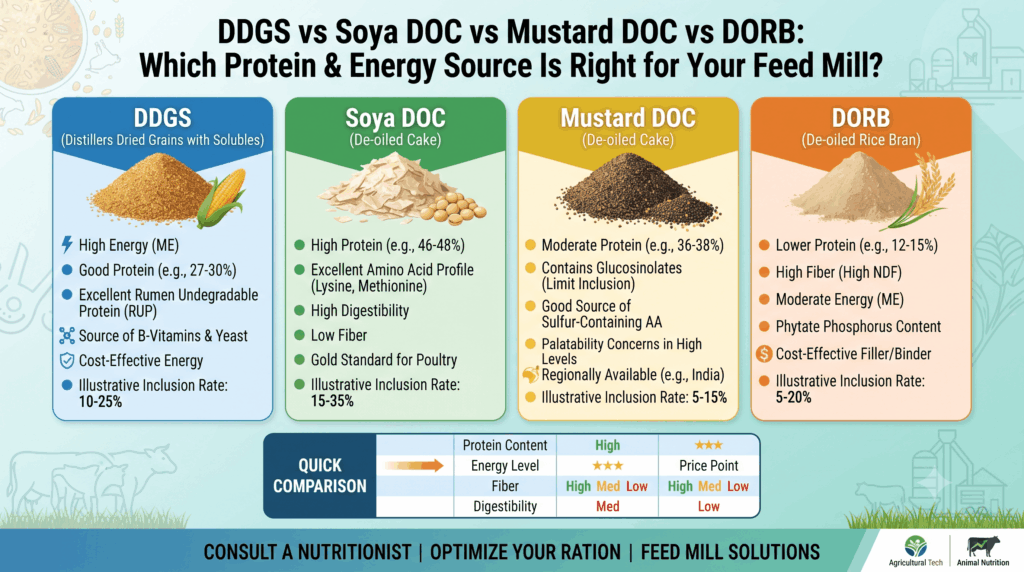
If you run a feed mill, a cattle feed unit, or a poultry/swine feed line in India, you have almost certainly weighed these four ingredients against each other at some point: DDGS (Rice or Maize), Soya DOC, Mustard DOC, and DORB (De-Oiled Rice Bran). Each one shows up in ration sheets across the country, each has a different price trend, and each solves a slightly different formulation problem.
The trouble is that most sourcing decisions get made in isolation — a call about soya DOC prices this week, a call about DDGS availability next week — rather than as a side-by-side comparison. That’s expensive. Swapping even 5-10% of your ration composition between these ingredients, without understanding the trade-offs, can quietly move your feed conversion ratio (FCR) and your margins.
This guide puts all four raw materials on one table: protein and energy content, fibre load, typical price positioning, ideal inclusion rates, and which livestock category each one suits best. If you procure raw material for cattle, broiler, layer, or swine feed, this is written for you.
Quick Comparison: DDGS vs Soya DOC vs Mustard DOC vs DORB
| Parameter | Rice/Maize DDGS | Soya DOC | Mustard DOC | DORB |
|---|---|---|---|---|
| Crude Protein | 28-47% (varies by source grain) | 42-48% | 34-38% | 12-16% |
| Primary Role | Protein + energy (dual-purpose) | Primary protein source | Secondary/alternative protein | Energy + fibre filler |
| Fat Content | Moderate-high | Low (post-extraction) | Moderate | Moderate |
| Fibre Level | Moderate | Low | High | High |
| Price Position | Mid-range, tracks ethanol/starch industry output | Typically the most expensive protein source | ₹8-12/kg below Soya DOC on average | Most economical of the four |
| Typical Inclusion Rate | Up to 15-20% in cattle rations, lower in poultry | 15-25% depending on species | 8-15%, higher tolerance in ruminants | 10-20%, mainly ruminant diets |
| Best Suited For | Dairy cattle, layer, broiler (as partial protein/energy blend) | Broiler, layer, swine, high-yield dairy cattle | Ruminants, dairy cattle where cost matters | Dairy cattle, cattle feed concentrates |
Exact specifications vary by batch and supplier — always confirm crude protein, moisture, aflatoxin, and fibre values against a lab report before finalizing a purchase order.
Rice & Maize DDGS: The Dual-Purpose Ingredient
DDGS (Distillers Dried Grains with Solubles) is a co-product of ethanol production, which means its supply is tied to grain processing output rather than a dedicated crop cycle — a factor worth watching if you’re planning quarterly procurement.
What makes DDGS distinct from a straight protein meal is that it carries both protein and residual energy (fat and unfermented starch) in the same ingredient. That dual role is useful when you want to lift ration energy density without adding a separate fat source. Rice DDGS tends to run leaner in protein than maize DDGS but is often more consistent in fibre, while maize DDGS brings a stronger amino acid profile for poultry rations.
Where it fits best: Dairy cattle rations (as a partial substitute for cottonseed/soya meal), and as a supporting ingredient in broiler and layer feed where energy top-up is needed alongside protein.
Related reading: What Is DDGS and Its Benefits for Animal Feed? · Rice DDGS or Maize DDGS: A Guide for Feed Millers
Product pages: Rice DDGS · Maize DDGS
Soya DOC: The Protein Benchmark
Soya DOC (de-oiled cake) remains the reference point every other protein source in this list gets measured against — it has the most balanced amino acid profile, particularly lysine, and the highest digestibility of the four. That’s exactly why it also carries the highest price tag, and why 2026 has seen mills actively looking for partial substitutes when soya prices spike.
If your rations are for broiler starter feed, layer feed during peak lay, or high-yield dairy cattle, soya DOC is difficult to fully replace without a formulation review. But for grower/finisher rations or maintenance-stage dairy cattle, blending in DDGS, mustard DOC, or DORB to cover 20-30% of the protein/energy requirement is a common cost lever — provided the substitution is calculated against actual lab values, not assumed averages.
Related reading: Soybean Meal Crisis in India (2026): Prices, GM Import Debate & Alternatives · Benefits of Soya DOC in Animal Feed
Product page: Soya DOC
Mustard DOC: The Cost-Conscious Protein Alternative
Mustard DOC is the most direct domestic substitute for soya DOC in ruminant diets, typically priced meaningfully below it while still delivering 34-38% crude protein. The catch is inclusion rate discipline — mustard DOC carries glucosinolates and a higher fibre load than soya DOC, so most nutritionists cap it at 8-15% depending on the animal category rather than treating it as a one-for-one swap.
For cattle feed manufacturers in Punjab, Haryana, and Rajasthan — where mustard is grown locally and supply chains are shorter — mustard DOC is often the most logistically efficient protein source, not just the cheapest on paper.
Related reading: Mustard DOC Animal Feed: Complete Guide
Product page: Mustard DOC
DORB (De-Oiled Rice Bran): The Economical Energy & Fibre Base
DORB doesn’t compete on protein — at 12-16% crude protein, it isn’t trying to. Its job is to supply digestible fibre and energy at the lowest cost per kilogram in this comparison, which frees up your protein budget to be spent on soya DOC or mustard DOC where it actually moves productivity.
DORB is a staple in cattle feed concentrates and dairy rations, where it works alongside a protein source rather than instead of one. Mills that try to push DORB inclusion too high to cut costs typically see it show up as reduced ration energy density and, over time, softer milk yield or weight gain numbers — so treat it as a formulation component with a ceiling, not a filler with no limit.
Related reading: De-Oiled Rice Bran (DORB): Animal Feed Benefits & Nutrition · How DORB Is Made
Product page: De-Oiled Rice Bran
Decision Framework: Which Combination Fits Your Feed Line?
Dairy cattle (high-yield): Soya DOC as the primary protein anchor, DDGS for energy top-up, DORB as the economical filler. Mustard DOC can flex in when soya prices spike, capped at around 10-12%.
Dairy cattle (maintenance/dry period): Mustard DOC or DDGS can carry a larger share of protein needs since peak productivity isn’t the priority — this is where cost savings are easiest to capture without a performance trade-off.
Broiler feed: Soya DOC remains dominant for amino acid balance, especially lysine and methionine. Maize DDGS can offset a portion of the energy requirement, but keep inclusion moderate in starter rations.
Layer feed: Similar logic to broiler — protect protein quality during peak lay, and use DDGS or mustard DOC more freely during the later lay cycle.
Swine feed: Soya DOC remains the strongest fit given digestibility requirements, with DDGS as a supporting energy source. DORB and mustard DOC are used more cautiously given fibre tolerance limits in monogastric diets.
Feed concentrates (mixed-species blends): This is where all four ingredients typically appear together, and where getting the ratio wrong is most costly at scale — small percentage errors compound across tonnes of output.
Quality Checks Before You Commit to a Supplier
Whichever combination you land on, the ingredient comparison only holds up if what arrives at your mill matches the lab report you were quoted against. Before finalizing a bulk order, verify:
- Crude protein and moisture against an independent or third-party lab test, not just the supplier’s certificate
- Aflatoxin levels, especially for monsoon-season deliveries or any maize-derived ingredient
- Fibre and sand/silica content, which affects both nutrition and milling equipment wear
- Certifications held by the supplier — BIS, GMP, ISO 9001:2015, GAFTA, or FOSFA are reasonable baseline checks for consistency across shipments
See our certifications and quality process for how this is handled end-to-end.
Frequently Asked Questions
1. Can DDGS fully replace Soya DOC in a ration? Not fully. DDGS lacks the lysine density of soya DOC, so most nutritionists use it as a partial substitute (covering roughly 20-30% of the protein/energy requirement) rather than a full replacement, particularly in poultry starter feed.
2. Is Mustard DOC safe for poultry feed? Mustard DOC is used more conservatively in poultry than in ruminant diets because of its glucosinolate content and fibre load. It’s most reliable in ruminant (cattle) rations at controlled inclusion rates.
3. Why is DORB not counted as a protein source? At 12-16% crude protein, DORB is classified as an energy and fibre ingredient rather than a protein source. It’s typically paired with soya DOC, mustard DOC, or DDGS rather than used alone.
4. How do I decide the right blend ratio for my mill? Start from your target crude protein and energy values per animal category, then price out combinations against current market rates for each ingredient. A nutritionist or feed formulation software can model this precisely, but the comparison table above is a reasonable starting point for a directional decision.
5. Do prices for these four ingredients move together or independently? Independently, for the most part. Soya DOC tracks global oilseed and soybean meal markets, mustard DOC tracks the domestic mustard crop cycle, DDGS tracks ethanol/grain processing output, and DORB tracks rice milling volumes. That’s exactly why blending across all four, rather than relying on one, is a practical hedge against price volatility in any single ingredient.
Get a Bulk Quote Across All Four Ingredients
Brinda Foods has supplied Rice DDGS, Maize DDGS, Soya DOC, Mustard DOC, and DORB to feed manufacturers and millers across Punjab, Uttar Pradesh, Haryana, and international markets since 1987. If you’re comparing combinations for your next production cycle, our team can walk through current lab specifications and bulk pricing for each ingredient together, so you’re comparing real numbers instead of estimates.

[…] Maize DDGS still wins on raw cost-per-protein because it’s a lower-value byproduct to begin with, but it can’t match Maize Gluten Meal’s protein density or its energy contribution per kilogram — the two ingredients solve different formulation problems rather than compete head-on. Most mills that adopt Maize Gluten Meal use it as a protein “top-up” layered alongside Soya DOC, Mustard DOC, or DDGS, not as a wholesale replacement. For the fuller ingredient-by-ingredient breakdown, see our DDGS vs. Soya DOC vs. Mustard DOC vs. DORB comparison guide. […]
[…] the amino acid balance is weaker, so factor the synthetic amino acid cost into the comparison. Our comparison of DDGS, Soya DOC, Mustard DOC and DORB works through the […]