India holds the world’s largest goat population and the third-largest sheep population — over 220 million goats and roughly 75 million sheep, concentrated across Rajasthan, Uttar Pradesh, West Bengal, Haryana, and the southern states. Yet small-ruminant nutrition gets a fraction of the formulation attention that cattle and poultry feed receive. Most goat and sheep flocks in India are still fed on grazing plus whatever crop residue is on hand, with concentrate feed — if used at all — mixed informally on-farm rather than formulated to a nutrient target.
That gap is exactly where the opportunity sits, both for flock productivity and for feed millers building a small-ruminant product line. This guide covers what goats and sheep actually need at each production stage, which raw materials perform best in Indian concentrate formulas, and the mistakes that quietly cap growth rate, milk yield, and kidding/lambing percentage on otherwise well-run farms.
Why Goat and Sheep Nutrition Gets Overlooked — and Why That’s a Mistake
Goats and sheep are ruminants, like cattle, so there’s a common assumption that “cattle feed principles apply, just smaller quantities.” That’s only partly true. Two things make small-ruminant nutrition genuinely different:
- Goats are selective browsers, not grazers. Left to forage, goats will pick the most nutritious leaves and shoots first — which means a goat on poor-quality grazing can look adequately fed while actually running a protein and mineral deficit that only shows up as poor kidding rates or slow-growing kids months later.
- The economic ceiling is different. Commercial goat and sheep farming in India is increasingly driven by meat (chevon and mutton) rather than fibre or dairy, and buyers pay a premium for live weight and body condition at the point of sale. A properly formulated concentrate that adds 100–150 grams of daily gain over grazing-only feeding has a direct, measurable payback — but only if the concentrate is balanced, not just “some grain thrown in.”
The result: flocks fed on instinct rather than formulation are leaving weight gain, milk yield, and reproductive performance on the table — and most farmers don’t have a benchmark to know it.
Goat and Sheep Nutrient Requirements by Production Stage
| Stage | Crude Protein | TDN (Energy) | Notes |
|---|---|---|---|
| Maintenance (dry doe/ewe) | 10–12% | 55–60% | Grazing alone often meets this if pasture quality is decent |
| Growing kids/lambs (weaning–6 months) | 16–18% | 65–70% | Highest-priority stage for concentrate — determines mature size |
| Late pregnancy (last 6 weeks) | 12–14% | 60–65% | Foetal growth is fastest in the final trimester; underfeeding here is the single biggest cause of weak/low-birth-weight kids and lambs |
| Lactation (peak) | 16–18% | 65–70% | Milk synthesis demand is comparable to a dairy animal, pound for pound |
| Breeding bucks/rams (pre-mating flush) | 14–16% | 60–65% | A 3–4 week “flushing” period before mating measurably improves conception rates |
The pattern mirrors dairy cattle and layer poultry: nutrient density peaks around reproduction and lactation, and drops during maintenance. The stage most Indian smallholder operations get wrong is late pregnancy — because a dry, visibly non-lactating doe or ewe looks like she needs less feed, when in fact foetal growth in the final six weeks is the single largest nutritional demand of the entire reproductive cycle short of peak lactation itself.
Building a Concentrate Formula: Key Raw Materials
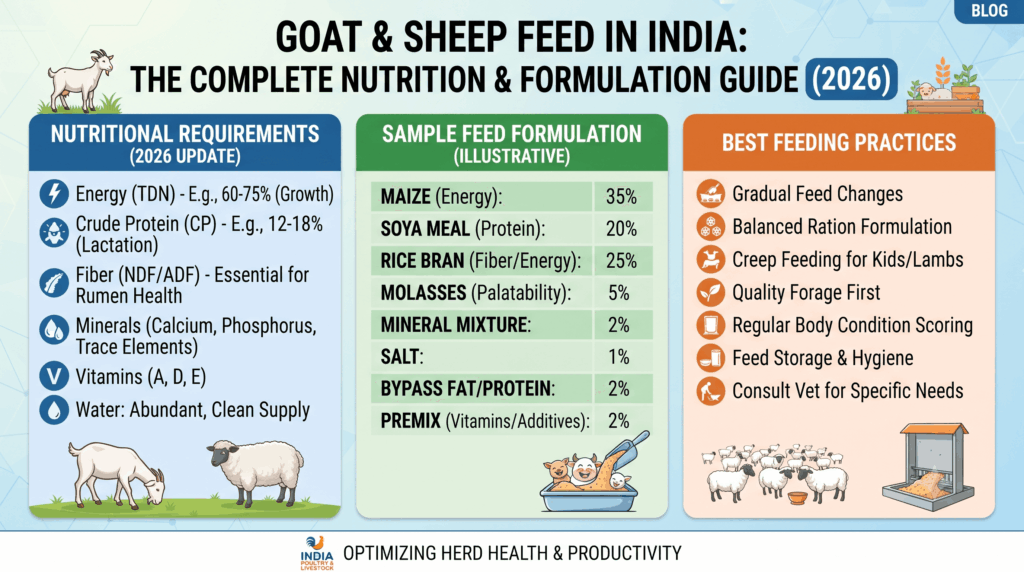
Grazing and crop residues (wheat straw, paddy straw, berseem, seasonal fodder) supply the bulk of a small-ruminant diet’s volume, but rarely enough protein and energy density during growth, late pregnancy, or lactation. A concentrate mix — typically fed at 300–600 grams/day for growing/lactating animals — closes that gap.
Maize — The Energy Base
Maize supplies the bulk energy in most Indian goat and sheep concentrate mixes, typically 35–45% of the formula. It’s palatable, energy-dense, and the most cost-stable cereal energy source available to Indian feed compounders.
Mustard DOC — The Regional Protein Workhorse
Mustard DOC is, in practice, the default protein source for goat and sheep concentrates across North India — it’s regionally available, competitively priced against soya, and ruminants tolerate its glucosinolate content far better than monogastric animals do.
Recommended inclusion: 15–25% in growing and lactating-animal concentrates; up to 20% is common in late-pregnancy flushing rations. Because goats and sheep are ruminants, the detoxification concerns that limit mustard DOC in poultry and swine diets are far less restrictive here.
For a full breakdown of mustard DOC’s protein profile, glucosinolate handling, and inclusion limits across species: Mustard DOC in Animal Feed: The Complete Guide
Maize DDGS — Protein and Energy in One Ingredient
Maize DDGS is well suited to small-ruminant diets because sheep and goats tolerate considerably higher DDGS inclusion than monogastric livestock — research on meat goats shows DDGS can run up to roughly 30% of the diet without hurting intake, growth rate, or carcass quality, and finishing lambs tolerate even higher levels. For Indian concentrate formulation, a conservative and consistent 15–20% inclusion delivers strong protein and energy value without formulation risk.
For more on DDGS economics and how it compares to other protein-energy sources: Maize DDGS Price in India: Rate, Supply & Buying Guide
De-Oiled Rice Bran (DORB) — Fibre, Bulk, and Cost Control
DORB is a practical filler and moderate-energy ingredient in goat and sheep rations, useful for adding bulk and controlled fibre at a lower cost per kilogram than maize or the protein cakes.
Recommended inclusion: 15–20% in maintenance and dry-stage rations, tapering to 10% in high-production stages (peak lactation, growing kids) where energy and protein density matter more than bulk.
For the full manufacturing and nutritional profile: How De-Oiled Rice Bran (DORB) Is Made
Soya DOC — For Premium, High-Performance Formulas
Soya DOC is not the default protein choice for small ruminants in India on cost grounds, but it earns a place in premium formulations — commercial breeding-buck rations, intensive meat-goat finishing operations, or dairy-goat enterprises — where its superior amino acid profile justifies the premium over mustard DOC.
Recommended inclusion: 8–12%, typically blended alongside mustard DOC rather than replacing it outright, in higher-performance formulas.
Minerals and Salt
Small ruminants are notably prone to mineral deficiencies that don’t show up until they cause a visible problem — copper and selenium deficiency in particular are widespread in Indian goat and sheep flocks and depress fertility, immunity, and kid/lamb vigour well before any obvious clinical sign appears. A mineral mixture at 2–3% of the concentrate, plus free-choice salt, is inexpensive insurance against a class of problems that otherwise gets misdiagnosed as “poor genetics” or “bad luck” for years.
A Practical Concentrate Formula Example
| Ingredient | Growing Kids/Lambs | Lactating Does/Ewes | Maintenance/Dry |
|---|---|---|---|
| Maize | 40% | 38% | 30% |
| Mustard DOC | 22% | 25% | 18% |
| Maize DDGS | 18% | 15% | 12% |
| DORB | 12% | 12% | 30% |
| Mineral mixture + salt | 3% | 3% | 3% |
| Molasses (binder, optional) | 5% | 7% | 7% |
This is a starting template, not a fixed prescription — actual formulation should account for grazing/fodder quality already available on the specific farm, since a flock on strong berseem grazing needs a leaner concentrate than one relying on dry wheat straw.
Common Mistakes in Indian Goat and Sheep Feeding
1. Treating “dry” animals as needing no concentrate The final six weeks of pregnancy is the highest-stakes nutritional window in the entire cycle. Cutting concentrate because the doe or ewe “isn’t producing anything yet” is the single most common cause of weak, low-birth-weight kids and lambs — and of does/ewes that struggle to rebreed.
2. Assuming grazing alone covers growing kids and lambs Selective browsing means a kid or lamb can appear to be grazing normally while running a real protein deficit, because the most nutritious forage gets picked over first and isn’t always available in sufficient quantity. Growing animals without supplemental concentrate routinely fall short of genetic growth potential — the animal isn’t visibly starving, it’s just smaller at market weight than it should be.
3. No mineral supplementation Copper, selenium, and iodine deficiencies are common in Indian soils and forage, and their symptoms (poor conception, weak kids, reduced immunity) are easy to misattribute to breed, management, or disease. A basic mineral mixture is one of the cheapest fixes available in small-ruminant nutrition.
4. Sudden diet changes Goats and sheep are more sensitive to abrupt feed changes than cattle — a sudden shift from grazing to a high-concentrate diet, or a sudden increase in concentrate quantity, raises real risk of acidosis. Transitions should be stepped over 7–10 days.
5. Overfeeding energy to maintenance-stage animals Concentrate formulated for growing or lactating animals, fed at the same rate to dry/maintenance animals, causes unnecessary over-conditioning — which is a real cost (wasted feed) and, in does/ewes, can complicate kidding/lambing.
6. No separation of buck/ram nutrition from the general flock Breeding males are frequently fed whatever the general flock gets, with no pre-mating flush. A 3–4 week period of improved nutrition (14–16% CP) before the breeding season is a low-cost, high-return practice that’s widely underused.
Frequently Asked Questions
What is the ideal protein percentage for goat and sheep feed in India? It depends on production stage: 10–12% crude protein is adequate for dry, maintenance-stage animals; growing kids/lambs and lactating does/ewes need 16–18%; late-pregnancy animals need 12–14%. Feeding one flat protein level across all stages either wastes feed on animals that don’t need it or underfeeds the stages that matter most.
Can DDGS be used in goat and sheep concentrate feed? Yes, and small ruminants tolerate it well — research shows meat goats can handle DDGS inclusion up to roughly 30% of the diet without hurting growth or carcass quality, and finishing lambs tolerate even higher levels. For consistent Indian concentrate formulation, 15–20% is a practical, well-established range.
Is mustard DOC or soya DOC better for goat and sheep feed? For most Indian operations, mustard DOC is the more practical protein source — it’s regionally available, cost-competitive, and ruminants handle its glucosinolate content well. Soya DOC’s superior amino acid profile makes it worth including in premium formulations (breeding stock, intensive finishing, dairy goats), typically blended alongside mustard DOC rather than replacing it entirely.
Why is late pregnancy the most critical feeding stage for goats and sheep? Roughly 70% of foetal growth happens in the final six weeks of pregnancy, making this the single largest nutritional demand of the reproductive cycle outside of peak lactation. Underfeeding a visibly “dry” doe or ewe during this window is the most common cause of weak or low-birth-weight offspring and of poor rebreeding performance afterward.
How much concentrate should a goat or sheep be fed per day? As a general guide, 300–400 grams/day for growing kids and lambs, and 400–600 grams/day for lactating does and ewes, alongside adequate grazing or fodder — adjusted up or down based on the quality of forage already available and the animal’s body condition.
Conclusion
Goat and sheep nutrition in India runs on instinct and grazing far more often than formulation — which means the flocks that do move to a properly balanced concentrate, matched to production stage, have a real and largely uncontested advantage in growth rate, milk yield, and reproductive performance. Mustard DOC, maize DDGS, and DORB form a cost-effective, regionally available concentrate base for Indian conditions; soya DOC has a place in premium formulations where amino acid precision pays for itself.
For feed millers, small-ruminant concentrate is also a genuinely underserved product category next to the crowded cattle and poultry feed markets — the raw material base is largely the same, which makes it a low-incremental-cost line extension.
Brinda Foods supplies certified-quality Mustard DOC, Maize DDGS, De-Oiled Rice Bran (DORB), Soya DOC, and Maize to feed millers and flock operators formulating goat and sheep concentrate across India. Every batch is tested and comes with nutritional specification documentation.
For bulk pricing and sourcing enquiries: Contact Us | Submit an Enquiry | Call: 9992500442 | Email: sales1@brindafoods.com