
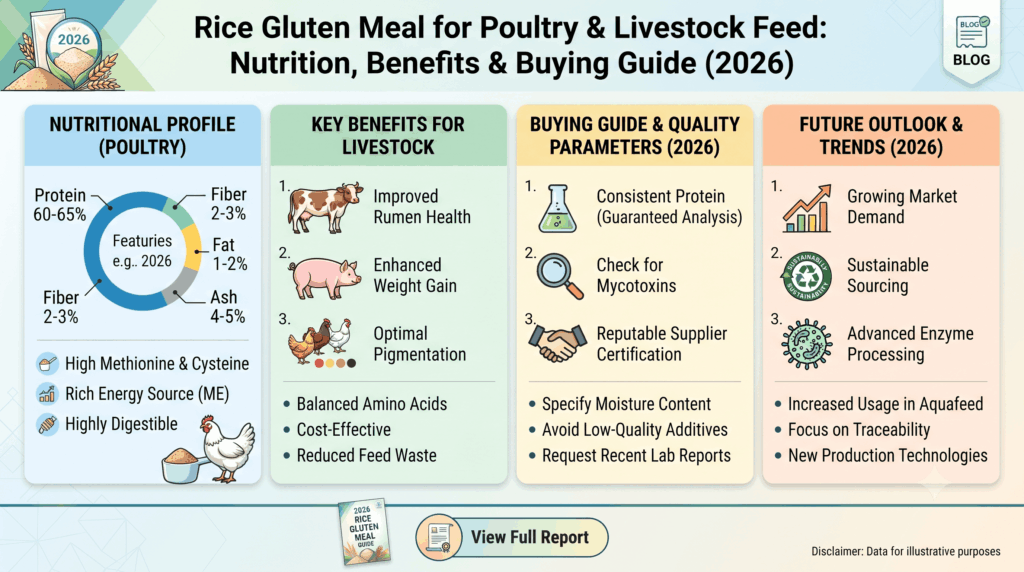
Rice gluten meal is one of the newer entrants to the Indian feed raw material market, but it’s building a strong case for itself in poultry and livestock formulations. As a by-product of rice wet-milling, it offers a genuinely useful combination of protein, digestibility, and energy — at a time when feed millers are actively hunting for alternatives to costlier protein sources like soybean meal.
Here’s what feed millers and manufacturers need to know before working it into a formulation.
What Is Rice Gluten Meal?
Rice gluten meal is produced during the wet-milling of rice, where starch and protein fractions are separated and the protein-rich residue is dried into a brownish, coarse powder. It’s a relatively newer feedstuff compared to maize gluten meal or DDGS, but research from Indian poultry science institutions has consistently validated its performance as an alternate protein source.
Rice Gluten Meal: Nutritional Profile
| Parameter | Typical Value |
|---|---|
| Dry Matter | ~92.3% |
| Crude Protein | 50–60% (dry-matter basis) |
| Ether Extract (Fat) | ~6.9% |
| Crude Fibre | ~9.5% |
| Ash | ~4.4% |
| Apparent Metabolizable Energy (AME) | ~3,031 kcal/kg |
| In-vitro Digestibility (IVPPD) | ~81.5% |
| Total Phosphorus | ~0.78% |
Research published in the Indian Journal of Animal Sciences on rice gluten meal in broiler diets found favourable digestibility and metabolizable energy values, supporting its use as a genuine alternate feed source — not just a filler ingredient.
At Brinda Foods, our Rice Gluten is tested against this nutrient matrix — protein, moisture, and fibre — before every dispatch, so formulators can rely on consistent batch-to-batch specification.
Why Rice Gluten Meal Is Gaining Ground in 2026
1. A genuine mid-protein alternative amid the soybean meal crunch With soybean meal prices up sharply through 2026, rice gluten meal’s 50–60% protein content positions it as a workable partial substitute — particularly in poultry diets where digestibility and AME both hold up well against inclusion. For full context on why protein sourcing has become so tight this year, see our post on the soybean meal crisis in India.
2. Strong digestibility for poultry An in-vitro pepsin-pancreatin digestibility of over 81% means rice gluten meal is well-utilised by broilers and layers, rather than passing through largely undigested — a key differentiator from lower-quality fibre by-products.
3. Energy density on top of protein At roughly 3,031 kcal/kg AME, rice gluten meal contributes meaningfully to the energy specification of a ration, not just the protein line — useful for formulators managing both targets simultaneously.
4. Fits across species While much of the published research focuses on poultry, rice gluten meal is also used in cattle, dairy, and aquaculture feed formulations as a protein-energy source, similar in role to maize gluten meal. See our comparison of the two in Maize Gluten vs. Rice Gluten.
Rice Gluten Meal in Poultry Feed Formulation
For broiler feed and layer feed, rice gluten meal is typically introduced at moderate inclusion levels as part of the protein-energy matrix, alongside soya DOC or maize gluten meal rather than as a standalone replacement. Because of its digestibility profile, it performs particularly well in starter and grower phases where nutrient absorption efficiency matters most — see our broiler feed guide for phase-wise formulation detail.
Rice Gluten Meal vs. Other Protein-Energy Ingredients
| Ingredient | Crude Protein | AME (kcal/kg, approx.) | Best Fit |
|---|---|---|---|
| Rice Gluten Meal | 50–60% | ~3,031 | Poultry protein + energy, digestibility |
| Maize Gluten Meal | 60%+ | Higher energy density | Protein concentrate, pigmentation |
| Rice DDGS | 20–24% | Moderate | Fibre + protein combination |
| Soya DOC | 42–45% | Moderate | Amino acid-balanced protein base |
What to Check Before Buying Rice Gluten Meal in Bulk
- Protein and moisture verification — confirm lab-tested crude protein rather than relying on supplier claims alone.
- Colour and texture consistency — a uniform brownish, coarse texture indicates proper wet-milling and drying.
- Fibre content — higher-than-specified crude fibre can dilute the energy value of the batch.
- Aflatoxin testing — critical for any milled by-product, particularly during monsoon storage. See our guide on monsoon mycotoxin and aflatoxin risk.
- Supplier consistency — as a newer ingredient category in India, batch-to-batch consistency varies more between suppliers than it does for established commodities like DOC or DDGS, so a tested, traceable source matters.
Sourcing Rice Gluten Meal from Brinda Foods
Brinda Foods has supplied premium feed raw materials to manufacturers and millers across Punjab, Haryana, and Uttar Pradesh — and to international markets — since 1987. Our Rice Gluten is sourced from approved suppliers and verified through scientific sampling and lab testing before it reaches your feed mill, backed by four decades of quality-first sourcing.
To check current availability and pricing for bulk supply, send us an enquiry.
Frequently Asked Questions
What is the protein content of rice gluten meal? Rice gluten meal typically contains 50–60% crude protein on a dry-matter basis.
Is rice gluten meal suitable for broiler feed? Yes — research shows favourable digestibility (over 81%) and metabolizable energy (~3,031 kcal/kg), making it a viable protein-energy source in broiler diets.
How is rice gluten meal different from rice DDGS or de-oiled rice bran? Rice gluten meal is a wet-milling protein by-product with 50–60% protein, whereas rice DDGS and de-oiled rice bran are lower-protein by-products (roughly 20–24% and 12–14% respectively) with a higher fibre component.
Can rice gluten meal replace soybean meal? It can serve as a partial substitute for protein, particularly in poultry rations, though full formulation adjustments should account for amino acid profile alongside crude protein percentage.

[…] Quick Read: Rice Gluten Meal for Poultry & Livestock Feed: Nutrition & Buying Guide […]