
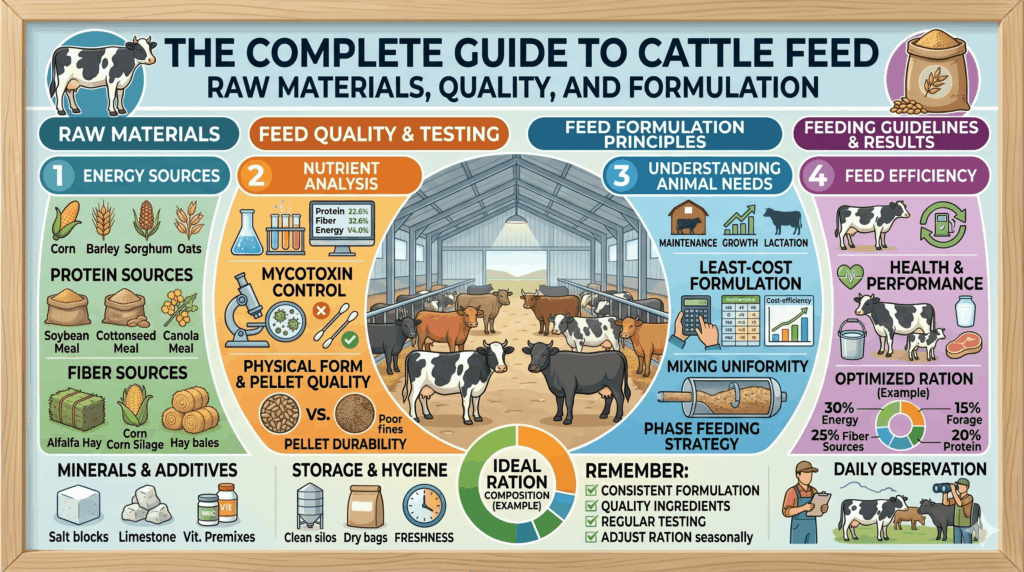
Cattle feed isn’t just something cows eat to fill up. For feed millers and manufacturers, it’s a carefully built mix where every ingredient is picked for what it adds, how steady it stays, and what it costs. And here’s the truth of it: your feed can only ever be as good as what goes into it. Weak raw materials, weak feed. It’s that simple.
So this guide walks you through the basics what actually goes into cattle feed, which raw materials carry the most weight, and the quality checks that separate a solid batch from a shaky one
What Cattle Feed Is Made Of?
A balanced cattle ration is built from a few core nutritional groups. Feed formulators combine these to hit target levels of energy, protein, fibre, and minerals — often working to the broad specifications laid out in standards like BIS IS 2052 for compounded cattle feed.
- Energy sources — provide the calories cattle need for maintenance, growth, and milk production.
- Protein sources — supply amino acids essential for muscle development and milk yield.
- Fibre sources — support rumen function and digestion.
- Minerals and additives — fill micronutrient gaps and stabilise the ration.
The formula is only ever as strong as the inputs behind it.
Key Raw Materials and What They Deliver
Most commercial cattle feed relies on agro-industrial by-products. These deliver concentrated nutrition at a workable cost, which is exactly why millers depend on a steady supply of consistent material. Typical crude protein ranges give a sense of where each one fits:
- Maize DDGS — a strong energy- and protein by-product, usually around 26–30% crude protein, with reliable consistency batch to batch.
- Rice DDGS — a regionally available alternative that often runs higher in protein, in the 40%+ range, and fits well into North Indian formulations.
- Soya DOC (De-oiled Cake) — one of the most valued plant proteins at roughly 45–48% crude protein, prized for its amino acid profile.
- Mustard DOC — a cost-effective protein source, commonly in the 35–38% range.
- DORB (De-oiled Rice Bran) — an energy-and-fibre contributor, typically 14–16% protein, useful for balancing rations economically.
- Maize Gluten and Rice Gluten — concentrated protein fractions used to lift the overall protein percentage of a mix.
A single ingredient is not enough. The formulator has to learn the combination of multiple components to reach the nutritional targets. Also focus on cost-controlling measures to optimise everything.
The Quality Benchmarks That Matter!
For a feed mill, raw material quality is not a nice-to-have. Variations in incoming material flow straight through to the finished feed. These are the checks that decide whether a lot is accepted or rejected at intake:
- Crude protein
The headline figure for any protein ingredient. Tight, repeatable values keep a formula stable.
- Moisture content
most millers reject material above roughly 11–12%, since excess moisture invites spoilage, shortens shelf life, and distorts the true nutrient value being paid for.
- Mycotoxin levels
Aflatoxin contamination is a serious risk in by-products. A common working threshold is rejection above around 20 ppb total aflatoxin, with dairy operations often applying tighter limits because of aflatoxin carry-over into milk.
- Fibre and ash content — indicators of purity and how much of the material is actually contributing nutrition versus filler.
- Oil content — relevant for de-oiled cakes and energy-dense ingredients, where residual oil affects both value and storage life.
When these numbers hold steady, formulators can lock in a recipe with confidence. When they swing, every batch becomes a guessing game.
What Consistency Looks Like on the Mill Floor?
If you supply raw materials, you learn to spot a problem lot early — usually well before it ever reaches the mixer. It shows up in small ways: the moisture reading when the truck is unloaded, the colour and smell of a DDGS consignment, or a protein result that comes back a point or two below what it should be.
And that one point matters more than you’d think. When inputs keep shifting, formulators have to add a safety margin and over-formulate just to be safe. That quietly pushes up cost and drags down your Feed Conversion Ratio (FCR).
Consistent material lets millers do the following:
- Hold nutritional specifications tightly, batch after batch.
- Cut costly reformulation between lots.
- Deliver predictable performance to their own customers.
In a competitive feed market, that reliability is often the difference between keeping a buyer and losing one.
Sourcing Raw Materials You Can Trust
The strongest feed formula still depends on a dependable supply chain. Millers need raw materials that arrive on spec, on time, and with traceable quality – ration after ration.
Brinda Foods manufactures and supplies a range of cattle feed raw materials like maize DDGS, rice DDGS, soya DOC, mustard DOC, DORB, maize gluten, and rice gluten. They supply feed millers and manufacturers across North India, with a focus on consistent, well-tested material that removes guesswork from the production line.
Final Thoughts
Cattle feed quality starts long before the mixer. For feed millers, the priorities stay the same:
- Choose ingredients that fit your nutritional and cost targets.
- Insist on tested, consistent quality at intake.
- Build supply relationships that keep your formulations stable over time.
Get the raw materials right, and everything will follow downstream. Formulation, FCR, and finished feed performance become far easier to control if you are on track with these things.

[…] you want the bigger picture on cattle feed first, read our guide to cattle feed raw materials, quality and formulation. This article is only about concentrate. What’s in it, why it matters and how much a cow […]
[…] We’ve written a longer checklist on cattle feed ingredients and quality standards. […]