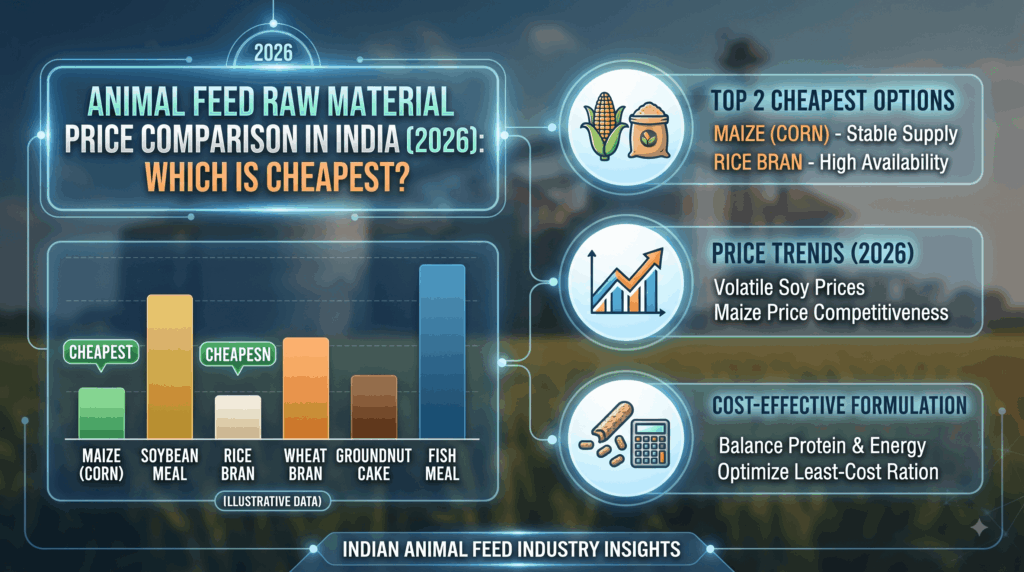
Quick answer: As of October 2026, feed-grade Maize/Corn DDGS is the cheapest raw material in the lineup at ₹12.5–15.5/kg, followed by DORB at ₹9–15/kg (though DORB is primarily an energy ingredient, not a protein source), Mustard DOC at ₹20–27/kg, Rice DDGS at ₹22–29/kg, Rice Gluten Meal at ₹30–36/kg, Maize Gluten Meal at ₹35–48/kg, and Soya DOC at ₹40–52/kg — currently the most expensive protein source in the market. But price per kg tells only half the story: once you normalize for protein content, Maize DDGS is actually the cheapest source of protein in this entire list, not just the cheapest ingredient. See the full breakdown below.
Rates move week to week with the underlying commodity cycle, so treat every figure here as a directional snapshot and confirm today’s rate with your supplier before booking.
Current Price Snapshot: All Major Feed Raw Materials (October 2026)
| Raw material | Price range | Crude protein | Primary role |
|---|---|---|---|
| Maize/Corn DDGS | ₹12.5–15.5/kg | 28–32% | Protein + energy (dual-purpose) |
| DORB (De-Oiled Rice Bran) | ₹9–15/kg | 12–16% | Energy + fibre, not a primary protein source |
| Mustard DOC | ₹20–27/kg | 35–38% | Secondary/alternative protein, ruminant-favoured |
| Rice DDGS | ₹22–29/kg | 25–30% (variable) | Protein + energy (dual-purpose) |
| Rice Gluten Meal | ₹30–36/kg (std.) | 45–50% | Concentrated protein, poultry/aquafeed |
| Maize Gluten Meal | ₹35–48/kg | 60% | Most concentrated protein source available |
| Soya DOC | ₹40–52/kg | 44–48% | Primary/reference protein source |
All figures are bulk, feed-grade rates as of October 2026. Premium, low-moisture, or lab-verified lots run toward the top of each range or higher; retail/small-lot listings elsewhere on the web often run above these bulk figures. Sources and individual price-driver breakdowns are linked in each ingredient’s dedicated guide below.
Which Ingredient Actually Gives You the Best Value? (Cost Per Kg of Protein)
Comparing raw materials on price-per-kg alone is misleading, because a cheap ingredient with low protein content can cost more per unit of actual nutrition delivered than an expensive one with high protein content. Normalizing each ingredient’s midpoint price against its midpoint crude protein gives a fairer picture:
| Raw material | Approx. cost per kg of protein | How it compares |
|---|---|---|
| Maize/Corn DDGS | ~₹47/kg protein | Cheapest protein in the entire lineup — despite being a “low-protein” ingredient on paper |
| Mustard DOC | ~₹64/kg protein | Meaningfully cheaper than Soya DOC per unit of protein |
| Rice Gluten Meal | ~₹69/kg protein | Comparable to Mustard DOC once normalized, despite a much higher headline price |
| Maize Gluten Meal | ~₹69/kg protein | Same story — high sticker price, competitive cost-per-protein |
| Rice DDGS | ~₹93/kg protein | More expensive per unit of protein than its low sticker price suggests, due to variable, often lower protein content |
| Soya DOC | ~₹96/kg protein | The most expensive protein source per kg of protein delivered, even before accounting for 2026’s elevated soymeal market |
DORB is intentionally excluded from this table — at 12–16% crude protein, it’s bought primarily as an energy and bulking ingredient, not evaluated as a protein source, so a cost-per-protein comparison would be misleading.
The standout finding: Maize DDGS is not just the cheapest ingredient on the shelf, it’s the cheapest source of protein, period — roughly half the cost per unit of protein of Mustard DOC and a full third the cost of Soya DOC. That’s the core reason more Indian feed mills have been formulating DDGS into rations that used to lean almost entirely on soya, especially with soybean meal still trading at elevated 2026 levels.
Why These Prices Look the Way They Do in 2026
This year’s price spread is unusually wide by historical standards, and it traces back to one dominant story: India’s 2025–26 soybean crop came in roughly 17% below the prior year, pushing soymeal (Soya DOC) prices up more than 40% in a matter of weeks and pulling the entire protein complex higher in sympathy. Full detail in our soybean meal crisis explainer.
DDGS and gluten meal prices, by contrast, are tied to a completely different supply chain — ethanol and starch processing output — which didn’t face the same shortage, which is exactly why the gap between Soya DOC and everything else has widened so much this year. Meanwhile, a record 2025–26 kharif maize harvest has kept DORB’s key substitute (maize) relatively affordable, holding DORB itself near the bottom of the price table.
How to Use This Table When You’re Actually Buying
1. Match the ingredient to the job, not just the price. DDGS and Rice DDGS supply protein and energy together; DORB supplies energy and bulk with almost no protein; Soya DOC, Mustard DOC, and the gluten meals are protein-first ingredients with very different inclusion-rate ceilings. Cheapest-per-kg is meaningless if the ingredient can’t do the job your ration needs.
2. Run the cost-per-protein math on your own quotes, not just this table. Supplier quotes shift week to week — take whatever price you’re quoted, divide by the confirmed crude protein percentage (from a lab report, not the label), and compare that number, not the headline ₹/kg.
3. Check inclusion-rate ceilings before you commit to a blend. Mustard DOC’s glucosinolates, DDGS’s fibre load, and gluten meal’s amino acid profile all cap how much of your ration each one can realistically replace — see our DDGS vs Soya DOC vs Mustard DOC vs DORB comparison guide for species-specific inclusion rates.
4. Confirm moisture and mycotoxin risk, especially on the cheaper end of any range. Lower-priced lots are sometimes cheaper because of higher moisture or lower-grade processing, not because you found a better deal — always request a Certificate of Analysis (COA).
5. Lock in contract pricing if you’re a regular multi-tonne buyer. Every ingredient in this table shows a meaningful spread between spot/retail and contract/bulk pricing — the numbers above are bulk feed-grade rates, and regular buyers typically do better still.
Dig Deeper Into Any Single Ingredient
Each raw material above has its own dedicated price guide with the full driver analysis, regional variation, and buying tips:
- Maize DDGS Price in India (2026)
- Rice DDGS Price in India (2026)
- Soya DOC Price in India (2026)
- Mustard DOC Price in India (2026)
- DORB Price in India (2026)
- Maize Gluten Meal Price in India (2026)
- Rice Gluten Meal Price in India (2026)
Frequently Asked Questions
Which animal feed raw material is cheapest in India right now? By price per kg, DORB (₹9–15/kg) and Maize/Corn DDGS (₹12.5–15.5/kg) are the cheapest. But DORB is an energy/fibre ingredient, not a protein source — for cost per kg of protein specifically, Maize DDGS is the cheapest by a wide margin at roughly ₹47/kg of protein.
Is Soya DOC or Mustard DOC better value in 2026? Mustard DOC is meaningfully better value per unit of protein (~₹64/kg protein vs. ~₹96/kg protein for Soya DOC) as of October 2026, given how far soymeal prices have risen this year. Soya DOC still has the strongest amino acid profile of the two, so the trade-off is cost against formulation quality, not a straight swap.
How do I compare feed ingredient prices fairly? Don’t compare ₹/kg alone. Divide the confirmed crude protein percentage (from a lab report) into the price to get cost per kg of protein, which is the number that actually reflects value for protein-first ingredients. For energy ingredients like DORB, compare against maize or other energy sources instead.
Why is Soya DOC so much more expensive than DDGS or gluten meal in 2026? Soya DOC tracks India’s soybean crop, which came in roughly 17% short in 2025–26, pushing prices up more than 40% in weeks. DDGS and gluten meal track a separate supply chain — ethanol and starch processing — that wasn’t affected by the soybean shortfall, which is why the price gap has widened so much this year.
Where can I get current bulk pricing across all these raw materials? Brinda Foods supplies Maize DDGS, Rice DDGS, Soya DOC, Mustard DOC, and DORB in bulk from Panipat, Haryana. Request a current bulk quote — pricing is confirmed at time of order given weekly rate movement.
About Brinda Foods
Brinda Foods has supplied animal feed raw materials from Panipat, Haryana since 1987. We provide bulk supply of Soya DOC, Maize DDGS, Rice DDGS, De-Oiled Rice Bran (DORB), Mustard DOC, and other feed ingredients to mills and farms across India. ISO 9001:2015 certified.
Get today’s bulk quote: Request a quote or contact our team.

[…] Feed Price in IndiaBroiler Feed Price IndiaCattle Feed Price in IndiaMaize Price Per Kg India 2026Feed Raw Material Price Comparison IndiaCorn DDGS Price India 2026Rice Gluten Meal Price India 2026Dorb Price In India 2026Maize Gluten Meal […]
[…] Feed Price in IndiaBroiler Feed Price IndiaCattle Feed Price in IndiaMaize Price Per Kg India 2026Feed Raw Material Price Comparison IndiaCorn DDGS Price India 2026Rice Gluten Meal Price India 2026Dorb Price In India 2026Maize Gluten Meal […]
[…] work out cheaper per kg of protein than a lower priced 44% lot travelling twice the distance. Our feed raw material price comparison and guide to reducing feed cost walk through this kind of maths in more […]