
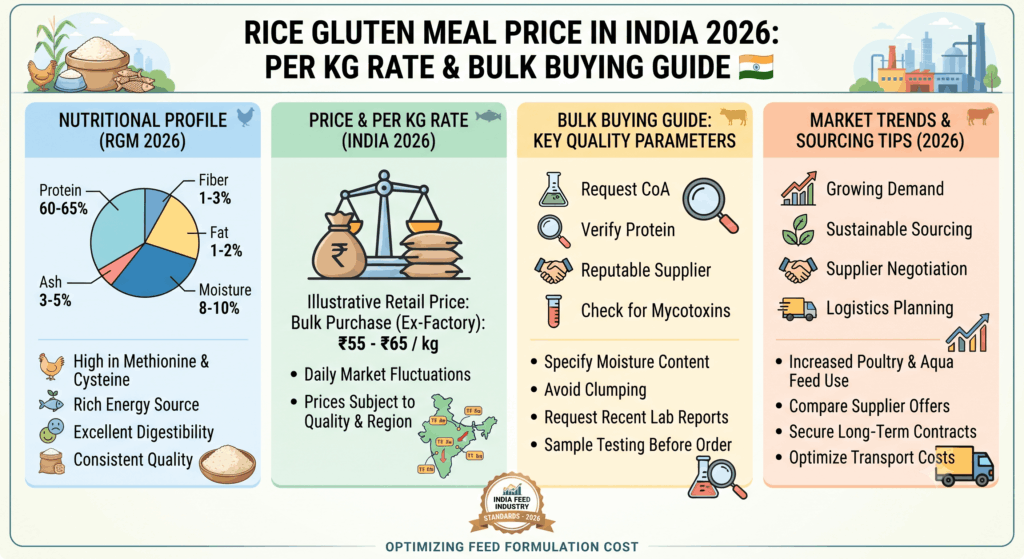
Rice gluten meal is still one of the least-standardised ingredients in the Indian feed trade, which means most feed millers asking “what’s the price?” get inconsistent answers depending on who they call. This guide lays out where pricing actually sits as of September 2026, what drives the swings, and how it stacks up against maize gluten meal and soya DOC on a cost-per-protein basis — the number that should actually decide your sourcing call.
Current Rice Gluten Meal Price (October 2026)
| Grade / Protein | Typical Price Range | Best Suited For |
|---|---|---|
| Standard bulk, 45–50% CP | ₹30–36/kg | Cattle, dairy, swine, aquafeed |
| Higher-protein lots, 50–60% CP | ₹36–44/kg | Poultry (broiler/layer), where digestibility matters |
| Verified, batch-tested premium grade | ₹44–48/kg | Feed mills needing consistent, lab-certified specification |
| Loosely graded / unverified regional supply | Wide, often below ₹30/kg | Not comparable — protein and moisture unverified |
Rice gluten meal is a genuinely regional commodity — supply is concentrated around rice wet-milling and starch-processing hubs in South and Southeast Asia, volumes are far lower than maize gluten meal, and processing methods vary noticeably between facilities. That makes pricing data thinner and swings sharper than for an established commodity like Soya DOC or DDGS. Treat the ranges above as directional and always confirm against a current lab-verified quote before ordering.
Quick Read: Maize Gluten Meal Price in India (October 2026)
Quick Read: Rice Gluten Meal for Poultry & Livestock Feed: Nutrition & Buying Guide
Why Rice Gluten Meal Pricing Is Harder to Pin Down Than Other Proteins
It’s a newer, less standardised category. Unlike Soya DOC or DDGS, which trade against fairly established benchmarks, rice gluten meal composition — protein, moisture, digestibility — can differ meaningfully between suppliers and even between shipments from the same supplier. That variability shows up directly in the price you’re quoted.
Supply is regional, not national. Rice gluten meal is produced where rice starch processing happens, concentrated in specific belts rather than spread evenly across India. Buyers further from those hubs pay a real freight premium on top of the base rate — the same dynamic seen with DORB relative to rice-milling regions.
Protein range is wider than a single number suggests. Depending on the supplier and processing method, crude protein can land anywhere from roughly 45% to 60%. A lot quoted at the low end of that range should not be priced the same as one verified at the high end, but in an under-standardised market, it sometimes is — which is exactly where buyers overpay.
Rice Gluten Meal vs. Maize Gluten Meal vs. Soya DOC: Cost Per Protein
Sticker price alone is misleading across these three ingredients because their protein content is so different. Cost per kilogram of protein delivered is the number that actually determines value.
| Ingredient | Typical Price (Aug 2026) | Crude Protein | Approx. Cost per kg of Protein |
|---|---|---|---|
| Soya DOC (standard bulk feed-grade) | ₹40–46/kg | 44–46% | ~₹96/kg protein |
| Rice Gluten Meal | ₹30–44/kg | 45–60% | ~₹74/kg protein |
| Maize Gluten Meal | ₹35–48/kg | 60% (±2%) | ~₹67/kg protein |
| Rice DDGS | ₹12.5–15.5/kg | 20–24% | ~₹60/kg protein |
Rice gluten meal lands between maize gluten meal and Soya DOC on cost-per-protein — cheaper than the soya benchmark, though not quite matching maize gluten’s protein density and price efficiency. Where it earns its place is less about beating maize gluten on paper and more about situations where maize gluten is priced out, in short supply, or where the formulation calls specifically for aquafeed, swine, or a more balanced lysine contribution — as covered in our Maize Gluten vs. Rice Gluten comparison.
What Determines the Price You Actually Pay
Crude protein verification. The single biggest swing factor. A 45% CP lot and a 58% CP lot are meaningfully different products commercially, even when both are marketed simply as “rice gluten meal” — always request a lab certificate rather than a supplier’s label claim.
Moisture and drying quality. Feed-grade material should be properly dried and stored; higher-moisture lots are cheaper up front but risk mould, spoilage, and reduced shelf life during monsoon storage.
Colour and texture consistency. A uniform brownish, coarse texture signals proper wet-milling; inconsistent batches usually mean inconsistent composition too.
Distance from processing hubs. Because supply is regional, freight from the nearest rice starch-processing centre is a real, often underestimated share of your delivered cost.
Order volume. As with every raw material in this category, single-bag or small-lot marketplace pricing overstates what mills and recurring bulk buyers should actually be paying.
How to Buy Rice Gluten Meal in Bulk Without Overpaying
1. Insist on a lab certificate for crude protein, moisture, and fibre before comparing quotes. In a category this under-standardised, the certificate — not the label — is the real product spec.
2. Compare cost per kg of protein against your current maize gluten or Soya DOC spend, not sticker price alone. That’s the number that tells you whether switching actually saves money.
3. Ask for batch-specific digestibility data where available, particularly for poultry formulations, since digestibility varies more here than for established commodities.
4. Source from a supplier with a traceable, consistent process. Given how much composition can vary facility to facility, supplier consistency matters more for rice gluten meal than for almost any other ingredient on a typical ration sheet.
5. Build in a freight check before finalising a quote. Regional supply means two suppliers quoting the same per-kg rate can land very differently once delivery is factored in.
Frequently Asked Questions
What is the current price of rice gluten meal in India? As of October 2026, rice gluten meal trades roughly between ₹30–44/kg depending on crude protein content (45–60% CP), with verified, batch-tested premium lots running up to ₹44–48/kg. Pricing is less standardised than for Soya DOC or DDGS, so always confirm against a current lab-verified quote.
Is rice gluten meal cheaper than maize gluten meal? On a straight per-kg basis, ranges overlap closely. On a cost-per-protein basis, maize gluten meal is generally more efficient (~₹67/kg protein vs. ~₹74/kg protein for rice gluten meal) because of its higher, more consistent crude protein content.
Why does rice gluten meal pricing vary so much between suppliers? Because it’s a newer, more regional commodity with less standardised processing — protein content, moisture, and digestibility can all differ meaningfully by supplier and even by shipment, which drives a wider price range than established ingredients.
Can rice gluten meal replace soybean meal or Soya DOC? It can serve as a partial protein substitute, particularly in poultry, aquaculture, and swine formulations, but full replacement requires checking amino acid balance — rice gluten meal’s protein content and profile differ from Soya DOC’s.
Where can I get a bulk quote for rice gluten meal? Brinda Foods supplies Rice Gluten in bulk from Panipat, Haryana, to feed mills across North India, with every batch lab-tested for protein, moisture, and aflatoxin before dispatch. Send an enquiry for a current bulk quote.

[…] IndiaMaize Price Per Kg India 2026Feed Raw Material Price Comparison IndiaCorn DDGS Price India 2026Rice Gluten Meal Price India 2026Dorb Price In India 2026Maize Gluten Meal Price India 2026Soya Doc Price India 2026Maize DDGS Price […]
[…] IndiaMaize Price Per Kg India 2026Feed Raw Material Price Comparison IndiaCorn DDGS Price India 2026Rice Gluten Meal Price in India 2026Dorb Price in India 2026Maize Gluten Meal Price India 2026Soya Doc Price India 2026Maize DDGS Price […]
[…] IndiaMaize Price Per Kg India 2026Feed Raw Material Price Comparison IndiaCorn DDGS Price India 2026Rice Gluten Meal Price India 2026Dorb Price In India 2026Maize Gluten Meal Price India 2026Soya Doc Price India 2026Maize DDGS Price […]
[…] Price in IndiaCorn DDGS Price India 2026Rice Gluten Meal Price IndiaMaize DDGS Price IndiaRice DDGS Price IndiaSoya Doc Price in […]
[…] Price in IndiaCorn DDGS Price India 2026Rice Gluten Meal Price IndiaMaize DDGS Price IndiaRice DDGS Price IndiaSoya Doc Price in […]
[…] Price in IndiaCorn DDGS Price India 2026Rice Gluten Meal Price IndiaMaize DDGS Price IndiaRice DDGS Price IndiaSoya Doc Price in […]