Industry experience holders know a significant difference between the broiler and layer feed. Bags might look the same, but the formulas behind the products go in two different directions. One product is focusing on the slaughtering in a few weeks, while the other one ensures the consistent laying cycles in birds.
If you are making neither of these options, then there is a gap between these, and you must know that your mistakes may cost you more money. So be careful about things, and manage everything smoothly.
Let’s get into the details below and understand how these two are different!
Two Birds, Two Completely Different Jobs
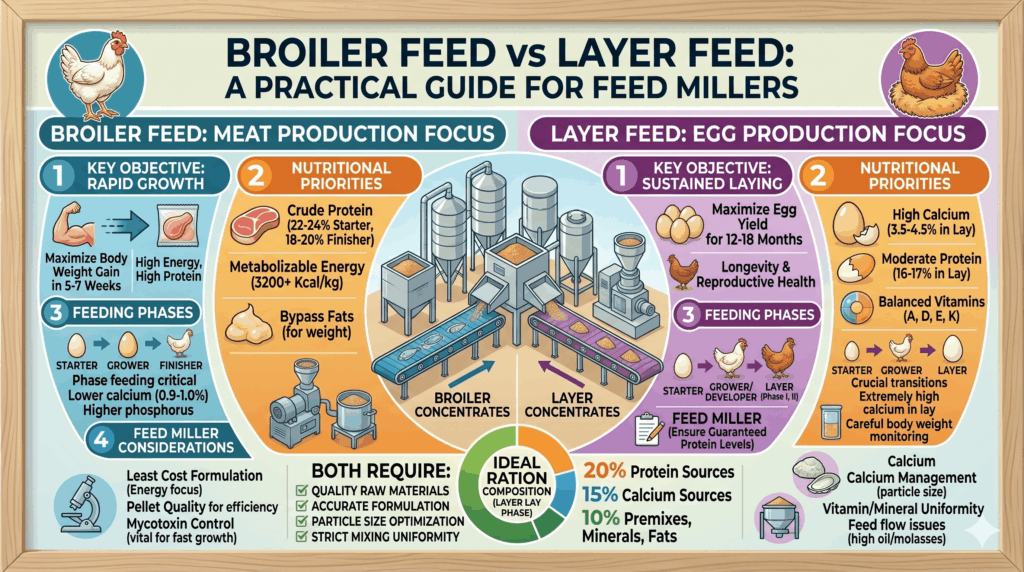
The broiler category demands to gain weight fast, like a sprint which focuses on speed. A layer exists to produce eggs, consistently, over a long haul. Everything in the ration is determined accordingly. .
For instance, if you feed a high-calcium layer ration to broilers, you’ll see it in poor growth and wasted feed cost. The two simply aren’t interchangeable.
- Broiler feed focuses on energy, protein, and a tight FCR.
- Layer feed is the storyline of calcium, balanced protein, and shell integrity that holds up egg after egg.
Broiler Feed: Speed Is the Whole Game
With broilers, every point of FCR matters to the profit ratio. That’s why these rations are phased. The bird needs at day three isn’t what it needs at day thirty. You have to check the cycle, and accordingly, feed to them. This is how things work smoothly, or else you will see the poor results and will think about where you lag behind.
Quick Read: Best Protein Supplement for Broiler Feed in India
A typical broiler programme runs roughly like this:
- Starter: high crude protein, often around 22–23%, to push early frame and muscle development
- Grower: protein eases slightly while energy stays high
- Finisher: protein settles near 18–20% as the bird fills out before market
A few things millers tend to watch closely:
- Metabolisable energy has to stay high throughout
- Lysine and methionine balance drives actual muscle gain, not just paper protein
- Calcium stays modest—there’s no shell to build here
Maize usually anchors the energy side, and the protein meals do the heavy lifting on growth. The trick is hitting those numbers without letting cost per tonne run away from you.
Layer Feed: Built to Last the Whole Cycle
Layer feed is meant for the complete cycle of production, not just a short story of power. The hen is productive for twelve months or more, and the layer feed has to support thousands of eggs. It also has to maintain the shell quality, falling apart somewhere in month eight.
What sets layer feed apart?
- Crude protein sits lower, generally 16–18%
- Calcium climbs to roughly 3.5–4.5%—this is the single biggest difference from broiler feed
- Phosphorus and vitamin D have to be balanced right, or all that calcium won’t get absorbed properly
- Energy stays steady, enough to maintain output without packing on fat
And this is where a lot of mills get caught out. Over a cycle this long, you can’t treat raw material consistency as an option. The problem is, when protein drifts or moisture runs high, nothing goes wrong right away. It quietly shows up weeks later as thinning shells, and by then you’re stuck working backwards. Now you have to try to figure out where it started.
Where Do Raw Materials Quietly Decide Everything?
A perfect formulation on the spreadsheet counts for nothing if the raw materials showing up at the mixer don’t match their specification. So you have to be aware about details and make the feed quality up the mark. And this is how you can do better. However, there are certain mistakes that may bring the hassles ahead:
The usual culprits are familiar to anyone in the trade:
- Crude protein that swings batch to batch
- Moisture that’s higher than declared
- Mycotoxin loads that creep in through poorly stored ingredients
This is the unglamorous reality of feed milling. The formulation gets the credit, but the raw materials decide whether it actually performs.
That’s why ingredient sourcing matters as much as the recipe:
- Soya DOC and Mustard DOC carry the protein for both growth and laying
- DDGS, both maize and rice, help balance energy and protein while keeping cost in check
- DORB brings energy and fibre into the mix
- Maize Gluten and Rice Gluten give you concentrated protein when the formulation needs tightening
How Brinda Foods Fits In
Brinda Foods is a raw material manufacturer and supplier working with feed millers and manufacturers across North India. The role is deliberately narrow and the focus is consistency: supplying raw feed materials with specifications you can actually formulate around.
The range covers most of what a poultry-feed mill reaches for:
- Maize DDGS and Rice DDGS
- Soya DOC and Mustard DOC
- DORB
- Maize Gluten and Rice Gluten
For a miller, the value isn’t complicated. When crude protein, moisture, and mycotoxin control stay predictable from one delivery to the next, formulation gets easier and your finished feed stops surprising you.
The Takeaway
Broiler and layer feed split apart on the things that matter most—protein phasing, energy density, and calcium. One feeds a bird sprinting to market weight; the other feeds a hen in it for the long run.
But deep down, both sit with the same requirement: raw materials you can trust, batch after batch. Sort that out, and half the formulation battle is already won. Also educate your staff members about the differences so that they also do not leave a stone unturned in the field and let you earn more profits ahead.
Also Check: How Much DDGS to Include in Dairy Cattle Feed: Rates, Benefits & Practical Guidelines