
Nobody buys DDGS because it is exciting. You buy it because it works — or you stop buying it when it stops working.
The shift happening right now across Indian compound feed operations is straightforward: rice DDGS has become cheap enough, available enough, and consistent enough to sit alongside maize DDGS as a genuine formulation option. Not a compromise. An option.
But they are not the same ingredient wearing different labels. What follows is a practical comparison where there is no filler, no generic nutrition textbook content written for the people actually making formulation and sourcing decisions.
Start Here: Why the Base Grain Changes Everything
Maize is a starch grain. Most of that starch leaves during fermentation, and what concentrates in the DDGS fraction is protein, fat, fibre, and whatever else the kernel carried.
Rice is different in structure. The bran layer is heavier relative to the grain. When rice goes through distillation, that bran fraction concentrates sharply and you end up with a DDGS that behaves more like a fibre-energy ingredient than a protein ingredient.That single structural difference explains most of what follows.
Protein: The Number Everyone Checks First
Fair enough. Here it is.
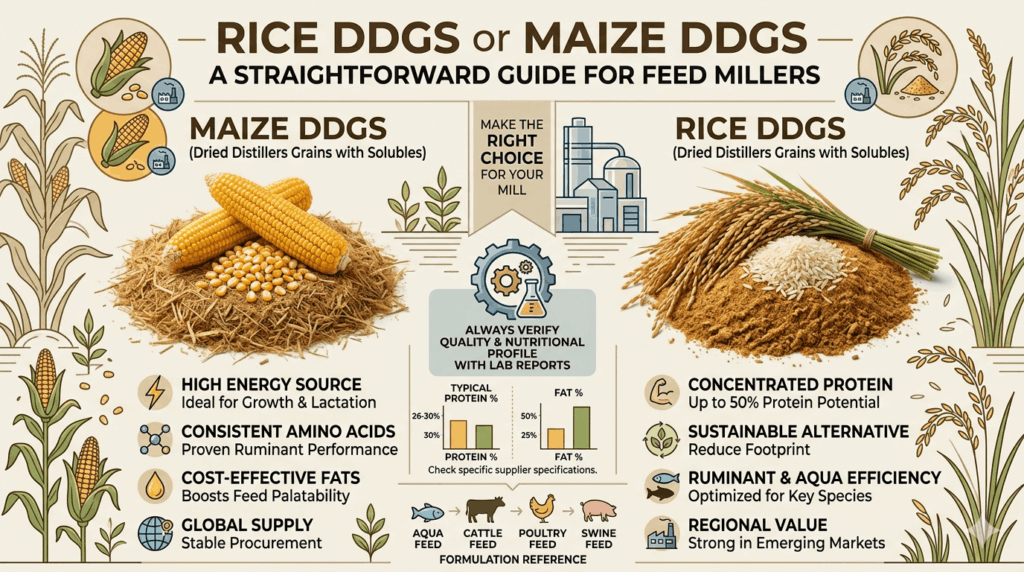
- Maize DDGS lands between 26–30% crude protein on a dry matter basis — consistently, across most origins
- Rice DDGS comes in at 16–22%, with more batch variation than maize
The lysine story matters too. Rice DDGS has a weaker amino acid profile relative to its protein percentage. In broiler and swine diets where you are running tight amino acid matrices, that deficit does not disappear. It gets transferred to another ingredient in the formula.
Maize DDGS is the stronger protein contributor. That is settled.What is less settled is whether protein is the right lens for evaluating rice DDGS at all. Most mills using it are not buying it for protein. They are buying it for something else entirely.
Fibre: The Characteristic That Defines Rice DDGS
This is the number that actually governs how rice DDGS behaves in a diet.
- Rice DDGS crude fibre: 10–14%
- Maize DDGS crude fibre: 7–10%
Four percentage points does not sound dramatic until you are watching FCR move in a broiler house. In poultry and finishing pig diets, fibre above threshold starts costing you digestibility drops, energy availability falls, and performance metrics follow.
Ruminant diets are a different story. That fibre fraction is not a liability in a dairy or beef ration — it is a structural contributor. Rice DDGS fits naturally alongside silage and roughage without forcing you to reformulate the whole diet. The species you are feeding determines whether this number works for you or against you.
Fat: The Energy Opportunity With a Catch
Rice DDGS runs higher on fat than most millers expect — and higher than maize DDGS.
- Rice DDGS fat content: 10–16%, predominantly unsaturated fatty acids from rice bran oil
- Maize DDGS fat content: 8–12%, higher in linoleic acid
The energy contribution from rice DDGS fat is real and usable. In ruminant diets especially, that fat fraction adds metabolisable energy without adding starch, which is often exactly what a dairy formulator wants.
The catch is storage. Unsaturated fat oxidises. In warm conditions — and Indian summers are not mild — rice DDGS batches that sit develop rancidity well before anything looks wrong visually. Palatability takes the hit first. By the time there is an odour issue at the mill, the batch has already done its damage.
FIFO rotation, covered storage, and antioxidant inclusion are not optional if rice DDGS is a regular ingredient for you. Treat it like the high-fat raw material it is.
Xanthophylls: The Reason Poultry Nutritionists Pay Attention
Maize DDGS has xanthophylls. Rice DDGS from pigmented varieties has more — and more reliably.
Xanthophylls deposit in egg yolk and broiler skin. If your customer is measuring yolk colour or paying a premium for skin pigmentation, that is a specification you are managing, not a nice-to-have.
- Rice DDGS from the right origin and variety delivers consistent xanthophyll levels that contribute meaningfully to pigmentation targets
- Maize DDGS xanthophyll content shifts with processing temperature, variety, and storage. Here is less predictable as a pigmentation tool.
- This advantage disappears entirely if you are not verifying xanthophyll levels on the COA. Do not assume, confirm the aspects.
For broiler and layer operations where pigmentation is part of the product spec, rice DDGS earns its place on the ingredient list for this reason alone.
Inclusion Rates: What Actually Works in Practice
- Broilers: Rice DDGS 5–10% / Maize DDGS 10–15%
- Layers: Rice DDGS 8–12% / Maize DDGS 10–15%
- Finishing pigs: Rice DDGS 5–10% / Maize DDGS 15–20%
- Dairy cattle: Rice DDGS 10–20% / Maize DDGS 15–25%
Push past these ranges without adjusting the rest of the matrix, and something gives — usually FCR, sometimes palatability, occasionally pellet quality.
These are not conservative recommendations for caution’s sake. They reflect where the ingredient stops contributing and starts competing with performance.
Mycotoxins: Both Sources Carry Risk, Neither Gets a Free Pass
Distillation concentrates. Whatever mycotoxin load the grain carried into the process comes out multiplied in the DDGS fraction. This is physics, not a supplier problem.
- Maize DDGS: aflatoxin, DON, and fumonisin risk — amplified significantly in difficult crop years
- Rice DDGS: lower baseline risk, but aflatoxin from paddy storage is documented and real in some origins
A COA from your supplier is a starting reference. It is not a substitute for incoming goods testing at your facility. If your mycotoxin control protocol relies entirely on paperwork, it is not a protocol.
The Actual Decision
If protein is the primary driver — monogastric diets, tight amino acid specs — maize DDGS is the more straightforward choice.
If you are formulating ruminant diets, managing pigmentation targets in poultry, or working to a cost optimisation brief where the fat-energy contribution of rice DDGS makes the numbers work rice DDGS belongs in the conversation.
The ingredient that belongs in your formulation is the one with the specification data to back it up. Not averages. Not range estimates. Actual batch COAs covering crude protein, crude fat, crude fibre, moisture, and mycotoxin screening.
Brinda Foods supplies both rice DDGS and maize DDGS to feed millers and compound feed manufacturers across India. Reach out to our team for current batch specifications, origin details, and inclusion rate guidance for your target species.


[…] contribution as maize DDGS, which matters if yolk colour is part of your buyer specification. Our Rice DDGS and Maize DDGS comparison for feed millers sets out where each one […]