
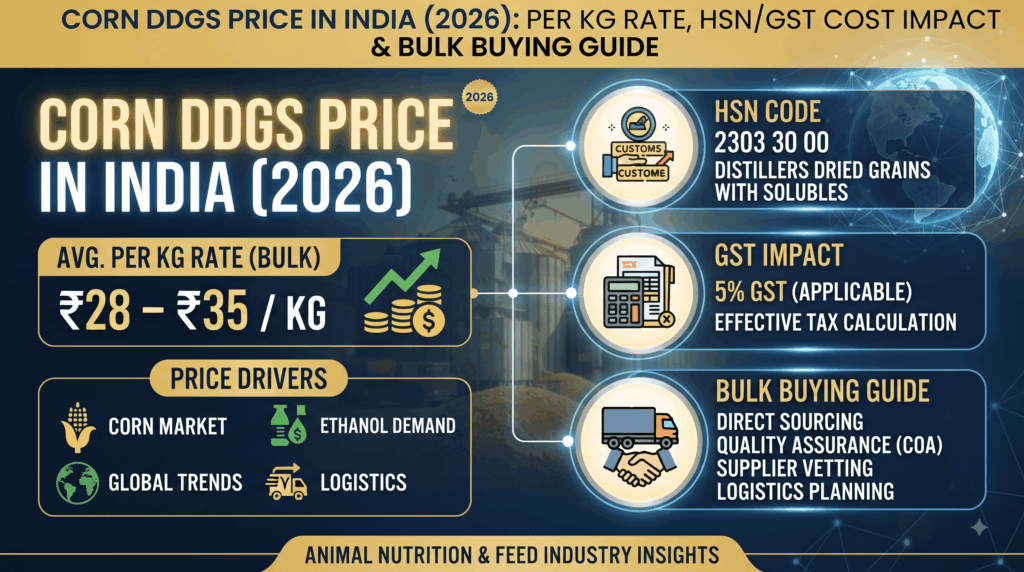
Quick answer: As of October 2026, Corn DDGS trades between ₹22-25/kg (roughly ₹13,000–16,000/tonne) for bulk feed-grade material (28–32% crude protein) in India — with listings as low as ₹12.5/kg near maize-ethanol hubs like Gujarat and up to ₹15.5/kg or higher elsewhere. Corn DDGS is also called Maize DDGS in Indian trade — the same product, same price band — so don’t treat quotes under either name as separate ingredients. Add 5% GST (HSN 2303 30 00) when calculating landed cost, since corn DDGS doesn’t fall under the nil-rated animal feed category some buyers assume.
Corn DDGS Price Snapshot (October 2026)
| Source / Grade | Typical Price Range | Notes |
|---|---|---|
| Bulk feed-grade, near ethanol hubs (e.g. Gujarat) | ₹12.5–13.5/kg | Lower freight cost close to producing plants |
| Standard bulk listings (pan-India average) | ₹13–15/kg | Most common range on trade platforms |
| Premium / consistent-grade, farther from plant | ₹15–15.5/kg | Higher freight, or tighter local supply |
| Contract / multi-tonne mill-direct | Lower end, negotiated further on volume | Best pricing for large, recurring orders |
These figures reflect feed-grade corn DDGS at 28–32% crude protein. Rice DDGS is a separate product with a different protein profile and price band (see comparison below) — don’t compare a corn DDGS quote against a rice DDGS quote without adjusting for the protein difference.
India’s DDGS market is valued at roughly USD 197.5 million in 2026, projected to reach USD 337.6 million by 2031 — an 11.3% CAGR — as more feed formulators treat it as a mainstream ingredient.
Why Corn DDGS Pricing Matters More Than Usual Right Now
If you’ve priced soybean meal recently, you already know the backdrop: a roughly 17% drop in India’s 2025–26 soybean crop pushed soybean meal prices up more than 40% in a matter of weeks, past ₹65/kg at the peak, before easing somewhat as the new sowing season progressed — though it remains historically elevated. Feed mills are actively re-evaluating cost-effective protein and energy alternatives, and corn DDGS, long treated as a niche ingredient, is getting a much closer look.
Cost per kg of protein — the number that matters more than the sticker price. At current prices, soybean meal works out to roughly ₹126 per kg of actual protein delivered. Corn DDGS works out to roughly ₹47 per kg of protein — less than half, and closer to a third at soybean meal’s recent highs. The caveat: corn DDGS has a weaker amino acid profile (particularly lysine) than soybean meal, so it’s a partial replacement, typically needing synthetic amino acid supplementation, not a straight swap.
How HSN Code & GST Affect Your Landed Corn DDGS Cost
This is a step buyers frequently miss when comparing quotes. Corn DDGS is classified under HSN 2303 30 00 (“brewing or distilling dregs and waste”) and attracts 5% GST, following the CBIC’s clarification after the 45th GST Council meeting. Some suppliers had previously — incorrectly — billed DDGS under HSN 2309 (prepared animal feed), which historically carried a nil rate.
What this means practically:
- A quote of ₹14/kg ex-GST becomes roughly ₹14.70/kg landed once 5% GST is added — build this into your budget rather than comparing raw ex-GST quotes across suppliers.
- If a supplier’s invoice shows a different HSN code or a nil GST rate, ask why — it could indicate a classification error that creates input tax credit complications down the line, not necessarily a genuine cost saving.
- For the full HSN code detail, GST classification history, and how it applies to export documentation, see our complete Corn DDGS guide.
Corn DDGS vs Soybean Meal vs Maize: Price Positioning
| Ingredient | Price (October 2026) | Protein | Primary Role |
|---|---|---|---|
| Soybean Meal | ₹57–66/kg (eased from a ₹65–66/kg peak) | 44–48% | Protein |
| Maize (Corn) | ₹18–22/kg | ~8–9% | Energy |
| Corn DDGS | ₹12.5–15.5/kg | 28–32% | Protein + Energy |
Corn DDGS undercuts whole maize on price despite carrying far more protein — a reflection of its status as a co-product rather than a primary crop commodity.
Quick Check: Corn DDGS Manufacturers in India (2026): How to Find & Vet a Reliable Bulk Supplier
Corn DDGS Price vs. Rice DDGS Price
Buyers evaluating both DDGS types often assume the higher-protein option costs proportionally more — that’s not quite how it plays out:
| Parameter | Corn DDGS | Rice DDGS |
|---|---|---|
| Typical Price (Aug 2026) | ₹12.5–15.5/kg | ₹22–29/kg |
| Crude Protein | 28–32% | 40–45% |
| Approx. cost per kg of protein | ~₹47/kg protein | ~₹58–65/kg protein |
| Regional Sourcing | Maize-ethanol hubs (e.g. Gujarat) | Rice-processing belts, wider regional spread |
Rice DDGS commands a meaningfully higher price per kg because of its much higher protein concentration — but on a cost-per-kg-of-protein basis, corn DDGS is still the more economical option for buyers who don’t specifically need rice DDGS’s higher protein density. The right choice depends on your ration’s protein target, not just the headline price. See our Rice DDGS price guide for the full pricing breakdown on that side of the comparison.
What Determines the Corn DDGS Price You Actually Pay
Proximity to the producing ethanol plant. Gujarat, in particular, tends to see lower corn DDGS prices given the density of maize-ethanol plants there. As with most bulk feed ingredients, freight becomes a bigger share of delivered cost the further you are from the source.
Protein grade and moisture. Corn DDGS should test in the target 28–32% crude protein band with moisture controlled below 12% to avoid spoilage risk in storage. Lots priced noticeably below range are worth checking against a lab certificate before committing to volume.
Order volume and contract terms. Multi-tonne and recurring-supply contracts consistently price below single-lot spot purchases.
GST and invoicing accuracy. As covered above, confirm HSN 2303 30 00 and 5% GST are correctly applied — this is a real component of landed cost, not a formality.
How to Buy Corn DDGS in Bulk Without Overpaying
- Ask for the Certificate of Analysis, not just a quoted price. Protein %, moisture, and fat content tell you whether a lower quote is genuinely a better deal or a lower grade.
- Confirm whether you’re buying corn (maize) DDGS or rice DDGS. The two are priced and formulated differently — don’t compare quotes across product types.
- Check the GST rate and HSN code on the quote. 5% GST under HSN 2303 30 00 is the correct classification; a mismatched invoice is worth questioning.
- Factor in amino acid supplementation cost when comparing to soybean meal. Corn DDGS is far cheaper per kg, but a fair cost comparison should include any synthetic lysine or methionine needed to balance the ration.
- Source close to maize-ethanol-producing regions where practical. Freight has an outsized effect on delivered cost given DDGS’s bulk weight.
- Lock in contract pricing if your monthly volume is steady. Mills that lock in DDGS supply agreements insulate part of their ration cost from further volatility.
Frequently Asked Questions
What is the current corn DDGS price per kg in India? As of October 2026, corn DDGS trades between ₹12.5–15.5/kg (roughly ₹13,000–16,000/tonne) for bulk feed-grade material, with pricing depending on protein grade, moisture, and proximity to the producing ethanol plant.
Is corn DDGS price the same as maize DDGS price? Yes. Corn and maize DDGS are the same product under two different names — the same price band applies regardless of which term a supplier uses in their listing.
How does GST affect the corn DDGS price I pay? Corn DDGS falls under HSN 2303 30 00 and attracts 5% GST. A quoted ex-GST price of ₹14/kg becomes roughly ₹14.70/kg landed — factor this into your cost comparison across suppliers.
Why is corn DDGS cheaper than rice DDGS? Primarily because rice DDGS carries substantially higher protein (40–45% vs. 28–32%). On a cost-per-kg-of-protein basis, the gap narrows considerably, and corn DDGS often remains the more economical choice unless your ration specifically needs rice DDGS’s higher protein density.
How much corn DDGS can I include in feed formulations? Typical inclusion is 5–10% in poultry starter and grower diets (up to 15% with lysine supplementation), 15–20% of dry matter in dairy cattle rations, and up to 20–25% in beef cattle and buffalo diets.
Where can I get a bulk quote for corn DDGS? Brinda Foods supplies corn (maize) DDGS in bulk from Panipat, Haryana, to feed mills and integrators across India, and exports to 25+ countries. Request a current bulk quote — pricing is confirmed at time of order given how quickly the market is moving in 2026.
About Brinda Foods
Brinda Foods has supplied animal feed raw materials from Panipat, Haryana, since 1987. We provide bulk supply of Maize (Corn) DDGS, Rice DDGS, De-Oiled Rice Bran (DORB), Soya DOC, and Mustard DOC to mills and farms across India. ISO 9001:2015 certified, GAFTA & FOSFA compliant.
Get today’s bulk quote: brindafoods.com/maize-ddgs | Call: [9992500442]

[…] pricing a specific type rather than the category as a whole, our type-specific guides go deeper: Corn/Maize DDGS price breakdown and Rice DDGS price […]
[…] IndiaCattle Feed Price in IndiaMaize Price Per Kg India 2026Feed Raw Material Price Comparison IndiaCorn DDGS Price India 2026Rice Gluten Meal Price India 2026Dorb Price In India 2026Maize Gluten Meal Price India 2026Soya Doc […]
[…] Price in IndiaCorn DDGS Price India 2026Rice Gluten Meal Price IndiaMaize DDGS Price IndiaRice DDGS Price IndiaSoya Doc Price in […]
[…] Price in IndiaCorn DDGS Price India 2026Rice Gluten Meal Price IndiaMaize DDGS Price IndiaRice DDGS Price IndiaSoya Doc Price in […]
[…] Price in IndiaCorn DDGS Price India 2026Rice Gluten Meal Price IndiaMaize DDGS Price IndiaRice DDGS Price IndiaSoya Doc Price in […]
[…] Price in IndiaCorn DDGS Price India 2026Rice Gluten Meal Price IndiaMaize DDGS Price IndiaRice DDGS Price IndiaSoya Doc Price in […]