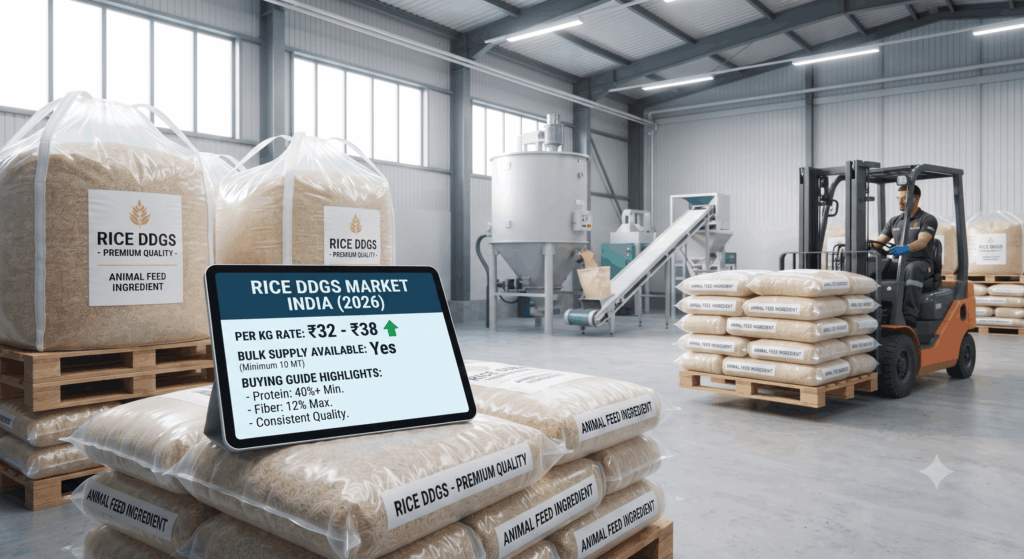
Quick answer: As of September 2026, Rice DDGS (Rice Distillers Dried Grains with Solubles) trades between ₹28–30/kg (roughly ₹22,000–29,000/tonne) for standard feed-grade bulk lots in India, with a handful of entry-level listings starting as low as ₹15–16/kg for lower-protein or higher-moisture material. Prices sit toward the lower end near rice-ethanol production hubs and climb for higher-protein, low-moisture, tightly specified lots.
If you buy Maize DDGS, Soya DOC, or DORB from us already, you’ve probably asked the same question about Rice DDGS — this guide breaks down what actually moves the price, how it stacks up against Maize DDGS, and what to check before you commit to a bulk order.
What Is Rice DDGS, and Why Is It Priced the Way It Is?
Rice DDGS is the dried, protein-and-fibre-rich co-product left over after rice grain is fermented to extract ethanol. Instead of discarding this material, ethanol plants dry it into a granular meal that feed millers can drop straight into cattle, poultry, and swine rations — much the same role Maize DDGS plays, but sourced from India’s much larger rice-milling base.
That supply base is exactly why the price behaves differently from Maize DDGS:
- India is a rice surplus economy first, a maize surplus economy second. More rice-ethanol capacity sits closer to the eastern and southern belts, so freight costs (and therefore delivered price) vary more by region than they do for maize-based DDGS.
- Protein content is more variable batch-to-batch than Maize DDGS, because it depends heavily on the fermentation process and the rice variety used upstream — this is the single biggest reason two “Rice DDGS” quotes from two different plants can differ by ₹5–7/kg.
- Demand is currently rising as a soybean meal substitute. With soybean meal trading above ₹65/kg through mid-2026 amid India’s soybean meal shortage, feed mills that had never sourced Rice DDGS before are now testing it — and that demand pressure has kept prices firmer than they were a year ago.
Rice DDGS Price Table (September 2026)
| Grade / Volume | Typical Price Range |
|---|---|
| Standard feed-grade, bulk (20+ tonnes) | ₹22–25/kg |
| Standard feed-grade, small lot (1–5 tonnes) | ₹25–29/kg |
| Entry-level / higher-moisture lots | ₹15–16/kg |
| Per-tonne (bulk) | ₹22,000–29,000/tonne |
These figures reflect publicly listed bulk feed-grade quotes as of September 2026 and will move with monsoon logistics, ethanol plant output, and the ongoing soybean meal price situation — treat this as a directional benchmark for budgeting, not a locked quote. Always confirm current pricing directly with your supplier before placing an order.
Rice DDGS vs. Maize DDGS: Which Costs More?
Feed millers comparing the two most common DDGS types in India will usually see Rice DDGS priced close to, or slightly above, Maize DDGS on a per-kg basis, even though Maize DDGS generally carries a marginally higher and more consistent protein specification. A few practical differences worth knowing before you choose:
- Consistency: Maize DDGS tends to run a tighter protein band (28–32%) because ethanol plants processing maize have more standardised inputs. Rice DDGS protein can range more widely depending on the source mill.
- Regional availability: Rice DDGS is easier to source in bulk near rice-processing regions; Maize DDGS logistics favour buyers closer to maize-ethanol hubs like Gujarat.
- Use case fit: Both work well as protein-and-energy co-products in cattle, poultry, and swine rations. If your ration already leans on rice-based ingredients like DORB, some millers prefer keeping the co-product sourcing aligned; others deliberately mix rice- and maize-based DDGS to smooth out nutrient variability.
For a full nutritional side-by-side, see our detailed comparison: Rice DDGS or Maize DDGS — A Straightforward Guide for Feed Millers.
What Actually Moves the Price Per Kg
Before you accept a quote, check these five variables — they explain almost all the spread between the ₹15/kg entry-level listings and the ₹29/kg premium lots:
- Protein content. Higher, tighter protein specs command a premium — always ask for a Certificate of Analysis (CoA), not just a headline percentage.
- Moisture level. Feed-grade material should sit at or below 12% moisture; wetter lots are cheaper but carry higher spoilage and mycotoxin risk, especially heading into monsoon.
- Proximity to the producing plant. Freight is a real share of delivered cost — buyers near rice-ethanol hubs consistently see better pricing than those sourcing over long hauls.
- Order size. Bulk orders of 20+ tonnes typically unlock meaningfully better per-kg pricing than 1–2 tonne lots, and repeat buyers can often negotiate further.
- Aflatoxin and quality certification. Lots tested and certified against BIS/GMP-style parameters cost more up front but reduce the risk of rejected shipments or feed-safety issues downstream — see our Monsoon Mycotoxin Risk in Animal Feed guide for why this matters more during the rainy season specifically.
Quality Checklist Before You Buy Rice DDGS in Bulk
| Parameter | What to Ask For |
|---|---|
| Crude Protein | Confirm exact % on the CoA, not a verbal estimate |
| Moisture | Max 12% for safe storage |
| Aflatoxin | Under 20 ppb, tested and documented |
| Appearance | Consistent golden-brown granular meal, no clumping |
| Packaging | 50 kg PP bags or bulk/container load, as needed |
| Supplier credentials | ISO 9001:2015, GMP, or equivalent quality certification |
Frequently Asked Questions
Is Rice DDGS cheaper than Maize DDGS? Not consistently — the two typically trade in a similar band, with Rice DDGS occasionally running slightly higher per kg despite a somewhat wider protein range. The better cost comparison is per unit of protein delivered, not the headline per-kg price alone.
How much Rice DDGS can I include in cattle or poultry feed? As with Maize DDGS, most feed formulations keep DDGS inclusion in the 10–20% range of total dry matter for dairy cattle, adjusted for lactation stage, with lower inclusion rates typically used for poultry and swine rations. Always formulate against your specific animal’s protein and energy targets rather than a flat percentage.
Why are feed mills switching to DDGS products right now? Primarily because Soya DOC and soybean meal prices have risen sharply through 2026 amid a domestic supply shortage. DDGS products (rice or maize) offer a comparatively affordable protein-and-energy source and have become a practical partial substitute in many rations — see our guide on the Soybean Meal Crisis in India (2026) for the full pricing story.
What is the minimum order quantity for bulk Rice DDGS? This varies by supplier. Bulk pricing tiers generally start improving from 20 tonnes onward, with container-load and full-truckload orders typically securing the best per-kg rates.
About Brinda Foods
Brinda Foods has supplied feed raw materials — including DDGS, DORB, Soya DOC, and Mustard DOC — to cattle, poultry, and swine feed manufacturers across Punjab, Uttar Pradesh, Haryana, and North India since 1987. Every batch is tested for crude protein, moisture, and aflatoxin before it leaves our warehouse. For current Rice DDGS rates and bulk availability, send us an enquiry.

[…] If you’re pricing a specific type rather than the category as a whole, our type-specific guides go deeper: Corn/Maize DDGS price breakdown and Rice DDGS price breakdown. […]
[…] Maize Kharif Sowing 2026 Ddgs Price OutlookDDGS Price in IndiaLayer Feed Price in IndiaBroiler Feed Price IndiaCattle Feed Price in IndiaMaize Price Per Kg India 2026Feed Raw Material Price Comparison IndiaCorn DDGS Price India 2026Rice Gluten Meal Price India 2026Dorb Price In India 2026Maize Gluten Meal Price India 2026Soya Doc Price India 2026Maize DDGS Price India 2026Mustard Doc Price India 2026Maize Animal Feed Price Nutrition Guide India 2026Rice Ddgs Price India 2026 […]
[…] Price in IndiaCorn DDGS Price India 2026Rice Gluten Meal Price IndiaMaize DDGS Price IndiaRice DDGS Price IndiaSoya Doc Price in […]
[…] Price in IndiaCorn DDGS Price India 2026Rice Gluten Meal Price IndiaMaize DDGS Price IndiaRice DDGS Price IndiaSoya Doc Price in […]
[…] Price in IndiaCorn DDGS Price India 2026Rice Gluten Meal Price IndiaMaize DDGS Price IndiaRice DDGS Price IndiaSoya Doc Price in […]