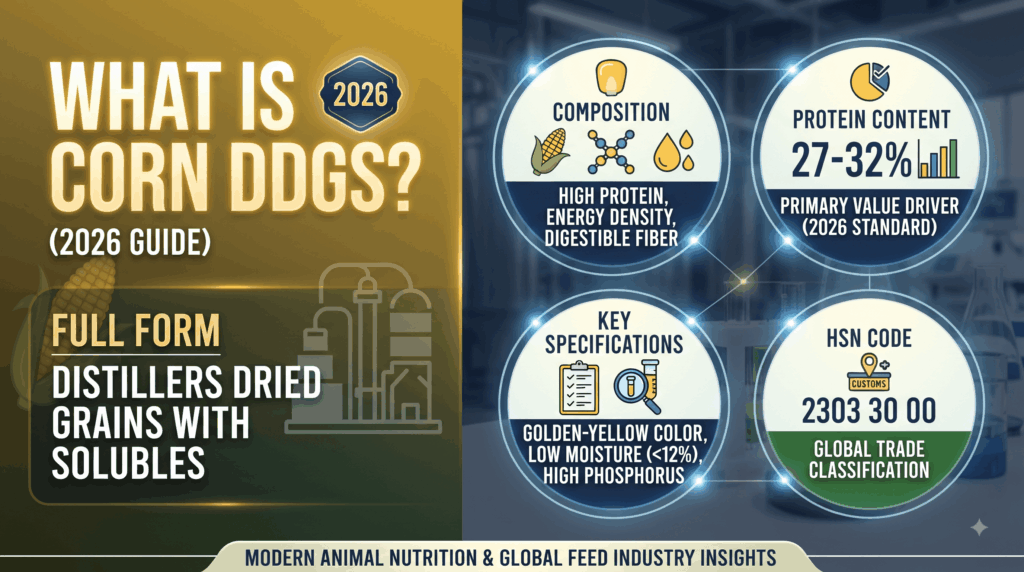
Quick answer: Corn DDGS stands for Distillers Dried Grains with Solubles — a protein-and-energy-rich co-product left over after corn (maize) is fermented to produce ethanol. In India, it’s most commonly called Maize DDGS, since “maize” is the standard trade term for corn — the two names refer to the same ingredient. Feed-grade corn DDGS typically runs 28–32% crude protein, carries the HSN code 2303 (23033000), and attracts 5% GST under India’s current classification. This guide covers everything a feed formulator, procurement manager, or importer needs to know before specifying it in a ration or a purchase order.
What Is Corn DDGS? (Full Form & Meaning)
Corn DDGS full form: Distillers Dried Grains with Solubles.
It’s a co-product — not a waste product — of the dry-milling ethanol process. When corn is processed to make ethanol, only the starch component is fermented into alcohol and carbon dioxide. Everything else in the kernel — protein, fat, fibre, minerals, and vitamins — doesn’t disappear; it gets concentrated roughly three-fold in what’s left behind. That leftover material is dried and sold as an animal feed ingredient.
How it’s made, in short:
- Corn is ground and mixed with water to form a mash.
- Enzymes convert starch to fermentable sugars.
- Yeast ferments the sugars into ethanol and CO₂, which are removed.
- What remains — the “whole stillage” — is separated into wet grains (thin stillage) and a nutrient-dense liquid (the “solubles” or condensed distillers solubles, CDS).
- The solubles are dried and blended back into the wet grains, then dried together to produce Distillers Dried Grains with Solubles — hence the name.
Because the starch (roughly two-thirds of the corn kernel) has been fermented off, the remaining protein, fat, and fibre are concentrated to about three times their level in raw corn — which is exactly why corn DDGS runs 28–32% crude protein even though whole corn itself is only around 8–9% protein.
Is corn DDGS the same as maize DDGS? Yes. In India, “maize” and “corn” are used interchangeably for the same crop, and DDGS made from either name refers to the identical product and process. Trade listings, GST filings, and export documentation in India will most often use “maize DDGS,” while “corn DDGS” is more common in international sourcing enquiries and technical literature — worth knowing so you don’t accidentally treat two quotes for the same ingredient as different products.
Quick Check: Corn DDGS Price in India (2026)
Corn DDGS Composition & Nutritional Value
Corn DDGS composition varies somewhat by ethanol plant, corn source, and drying process, but the typical proximate analysis (on a dry-matter basis) looks like this:
| Nutrient | Typical Value | Reported Range |
|---|---|---|
| Crude Protein | 28–32% | 25–33.5% |
| Crude Fat (Ether Extract) | 8–12% | 7–15.7% |
| Crude Fibre | 7–9% | 6–10% |
| Neutral Detergent Fibre (NDF) | ~34% | 18–47% |
| Ash | 4–6% | 3.4–7.5% |
| Moisture (as-fed) | ≤12% | 10–12% |
Energy value — corn DDGS is a genuine dual-purpose ingredient because it supplies meaningful energy alongside protein, unlike a straight protein meal:
| Species | Energy Value |
|---|---|
| Poultry (broiler) | ~12.3 MJ/kg DM AMEn (approx. 2,900–2,950 kcal/kg) |
| Cattle (ruminants) | ~14.2 MJ/kg DM ME |
| Swine (growing pigs) | ~15.3 MJ/kg DM MEn |
This is the core reason feed mills use corn DDGS as a partial substitute for both a protein meal (like soybean meal) and an energy ingredient (like corn itself) in the same inclusion — see our Maize DDGS price and soybean meal comparison for how that trade-off plays out on cost.
Also Check: Corn DDGS Manufacturers in India (2026)
Corn DDGS Protein Content: What Buyers Need to Know
Corn DDGS protein content typically sits between 28% and 32% crude protein on a feed-grade commercial basis (lab reference ranges published in nutrition literature run slightly wider, 25–33.5%, depending on the source study and drying method used at the plant).
Two things matter more than the headline protein percentage:
1. Amino acid balance. Corn DDGS protein is lysine-limited — it doesn’t carry the same balanced amino acid profile as soybean meal. That’s why nutritionists treat it as a partial protein replacement (typically 20–40% of the soybean meal in a ration) rather than a one-for-one swap, and why poultry rations with higher DDGS inclusion usually need supplemental synthetic lysine.
2. Bypass protein value for ruminants. For dairy cattle, a meaningful share of corn DDGS protein — often cited around 50–60% — survives rumen fermentation intact and is absorbed directly in the small intestine. This “bypass” or rumen-undegradable protein (RUP) is valuable in high-yield dairy rations where peak-lactation amino acid demand outpaces what rumen microbes alone can supply.
Always confirm protein content against a Certificate of Analysis (COA) for the specific batch you’re buying — headline percentages quoted verbally or in a listing can vary from what’s actually tested at dispatch.
Corn DDGS Specification Sheet
Here’s a standard feed-grade corn DDGS specification, the kind you should expect on a supplier’s COA before accepting a bulk shipment:
| Parameter | Typical Specification |
|---|---|
| Crude Protein | 28% minimum (28–32% standard grade) |
| Moisture | 12% maximum |
| Crude Fat | 8–12% |
| Crude Fibre | 10% maximum |
| Ash | 6% maximum |
| Aflatoxin (B1) | Under 20 ppb |
| Appearance | Light golden to golden-brown, granular, free-flowing |
| Odour | Characteristic fermented grain smell, no rancidity or mustiness |
| Packaging | 50 kg PP bags, or bulk/jumbo bags (1,000 kg) for large orders |
A note on colour: darker corn DDGS isn’t automatically lower quality, but it can indicate higher drying temperatures, which reduce lysine availability through Maillard-type browning reactions. If two lots quote the same protein percentage but look noticeably different in colour, ask the supplier about drying temperature and, ideally, request an amino acid digestibility figure rather than relying on crude protein alone.
Corn DDGS HSN Code & HS Code in India
For import, export, and GST purposes, corn DDGS (like other DDGS types) is classified under:
| Field | Value |
|---|---|
| HSN Code (India, 8-digit) | 2303 30 00 |
| Chapter | 23 — Residues and waste from the food industries; prepared animal fodder |
| Heading | 2303 — Residues of starch manufacture and similar residues, beet-pulp, bagasse and other waste of sugar manufacture, brewing or distilling dregs and waste |
| Sub-heading description | Brewing or distilling dregs and waste |
| GST Rate | 5% |
Why the classification matters: there was real ambiguity in the market for a period, with some traders classifying DDGS under HSN 2309 (prepared animal feed supplements), which historically attracted a nil GST rate. Following the 45th GST Council meeting, the CBIC clarified that Distillers’/Brewers’ Spent Grain and Dried Distillers Grains with Solubles fall under HSN 2303 and attract 5% GST, not the nil rate under 2309. If you’re budgeting a landed cost or reconciling a purchase invoice, confirm your supplier is billing under 2303 30 00 at 5% GST — incorrect classification on an invoice can create input tax credit complications later.
Corn DDGS HS code for international trade follows the same first six digits internationally (2303.30), with the remaining digits varying slightly by destination country’s tariff schedule — always confirm the exact code with your customs broker or the importing country’s tariff classification for cross-border shipments.
Rice DDGS vs Corn DDGS
Both are DDGS in the technical sense — dried co-products of a fermentation-to-ethanol process — but they come from different feedstocks and behave differently in a ration and on a price sheet.
| Parameter | Corn (Maize) DDGS | Rice DDGS |
|---|---|---|
| Crude Protein | 28–32% | 40–45% |
| Crude Fat | 8–12% | 3–5% |
| Crude Fibre | 7–9% | 3–5% |
| Primary Role | Protein + energy (dual-purpose) | Concentrated protein, strong bypass value |
| Protein Consistency | Tighter, more standardised batch-to-batch | More variable — depends heavily on source mill |
| Regional Sourcing (India) | Concentrated near maize-ethanol hubs (e.g. Gujarat) | Wider availability near rice-processing belts |
| Typical Price Position | Generally lower per kg | Generally similar to slightly higher per kg despite the protein gap |
| Best Fit | All-species partial protein + energy top-up | High-yield dairy rations needing concentrated bypass protein |
The practical takeaway: rice DDGS carries meaningfully higher protein per kg, so a fair cost comparison should always be done per kg of protein delivered, not per kg of raw material. At similar per-kg pricing, rice DDGS often works out cheaper per unit of protein — but corn DDGS’s higher fat content gives it a bigger energy contribution, which matters in rations where you’re trying to lift energy density alongside protein. See our full DDGS vs Soya DOC vs Mustard DOC vs DORB comparison guide for how both fit against other raw materials.
Corn Gluten Feed vs DDGS
These two are sometimes confused because both are corn-processing co-products used in similar rations, but they come from entirely different industrial processes and aren’t interchangeable at the same inclusion rate.
| Parameter | Corn DDGS | Corn Gluten Feed (CGF) |
|---|---|---|
| Source Process | Dry milling (ethanol production) | Wet milling (starch/sweetener/oil extraction) |
| Crude Protein | 28–32% | 18–21% |
| Crude Fat | 8–12% | 2–4% |
| Bypass Protein (UIP) | ~55–60% of protein | ~20–22% of protein |
| Degradable Protein (DIP) | Lower | Higher (~78–80%) |
| Energy Density | Higher (fat-driven) | Lower |
| Best Fit | Finishing rations, dairy needing bypass protein and energy | Growing/roughage-heavy cattle programmes, where higher rumen-degradable protein is useful |
Why this matters for sourcing: if a supplier or listing uses “corn DDGS” and “corn gluten feed” loosely as if they’re the same product, treat that as a red flag — the protein, fat, and bypass-protein differences are large enough to materially change a ration’s performance and cost calculation. Always confirm which specific co-product you’re being quoted, and ask for a COA that identifies the product by name, not just “corn feed by-product.”
Where Corn DDGS Fits in Animal Feed
| Species | Typical Inclusion | Key Consideration |
|---|---|---|
| Poultry (broiler/layer) | 5–10% (up to 15% with lysine supplementation) | Lysine-limited; balance the amino acid profile |
| Dairy cattle (lactating) | 15–20% of ration dry matter | Strong bypass protein value — see our dairy inclusion guide |
| Beef cattle / buffalo | Up to 20–25% | Good energy contribution; more tolerant of fibre than poultry |
| Swine | 10–15% | Fibre content caps higher inclusion |
| Aquaculture | Up to 10% | Species- and formulation-dependent |
Frequently Asked Questions
What is corn DDGS? Corn DDGS (Distillers Dried Grains with Solubles) is a protein-and-energy-rich co-product of the corn-to-ethanol dry-milling process. After starch is fermented into ethanol, the remaining protein, fat, and fibre are dried into a feed-grade ingredient used in poultry, cattle, swine, and aquaculture rations.
What is the full form of corn DDGS? DDGS stands for Distillers Dried Grains with Solubles.
Is corn DDGS the same as maize DDGS? Yes. “Corn” and “maize” refer to the same crop, and DDGS made from it is the identical product regardless of which name is used. In Indian trade documentation, “maize DDGS” is the more common term.
What is the protein content of corn DDGS? Feed-grade corn DDGS typically runs 28–32% crude protein, though lab reference ranges published in nutrition literature span roughly 25–33.5% depending on the source plant and drying process.
What is the HSN code for corn DDGS? Corn DDGS falls under HSN code 2303 30 00 (Chapter 23 — residues of starch manufacture and similar residues; brewing or distilling dregs and waste), and attracts 5% GST in India per the CBIC’s clarification following the 45th GST Council meeting.
What is the difference between rice DDGS and corn DDGS? Rice DDGS carries substantially higher protein (40–45% vs. 28–32% for corn DDGS) but lower fat and fibre. Corn DDGS contributes more energy per kg due to its higher fat content, while rice DDGS delivers more concentrated protein — the right choice depends on whether your ration needs more protein density or more energy top-up.
What is the difference between corn gluten feed and DDGS? Corn gluten feed comes from wet milling (starch/sweetener extraction) and runs 18–21% protein with low bypass protein value. Corn DDGS comes from dry milling (ethanol production) and runs 28–32% protein with significantly higher bypass protein (roughly 55–60% vs. 20–22%) and higher fat/energy content.
How much corn DDGS can I include in a ration? Typical inclusion is 5–10% in poultry (up to 15% with lysine supplementation), 15–20% of dry matter in dairy cattle rations, up to 20–25% in beef cattle and buffalo diets, and 10–15% in swine.
Where can I buy bulk corn DDGS in India? Brinda Foods supplies corn (maize) DDGS in bulk from Panipat, Haryana, to feed mills and integrators across India and to 25+ export markets. Request a current bulk quote.
About Brinda Foods
Brinda Foods has supplied animal feed raw materials from Panipat, Haryana, since 1987. We provide bulk supply of Maize (Corn) DDGS, Rice DDGS, De-Oiled Rice Bran (DORB), Soya DOC, and Mustard DOC to mills and farms across India. ISO 9001:2015 certified, GAFTA & FOSFA compliant.
Get today’s bulk quote: brindafoods.com/maize-ddgs | Call: [9992500442]