Most poultry farmers know that layer feed matters. But knowing why each nutrient matters — and what happens when it’s wrong — is what separates a 290-egg year from a 330-egg year. This guide walks through everything: phases, nutrients, formulation principles, common mistakes, and how to get the most out of every bag of layer feed.
What Makes Layer Feed Different from Broiler Feed?
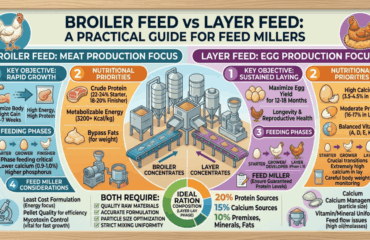
Before getting into formulation, this distinction matters: layer birds and broiler birds have fundamentally different nutritional goals.
Broilers are optimised for rapid muscle mass — maximum weight in 35–42 days. Layers are optimised for sustained, daily egg production across a 72-week productive life. That means the feed formula isn’t just about protein and energy. It’s about calcium metabolism, hormone support, bone density, and keeping the hen’s reproductive system running efficiently for nearly two years.
A common and costly mistake: feeding broiler-type formulas or general grain mixes to laying hens. The result is thin-shelled eggs, low production rates, and skeletal problems (cage layer fatigue) — all entirely preventable with the right formulation.
The 4 Phases of Layer Feed — And Why Each One Is Different
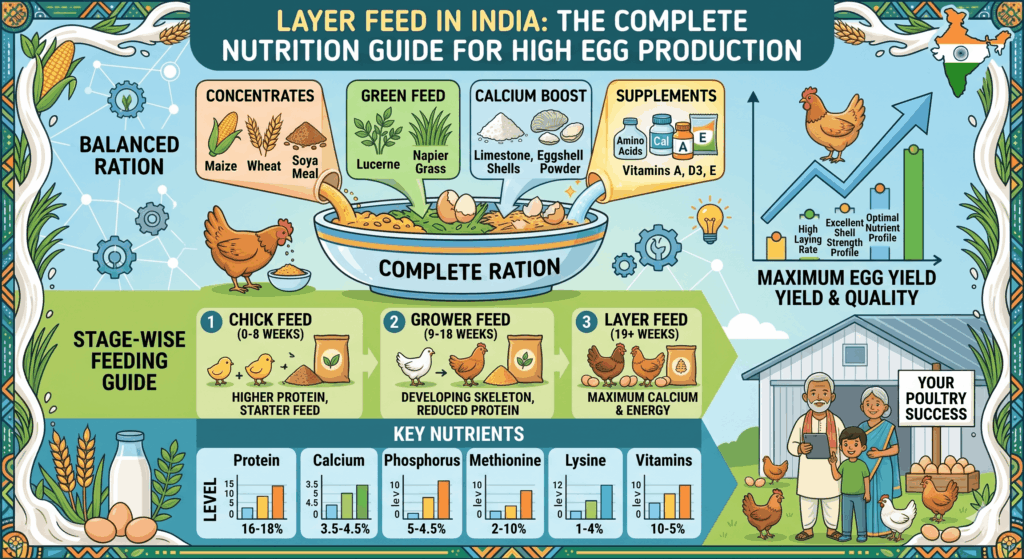
Commercial layer birds move through four distinct feeding phases. Each has its own protein, energy, calcium, and amino acid targets.
Phase 1: Chick Starter (0–6 Weeks)
At this stage, the primary goal is skeletal development. By week 6, roughly 85% of the bone structure is already set. That’s your foundation for everything that follows — including how well the bird handles calcium demands during peak lay.
| Nutrient | Target |
|---|---|
| Crude Protein | 20–22% |
| Metabolizable Energy | 2,800–2,900 kcal/kg |
| Calcium | 0.9–1.0% |
| Lysine | 1.0% minimum (BIS) |
| Methionine | 0.40% minimum (BIS) |
The high protein requirement here isn’t about egg production — it’s about tissue development. Cutting protein at this stage to save costs creates irreversible damage to bird size and bone density.
Phase 2: Grower Feed (6–17 Weeks)
Growth slows. The bird is building organ capacity, not muscle mass or egg machinery. Energy and protein requirements drop.
| Nutrient | Target |
|---|---|
| Crude Protein | 16–17% |
| Metabolizable Energy | 2,500–2,650 kcal/kg |
| Calcium | 1.0–1.2% |
| Lysine | 0.7% minimum (BIS) |
| Methionine | 0.35% minimum (BIS) |
One critical rule: do not push calcium above 1.2% during the grower phase. High calcium too early damages the kidneys before the hen’s system is equipped to handle it. This is a common quality issue when farms use a single “layer feed” for all ages.
Phase 3: Pre-Lay Feed (17–20 Weeks)
This is the most underutilised phase in Indian poultry farming — and one of the most important. The pre-lay feed acts as a bridge that prepares the bird’s calcium metabolism for the demands of egg production.
| Nutrient | Target |
|---|---|
| Crude Protein | 18% |
| Metabolizable Energy | 2,650–2,750 kcal/kg |
| Calcium | 2.0–2.5% |
| Phosphorus (available) | 0.40–0.45% |
The pre-lay phase raises calcium intake gradually, priming the medullary bone (the calcium store in the bird’s long bones) before the eggshell demands kick in. Farms that skip this phase and jump straight from grower to layer feed tend to see poor eggshell quality in the first 4–6 weeks of production — a problem attributed to feed timing, not genetics.
Important: Pre-lay feed must be withdrawn no later than 0.5% hen-day production. After that, the bird needs full production-phase calcium.
Phase 4: Layer Feed / Production Phase (20 Weeks Onwards)
This is where the economics happen. A well-nourished hen in peak production can lay 310–330 eggs per year, at a feed conversion ratio of 2.0–2.2 kg feed per dozen eggs.
| Nutrient | Phase I (20–45 Weeks) | Phase II (45–72 Weeks) |
|---|---|---|
| Crude Protein | 17–18% | 15–16% |
| Metabolizable Energy | 2,650–2,800 kcal/kg | 2,600–2,700 kcal/kg |
| Calcium | 3.5–4.0% | 4.0–4.5% |
| Available Phosphorus | 0.35–0.40% | 0.30–0.35% |
| Lysine | 0.72–0.78% | 0.65% |
| Methionine | 0.35–0.40% | 0.30% |
As the hen ages into Phase II, her metabolic efficiency declines — she needs slightly more calcium per egg even though production rate drops. Farms that keep the same formula through the entire laying cycle often see shell quality deteriorate in the last 15–20 weeks.
Calcium: The Most Critical Nutrient for Egg Production
A laying hen needs 4–5 grams of calcium every single day — almost entirely for eggshell formation. The eggshell is about 94% calcium carbonate. That means a hen producing 330 eggs a year is depositing roughly 1.5 kg of calcium into eggshells annually.
Where does that calcium come from?
- Dietary calcium (primary source) — limestone, oyster shell powder, calcium carbonate in the feed
- Medullary bone (buffer) — the skeletal calcium reserve that fills in when dietary intake dips
When dietary calcium is consistently inadequate, the bird pulls from medullary bone. Over time, this leads to thin shells, soft eggs, and in severe cases, cage layer fatigue — a condition where hens develop broken bones due to chronic calcium depletion.
Calcium Source Selection
Not all calcium sources are equal. Coarse limestone (particle size 2–4 mm) performs significantly better than fine-ground calcium carbonate for eggshell quality. The reason: coarser particles dissolve slowly in the gut, releasing calcium across the full night (when eggshell calcification occurs), rather than in a single early burst.
Best calcium sources for layer feed:
- Oyster shell powder (33–38% calcium) — slow-release, excellent for shell quality
- Coarse limestone (36–38% calcium) — effective and economical
- Dicalcium phosphate — provides both calcium and phosphorus
For Indian conditions, a blend of oyster shell (60%) and limestone (40%) works well in hot-climate months when heat stress already suppresses feed intake.
Protein and Amino Acids: What Actually Matters
The Crude Protein number on a feed bag doesn’t tell you much on its own. What matters is the amino acid profile — specifically the first and second limiting amino acids.
Methionine is typically the first limiting amino acid in layer diets based on maize and soya. It’s essential for feather quality, immune function, and egg yolk protein. A methionine shortfall shows up as poor feathering, immunosuppression, and reduced egg mass even before production numbers drop.
Lysine is the second limiting amino acid. It drives muscle maintenance and egg albumen quality.
In practical Indian formulations that rely on:
- Maize (energy base)
- Soya DOC (primary protein source)
- DORB/De-Oiled Rice Bran (energy + fibre + protein)
- Maize Gluten (concentrated protein + pigment)
…both methionine and lysine need to be verified against BIS standards at every batch because ingredient protein quality varies by source and season.
Key Raw Materials Used in Layer Feed Formulation
Maize
The dominant energy ingredient in most layer formulas — typically 50–60% inclusion. High-quality maize with moisture below 13% and low aflatoxin (<20 ppb) is essential. Aflatoxin at even sub-clinical levels suppresses immunity and disrupts calcium metabolism.
Soya DOC (De-Oiled Soybean Cake)
The primary protein source, contributing 18–25% of the formula. Soya DOC from high-quality solvent extraction delivers consistent 46–48% crude protein with well-balanced amino acids. Urease activity must be monitored — under-processed soya creates ANF (anti-nutritional factor) problems that reduce feed utilisation.
De-Oiled Rice Bran (DORB)
Typically included at 8–15% in layer diets. It provides digestible energy, fibre for gut health, and some protein. DORB quality varies significantly — fat content post-extraction, silica levels, and moisture all affect its nutritional contribution. High-silica DORB from poor milling can depress energy utilisation.
Maize Gluten
Included at 3–8% for concentrated protein (60–65% CP) and xanthophyll pigment, which directly affects yolk colour. Markets in India often price eggs partly on yolk colour — darker yellow yolks command premium pricing. Maize gluten is the most cost-effective way to achieve this without synthetic pigments.
Mustard DOC
An increasingly used protein source (typically 35–38% CP) that can partially replace Soya DOC on a cost-adjusted basis. Inclusion rates are generally capped at 8–10% due to glucosinolate content. At controlled levels, it works well in grower-phase diets.
Limestone / Oyster Shell
Added directly as a calcium source (not counted in the macro protein/energy balance). Usually included at 8–10% in production-phase layer feed.
Common Layer Feed Mistakes That Kill Production Numbers
1. Using a single feed for all life stages Skipping the pre-lay phase or using the same formula from week 8 to week 72 is the single most common mistake. It costs egg production in the first and last months of the laying cycle.
2. Low calcium in early lay If calcium doesn’t reach 3.5% by the time hens hit 1% production, you’ll see thin shells and prolapse issues. This can’t be corrected retrospectively.
3. Ignoring heat stress during summer months In Indian summers (April–July), ambient temperatures above 35°C suppress feed intake by 5–10%. Since calcium intake is proportional to feed intake, eggshell quality drops. The fix: increase calcium concentration in the formula (not just in absolute grams) to compensate for lower consumption volumes. Adding electrolytes (sodium bicarbonate) also helps maintain production.
4. Overusing fibrous by-products DORB and wheat bran are cost-effective but high-fibre ingredients. Exceeding 15–18% total fibre in layer diets reduces energy digestibility and depresses egg mass. Feed intake goes up while production output goes down — a bad trade.
5. Sourcing protein from inconsistent suppliers Batch-to-batch variation in Soya DOC or DDGS quality creates amino acid shortfalls that show up 3–4 weeks later as declining production — by which time the feed that caused the problem is long gone. Reliable sourcing from tested, certified suppliers eliminates this hidden variable.
How to Check If Your Layer Feed Is Working
You don’t need a lab to monitor whether your feed is performing. These farm-level indicators tell you within days:
- Hen-day production rate: Should be >85% at peak (weeks 25–35). Anything below 80% consistently points to a nutrition or health issue.
- Feed intake: Commercial layers consume 110–130 g/bird/day. Below 105 g suggests heat stress, disease, or palatability issues.
- Eggshell quality: Shell cracking rates above 3–4% indicate calcium or phosphorus imbalance.
- Egg weight: Target 55–65 g for commercial production. Low egg weight typically points to methionine or energy shortfall.
- Yolk colour: Measured on the Roche Fan scale; target 8–12 for most Indian markets. Below 7 suggests insufficient maize gluten or xanthophyll in the diet.
Layer Feed and Sustainability: The 2026 Context
India’s egg production crossed 140 billion eggs in 2025–26, making it the third-largest egg producer globally. Feed cost accounts for 65–70% of total layer production cost — so even a 3–5% improvement in feed efficiency translates directly to margin.
The trend is moving toward precision nutrition: using real-time amino acid monitoring, digestibility-corrected protein values, and least-cost formulation software to replace fixed-ratio formulas. Feed millers who supply layer farms are under increasing pressure to provide consistent batches with certified nutritional analysis — not just nominal values on a specification sheet.
FAQs: Layer Feed in India
What is the best layer feed formulation for Indian conditions? A maize-soya base (50–55% maize, 18–22% soya DOC) supplemented with DORB (8–12%), maize gluten (3–5%), oyster shell/limestone (8–10%), and a vitamin-mineral premix is the most widely used and reliable formula for Indian commercial layer operations. Adjustments for heat stress, water quality, and flock health status may apply.
How much calcium does a layer hen need per day? A laying hen requires 4–5 grams of calcium per day. Production-phase feed should contain 3.5–4.5% calcium depending on the laying phase. Coarse particle calcium sources (oyster shell, coarse limestone) are preferred over fine powder for sustained overnight calcium availability during eggshell calcification.
At what age should pre-lay feed be started? Pre-lay feed should begin at 17–18 weeks of age and be withdrawn at 0.5% hen-day production (typically around 20–21 weeks). This phase is critical for priming calcium metabolism before peak egg production demands begin.
Why are eggshells thin despite adding limestone to the feed? Thin shells with limestone in the diet usually indicate one of three things: limestone particle size is too fine (switches to coarser grade), phosphorus is too high relative to calcium (depresses calcium absorption), or heat stress is reducing feed intake enough that absolute calcium consumption is insufficient. Check all three before adjusting formulas.
Can DORB be used in layer feed? Yes. DORB is a practical and economical ingredient in layer diets at 8–15% inclusion. It contributes digestible energy, fibre, and protein. Quality matters — ensure silica content is within acceptable limits and fat content post-extraction is stable. High-silica DORB from substandard milling reduces energy utilisation.
Conclusion
Layer feed isn’t one product — it’s a system across four distinct phases, each targeting a different biological priority. Getting the transitions right, maintaining calcium at the correct level and particle size, sourcing consistent protein, and adjusting for Indian climate conditions are what actually drive egg numbers and shell quality.
If you’re a feed miller supplying layer farms, or a poultry producer managing your own mixing, the quality of your raw materials is where the formula lives or dies. Consistent sourcing of maize, Soya DOC, DORB, maize gluten, and calcium sources from certified suppliers removes the single biggest variable in layer feed performance.
Brinda Foods supplies high-quality feed raw materials — including De-Oiled Rice Bran (DORB), Soya DOC, Maize Gluten, Maize DDGS, and Rice DDGS — to feed millers and poultry operations across India. For bulk enquiries, contact our team at sales1@brindafoods.com or call 9992500442.