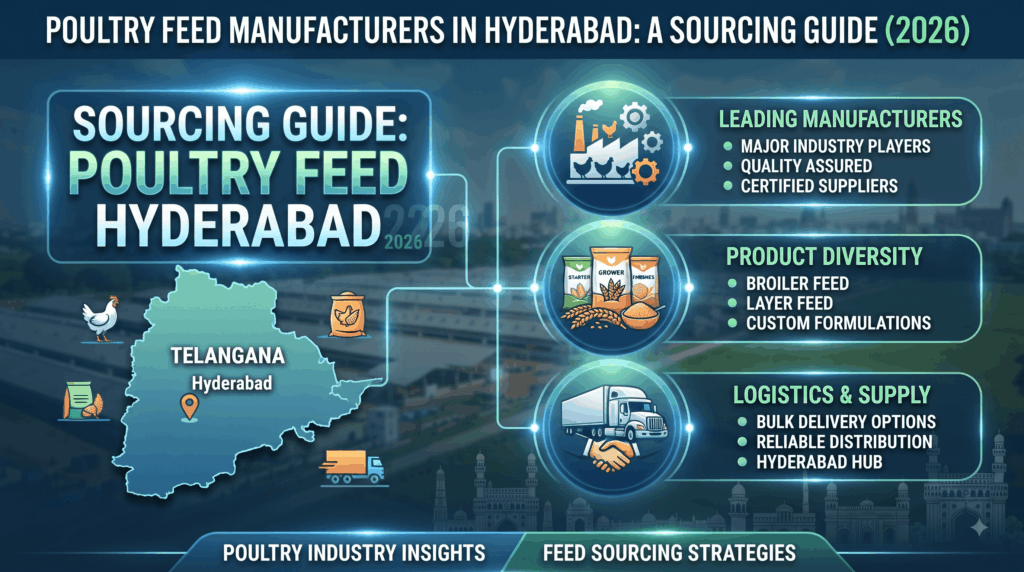
Hyderabad’s importance to feed raw material demand comes from two things working together — a large consuming population and a genuine feed-manufacturing belt in the districts that ring the city:
- Telangana contributes roughly 12.77% of India’s total egg production, and together with neighbouring Andhra Pradesh accounts for close to a third of the country’s egg output — making the southern poultry corridor, anchored by Hyderabad, one of India’s largest.
- Sangareddy district is widely regarded as the district-level “sweet spot” for poultry operations near Hyderabad — close enough to the city’s feed-mill and market infrastructure to keep logistics tight, while land costs stay meaningfully lower than inside Rangareddy or Medchal-Malkajgiri.
- Rangareddy and Medchal-Malkajgiri, the districts immediately bordering Hyderabad, carry the best power and market access in the region and host a dense concentration of established farms and feed infrastructure — though at a land-cost premium.
- India’s poultry feed production runs around 27 million metric tonnes a year nationally, inside an Indian poultry market valued at roughly ₹2,099 billion in 2023 and projected to grow at an 8.9% CAGR through 2032 — growth that the Hyderabad-anchored southern belt is positioned to keep capturing disproportionately.
For a raw material supplier, that combination — a large, growing consumption base plus a genuine feed-mill district ring around the city — is exactly why Hyderabad shows up as a distinct sourcing hub, separate from the Telangana state-level picture covered in our Telangana feed manufacturers guide.
What Hyderabad’s Poultry Rations Need Nutritionally
Broiler and layer operations across the Sangareddy–Rangareddy–Medchal belt need protein-energy supply that holds steady batch to batch, since flock performance in this region is judged against some of the most competitive production benchmarks in the country:
| Raw material | Crude protein | Role in the ration | Where it fits |
|---|---|---|---|
| Soya DOC | 44–48% | Primary plant protein source | Core protein base in broiler and layer rations |
| Maize DDGS | 28–32% | Protein-energy supplement | Cost-effective inclusion, partial soybean meal substitute |
| Rice DDGS | Variable, typically 25–30% | Cost-effective protein-energy alternative | Blended in to manage feed cost at scale |
| De-Oiled Rice Bran (DORB) | Moderate protein, high energy/fibre | Cost-effective bulking and energy | Managing overall ration cost |
DDGS functions as a practical, cost-effective partial substitute for soybean meal in poultry diets — a meaningful lever for feed mills in a region where raw material cost, not raw material access, is usually the binding constraint. Actual inclusion levels should always be set against your specific formulation software and target performance metrics rather than a flat percentage.
What Hyderabad’s Feed Manufacturers Need From a Raw Material Supplier
Because the region already has real feed-manufacturing scale, buyers here tend to compete on consistency and efficiency rather than simple access to product:
- Consistent, high-volume supply capability that can match established feed-mill throughput in the Sangareddy–Rangareddy corridor.
- Certificate of Analysis (COA) on every batch, not just at onboarding — critical for operations running tight, high-density broiler cycles.
- Certifications relevant to large-scale manufacturing — ISO 9001:2015, HACCP, and CLFMA membership matter to formal procurement teams evaluating suppliers at this scale.
- Mycotoxin-controlled processing and storage — poultry’s higher aflatoxin sensitivity makes this a non-negotiable check, particularly through the region’s monsoon and post-monsoon months.
- Reliable long-distance logistics — Hyderabad sits well outside North India’s grain-processing belt, so transit reliability into the region is a genuine evaluation criterion, not a formality.
- Transparent, commodity-linked pricing that visibly tracks the underlying market rather than resetting arbitrarily.
More detail in Cattle Feed Ingredients & Quality Standards and How to Choose a Feed Raw Material Supplier in India.
Brinda Foods: Pan-India Raw Material Supply Into Hyderabad
Brinda Foods (Brinda Feeds Private Limited) is based in Panipat, Haryana, and supplies feed millers and poultry integrators across South India, including Hyderabad and the wider Telangana and Andhra Pradesh belt. Core raw materials supplied include:
- Soya DOC — 44–48% crude protein, primary layer/broiler protein source
- Maize DDGS — 28–32% crude protein, COA-confirmed on every batch
- Rice DDGS — cost-effective protein-energy alternative
- De-Oiled Rice Bran (DORB) — energy and bulking component
As a veterinarian with an MVSc in Animal Nutrition from NDRI Karnal, I’ve built our quality frameworks around a simple principle: feed performance is decided at the raw material stage, before it ever reaches the mixer — a standard that matters most in a market like Hyderabad’s, where flocks are already run close to the performance ceiling and there’s little room for raw material inconsistency to hide. Learn more on our About Us page, review our certifications, or connect via my author page.
How Long-Distance Bulk Supply Into Hyderabad Works
- Specification alignment — confirming protein, fibre, and moisture targets against your broiler, layer, or dairy formulation.
- Sample and COA review — verifying batch quality before committing to volume.
- Bulk order and freight coordination — rail and road freight from Panipat into Telangana’s poultry belt (Hyderabad, Sangareddy, Warangal) is an established route for grain-processing byproducts.
- Standing supply agreement — most high-volume buyers move to a scheduled or standing order once quality is verified across a few shipments, keeping supply predictable through peak production cycles.
FAQs
Does Brinda Foods supply raw material to poultry feed manufacturers in Hyderabad? Yes. Brinda Foods supplies bulk Soya DOC, Maize DDGS, Rice DDGS, and DORB to feed millers and poultry integrators in Hyderabad and the surrounding Sangareddy, Rangareddy, and Medchal-Malkajgiri belt.
Why is demand for poultry feed manufacturers in Hyderabad growing so fast? Search interest is up roughly 143% year-over-year, reflecting real underlying growth: Telangana contributes about 12.77% of India’s egg production, Hyderabad’s population base exceeds 1 crore, and India’s poultry feed production runs around 27 million tonnes a year inside a market growing at an 8.9% CAGR through 2032.
Which district near Hyderabad is best for a new poultry or feed operation? Sangareddy is often described as the sweet spot — meaningfully lower land costs than Rangareddy or Medchal-Malkajgiri while still staying reasonably close to the city’s feed-mill and market infrastructure. Rangareddy and Medchal-Malkajgiri offer the strongest power and market access but at a land-cost premium.
How much DDGS can go into a Hyderabad poultry ration? DDGS inclusion in broiler and layer rations should be set against your specific formulation software and target performance metrics rather than a flat percentage — talk to your nutritionist about the right level for your flock.
What certifications should a Hyderabad feed plant look for in a supplier? ISO 9001:2015, HACCP certification, CLFMA membership, and a documented batch-level COA process. See our certifications page.
How do I request pricing for bulk DDGS or DOC delivered to Hyderabad? Request a quote or contact our team with your required product, specification, and delivery location.
Sourcing feed raw material for a Hyderabad poultry or dairy operation? Request a quote from Brinda Foods today.