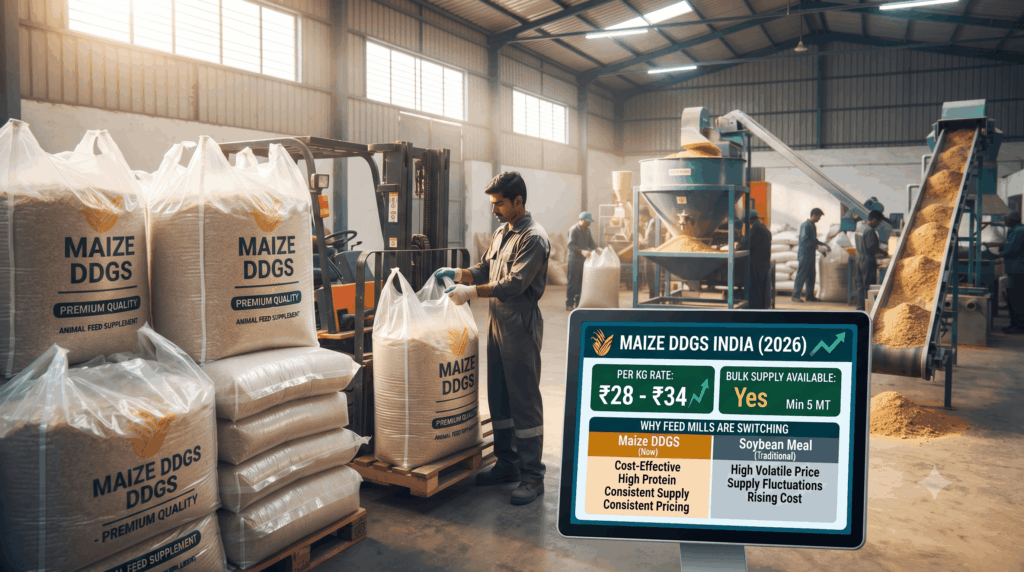
Quick answer: As of September 2026, Maize DDGS trades between ₹22-25/kg (roughly ₹13,000–16,000/tonne) for bulk feed-grade material in India, with listings as low as ₹12.5/kg near ethanol-producing hubs like Gujarat and up to ₹15.5/kg or higher elsewhere. That’s a fraction of soybean meal, which spiked past ₹65/kg at its mid-2026 peak and, per SOPA ex-factory Indore data, has since eased to roughly ₹57–59/kg by end-July — still historically elevated and well above DDGS, which is why more feed mills are asking about DDGS right now.
If you’ve priced soybean meal recently, you already know the story: a 17% drop in India’s 2025–26 soybean crop pushed meal prices up more than 40% in a matter of weeks, past ₹65/kg, before easing modestly in late July as the new sowing season progressed. Feed mills and integrators are scrambling for cost-effective protein and energy sources — and Maize DDGS, long used mainly as a niche energy ingredient, is getting a much closer look. Here’s what it actually costs, why the price varies, and how it stacks up against soybean meal right now.
Current Maize DDGS Price (September 2026)
Prices below reflect bulk feed-grade Maize DDGS (28–32% crude protein). Rice DDGS, a separate product with a different protein profile, tends to sit toward the higher end of the broader DDGS market and isn’t included here.
| Source / Grade | Typical Price Range | Notes |
|---|---|---|
| Bulk feed-grade, near ethanol hubs (e.g. Gujarat) | ₹12.5–13.5/kg | Lower freight cost close to producing plants |
| Standard bulk listings (pan-India average) | ₹13–15/kg | Most common range on trade platforms |
| Premium / consistent-grade, farther from plant | ₹15–15.5/kg | Higher freight, or tighter local supply |
| Contract / multi-tonne mill-direct | Lower end, negotiated further on volume | Best pricing for large, recurring orders |
India’s DDGS market itself is growing fast — valued at roughly USD 197.5 million in 2026 and projected to reach USD 337.6 million by 2031, an 11.3% CAGR, as more feed formulators adopt it as a mainstream ingredient rather than a niche substitute.
Quick Read: Mustard DOC Price in India (2026)
Quick Read: DORB Price in India (2026)
Why Maize DDGS Looks Especially Attractive Right Now
Maize DDGS isn’t new — Brinda Foods has supplied it for years as a protein-and-energy ingredient. What’s changed in 2026 is the price gap between DDGS and the ingredients it can partially replace.
| Ingredient | Price (September 2026) | Protein | Primary Role |
|---|---|---|---|
| Soybean Meal | ₹57–66/kg (eased from a ₹65–66/kg peak; SOPA ex-factory Indore ~₹57–59/kg late July) | 44–48% | Protein |
| Maize (Corn) | ₹18–22/kg (down from ₹26+/kg earlier in 2026 after a record kharif harvest) | ~8–9% | Energy |
| Maize DDGS | ₹12.5–15.5/kg | 28–32% | Protein + Energy |
Cost per kg of protein — the number that matters more than the sticker price. At current prices, soybean meal works out to roughly ₹126 per kg of actual protein delivered (₹58 ÷ 46% CP). Maize DDGS works out to roughly ₹47 per kg of protein (₹14 ÷ 30% CP) — still less than half, and closer to a third at soybean meal’s recent highs. That gap is why DDGS demand is climbing, but it comes with a caveat: DDGS has a weaker amino acid profile (particularly lysine) than soybean meal, so it’s a partial replacement that typically needs synthetic amino acid supplementation, not a straight swap.
This is also why DDGS pairs naturally with the other ingredients Indian feed mills are already leaning on during the shortage — see our coverage of the soybean meal crisis and the alternatives feed mills are switching to, including mustard DOC and DORB.
How Much Maize DDGS Can You Actually Include?
Inclusion limits are set by amino acid balance and species tolerance, not just cost — going too high without supplementation can hurt performance even though the ingredient is cheap.
| Species | Typical Inclusion | Key Consideration |
|---|---|---|
| Poultry (broiler/layer) | 5–10% (up to 15% with lysine supplementation) | Corn DDGS is low in lysine; balance the ration |
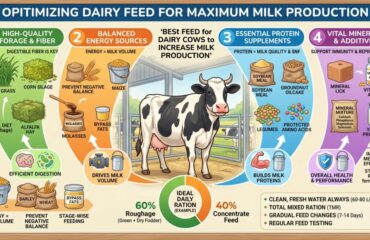
| Dairy cattle (lactating) | 15–20% of diet dry matter | High bypass protein value — see our full dairy inclusion guide |
| Beef cattle / buffalo | Up to 20–25% | Good energy source; less amino-acid-sensitive than poultry |
| Swine | 10–15% | Fibre content limits higher inclusion |
| Aquaculture | Up to 10% | Species- and formulation-dependent |
What Determines the Price You Actually Pay
Grain source: maize vs. rice. Maize DDGS and rice DDGS come from different feedstocks and price differently — rice-based, higher-protein variants generally sit toward the upper end of the broader DDGS price range. Make sure you’re comparing quotes for the same source grain.
Proximity to the producing ethanol plant. India’s ethanol production capacity is concentrated in certain states, and Gujarat in particular tends to see lower DDGS prices because of the density of plants there. As with most bulk feed ingredients, freight becomes a bigger share of delivered cost the further you are from the source.
Moisture and protein grade. DDGS should test in the target 28–32% crude protein band with moisture controlled to avoid spoilage risk in storage. Lots priced noticeably below range are worth checking against a lab certificate before committing to volume.
Order volume and contract terms. As with DORB and other bulk raw materials, multi-tonne and recurring-supply contracts consistently price below single-lot spot purchases — worth negotiating if your monthly volume supports it.
How to Buy Maize DDGS in Bulk Without Overpaying
1. Ask for the Certificate of Analysis, not just a quoted price. Protein %, moisture, and fat content tell you whether a lower quote is genuinely a better deal or a lower grade.
2. Confirm whether you’re buying maize DDGS or rice DDGS. The two are priced and formulated differently — don’t compare quotes across product types.
3. Factor in amino acid supplementation cost when comparing to soybean meal. DDGS is far cheaper per kg, but a fair cost comparison should include any synthetic lysine or methionine needed to balance the ration.
4. Source close to ethanol-producing regions where practical. Freight has an outsized effect on delivered cost given DDGS’s bulk weight.
5. Lock in contract pricing if your monthly volume is steady. With soybean meal prices unstable through 2026, mills that lock in DDGS supply agreements are insulating part of their ration cost from further volatility.
Frequently Asked Questions
What is the current Maize DDGS price per kg in India? As of September 2026, Maize DDGS trades between ₹12.5–15.5/kg (roughly ₹13,000–16,000/tonne) for bulk feed-grade material, with pricing depending on protein grade, moisture, and proximity to the producing ethanol plant.
Why is Maize DDGS cheaper than soybean meal right now? Soybean meal spiked above ₹65/kg in mid-2026 after India’s soybean crop fell roughly 17%, and while it has eased somewhat since — to roughly ₹57–59/kg by late July, per SOPA ex-factory Indore data — it remains historically elevated and supply relief isn’t expected before the new kharif crop reaches crushing plants around September–October. Maize DDGS supply hasn’t been hit by the same shock. On a cost-per-kg-of-protein basis, DDGS currently works out to well under half of what soybean meal costs.
How much Maize DDGS can I include in feed formulations? Typical inclusion is 5–10% in poultry starter and grower diets (up to 15% with lysine supplementation), 15–20% of dry matter in dairy cattle rations, and up to 20–25% in beef cattle and buffalo diets.
Is Maize DDGS a good substitute for soybean meal during the current shortage? It’s a partial substitute, not a full one. DDGS supplies protein and energy at a much lower cost, but has a weaker amino acid profile than soybean meal, so most nutritionists use it to replace 20–40% of the soybean meal in a ration alongside synthetic amino acid supplementation — not to eliminate soya entirely.
Where can I get a bulk quote for Maize DDGS? Brinda Foods supplies Maize DDGS in bulk from Panipat, Haryana, to feed mills and integrators across India, and exports to 25+ countries. Request a current bulk quote — pricing is confirmed at time of order given how quickly the market is moving in 2026.
About Brinda Foods
Brinda Foods has supplied animal feed raw materials from Panipat, Haryana, since 1987. We provide bulk supply of Maize DDGS, De-Oiled Rice Bran (DORB), Soya DOC, Mustard DOC, and other feed ingredients to mills and farms across India. ISO 9001:2015 certified, GAFTA & FOSFA compliant.
Get today’s bulk quote: brindafoods.com/maize-ddgs | Call: [9992500442]

[…] in India 2026Dorb Price in India 2026Maize Gluten Meal Price India 2026Soya Doc Price India 2026Maize DDGS Price India 2026Mustard Doc Price India 2026Maize Animal Feed Price Nutrition Guide India 2026Rice DDGS Price India […]
[…] Price India 2026Dorb Price In India 2026Maize Gluten Meal Price India 2026Soya Doc Price India 2026Maize DDGS Price India 2026Mustard Doc Price India 2026Maize Animal Feed Price Nutrition Guide India 2026Rice Ddgs Price India […]
[…] Price in IndiaCorn DDGS Price India 2026Rice Gluten Meal Price IndiaMaize DDGS Price IndiaRice DDGS Price IndiaSoya Doc Price in […]
[…] Price in IndiaCorn DDGS Price India 2026Rice Gluten Meal Price IndiaMaize DDGS Price IndiaRice DDGS Price IndiaSoya Doc Price in […]
[…] Price in IndiaCorn DDGS Price India 2026Rice Gluten Meal Price IndiaMaize DDGS Price IndiaRice DDGS Price IndiaSoya Doc Price in […]