
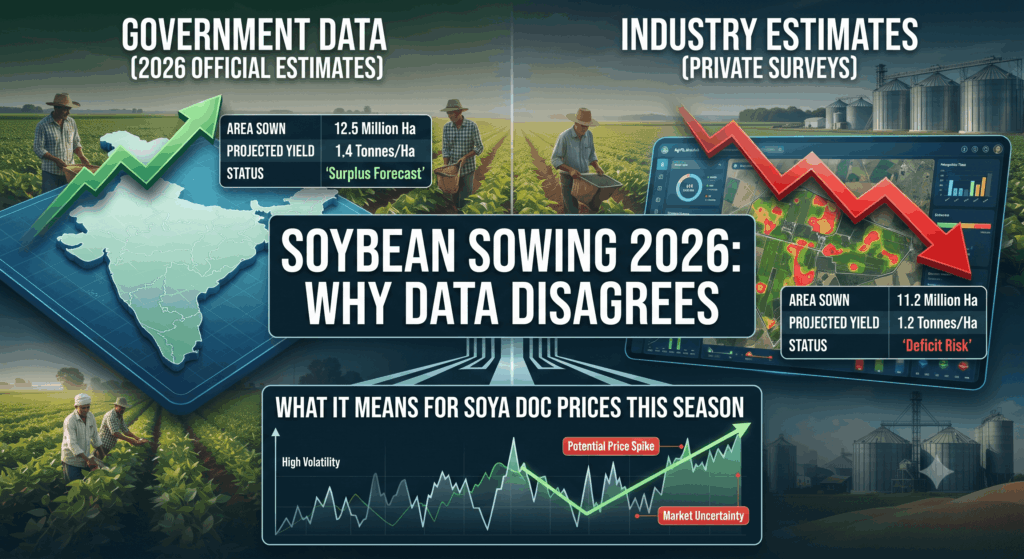
If you’ve been tracking Soya DOC prices through the 2026 supply crisis, the question on every buyer’s mind right now isn’t “why did prices spike” — that story is well documented. The question is: when does it end? The answer runs straight through this year’s kharif sowing season, and as of early July 2026, two very different data sets are telling two very different stories about how that season is going.
What the Government’s Numbers Say
According to the Union Ministry of Agriculture and Farmers’ Welfare, India’s total kharif sowing area stood at 350.85 lakh hectares as of July 5, 2026 — down 20.8% from 442.80 lakh hectares in the corresponding period last year, a shortfall of nearly 92 lakh hectares.
Oilseeds have taken the sharpest hit of any crop group, down 39.3% to 66.31 lakh hectares from 109.27 lakh hectares a year earlier. Soybean — India’s dominant kharif oilseed and the raw material behind every tonne of Soya DOC — accounts for most of that decline: official acreage stood at just 47.80 lakh hectares versus 79.20 lakh hectares last year, a drop of 31.40 lakh hectares, or roughly 40%.
Read at face value, this data points to a second consecutive year of tight soybean supply, which would mean sustained upward pressure on Soya DOC and soybean meal prices well into 2027.
Why the Industry Says the Real Picture Is Different
The Soybean Processors Association of India (SOPA) — the trade body closest to on-the-ground crushing and procurement — disputes the severity of that number, and the gap between its estimate and the government’s is large enough to matter.
SOPA’s rapid survey put soybean planting at approximately 28.9 lakh hectares as of June 30, more than four times the Agriculture Ministry’s figure of 6.9 lakh hectares for the same date. SOPA attributes the gap to a routine 7–10 day reporting lag in official state-level data collection, arguing that field-level sowing has moved considerably faster than government statistics currently reflect.
More importantly, SOPA expects total 2026 soybean acreage to exceed last year’s level once the season is fully sown — a materially more optimistic read than the government’s July 5 snapshot suggests.
Why the gap matters for buyers: if SOPA is right, the “40% acreage decline” in official data is a timing artefact, not a real trend, and a larger 2026-27 soybean crop should start easing Soya DOC and soybean meal prices once it reaches crushing plants around September–October. If the official numbers turn out closer to reality, the supply tightness that drove this year’s price crisis carries forward into the next crop year with less relief than the industry is hoping for.
State-by-State: Where Sowing Actually Stands
Madhya Pradesh — India’s largest soybean-producing state — is where the disagreement is starkest. SOPA estimates MP’s soybean acreage at roughly 15.56 lakh hectares by end-June, against the government’s 4.3 lakh hectares for the same period. Adequate rainfall across the state’s major growing belts has driven strong planting momentum, and SOPA expects sowing to be largely complete by July 15 if weather holds.
Maharashtra is lagging on soil moisture, with SOPA’s estimate at 8.45 lakh hectares. Planting is expected to accelerate over the next two weeks as recent rainfall improves ground conditions.
Rajasthan has completed an estimated 35–40% of its targeted soybean area so far.
Across all three states, the common driver is price: farmers who shifted out of soybean into maize last season, when soybean economics were weaker, are shifting back now that soybean is trading at a four-year high. That price-driven reversal is precisely the mechanism SOPA is counting on to deliver a larger crop.
The Monsoon Is the Real Variable
Sowing progress and eventual yield are two different things, and rainfall governs both. India’s cumulative monsoon rainfall deficit had been as steep as 40% in June before narrowing to around 20–24% by the first week of July, per India Meteorological Department data cited in recent reporting. Rainfall during July 1–5 came in 35% above normal, which has already meaningfully accelerated sowing in rain-dependent regions.
The practical read for feed procurement: acreage recovery is underway, but nothing about the 2026-27 soybean crop is locked in until rainfall distribution through the rest of the monsoon (July–September) is known. A strong acreage number sown into a poor rainfall second half of the season can still produce a disappointing crop — as happened with the 2025–26 crop that triggered this year’s crisis in the first place.
What This Means If You Buy or Formulate With Soya DOC
Short term (through August–September): Expect continued tightness and price volatility. Neither data set — government or industry — suggests meaningful new-crop supply reaches the market before the September–October harvest window. If you haven’t already reviewed substitution options with Mustard DOC, Rice DDGS, or DORB, this is the window where that matters most.
Medium term (October onward): If SOPA’s more optimistic acreage read proves accurate and monsoon distribution holds up through September, expect the new crop to start relieving Soya DOC prices as it reaches crushing plants — realistically from October, with the fuller effect visible by November–December as processing volumes ramp up.
The hedge that makes sense either way: Given that even SOPA’s own optimistic case depends entirely on rainfall that hasn’t happened yet, treat any pricing relief as a Q4 event at the earliest, not a Q3 one. Buyers with volume commitments running through September should not assume a September price break; contract accordingly and revisit sourcing strategy once the first hard acreage numbers (not estimates) are published after the sowing window closes in mid-to-late July.
Frequently Asked Questions
Is India’s 2026 soybean sowing up or down compared to last year? Both, depending on the source. Official government data as of July 5, 2026 shows soybean acreage down about 40% year-on-year. The Soybean Processors Association of India (SOPA) disputes this, citing a reporting lag in official statistics, and expects final 2026 acreage to exceed last year’s level once sowing is complete.
When will Soya DOC and soybean meal prices come down in India? Processors and industry bodies generally expect any relief to begin once the new soybean crop starts reaching crushing plants, typically September–October 2026, with fuller price effects visible by November–December if the crop turns out as strong as SOPA anticipates. Until then, expect prices to track close to current elevated levels.
Why is there such a large gap between government and industry soybean acreage data? SOPA attributes the gap to a routine 7–10 day lag in how state agriculture departments compile and report sowing data to the central Agriculture Ministry, meaning early-season government figures typically understate real field-level progress. This gap generally narrows as the sowing season progresses and reporting catches up.
Which Indian states are driving the 2026 soybean acreage recovery? Madhya Pradesh, India’s largest soybean-producing state, is showing the strongest planting progress after improved rainfall. Rajasthan has completed 35–40% of its targeted area. Maharashtra is lagging on soil moisture but is expected to accelerate as recent rainfall improves conditions.
Should feed mills lock in Soya DOC contracts now or wait for prices to fall? Given that any price relief depends on both a larger acreage materializing and favourable rainfall through September — neither of which is guaranteed as of early July — buyers with near-term volume needs should not defer sourcing decisions in anticipation of an imminent price break. Reviewing partial substitution with Mustard DOC or DDGS is a more reliable near-term cost lever than timing the market.
The Bottom Line
The 2026 kharif soybean season is a genuine open question, and the two most credible data sources on it — the Indian government and the industry’s own processors’ association — currently disagree by a wide margin. That disagreement matters more than it might seem: it’s the difference between a Soya DOC market that stays tight into 2027 and one that finds real relief by Q4 2026. For now, treat official acreage data as a lagging indicator, watch for updated numbers as the sowing window closes in mid-to-late July, and track monsoon distribution through September as the single biggest swing factor for where prices go next.
We’ll update this piece as clearer acreage and monsoon data becomes available through the rest of the sowing season.
Brinda Foods supplies certified-quality Soya DOC, Mustard DOC, De-Oiled Rice Bran (DORB), Maize DDGS, and Rice DDGS to compound feed manufacturers and livestock farms across India. Every batch is tested and comes with nutritional specification documentation.
For bulk pricing and sourcing enquiries: Contact Us | Submit an Enquiry | Call: 9992500442 | Email: sales1@brindafoods.com

[…] Everyone is now watching the same thing, which is a new crop. SOPA expects genuine relief once fresh beans reach crushing plants from September and October, with the fuller effect around November and December. Acreage data has been contradictory all season, with official numbers saying one thing and industry another, which we unpacked in our soybean sowing 2026 outlook. […]
[…] all season, with official numbers saying one thing and industry another, which we unpacked in our soybean sowing 2026 […]