India is now the world’s second-largest aquaculture producer, and its shrimp sector has grown at roughly a 25% CAGR over the past eight years, driven largely by the Vannamei shrimp boom. That growth has created a problem every aqua feed manufacturer knows well: fishmeal, the traditional backbone of shrimp and fish diets, is expensive, supply-constrained, and increasingly scrutinized on sustainability grounds. Domestic fishmeal output sits at only 250,000–350,000 metric tons a year, concentrated in Gujarat, Kerala, and Andhra Pradesh — nowhere near enough to feed an industry expanding this fast.
That gap is why ingredients like Rice DDGS and Soya DOC are moving from “alternative” to “standard” in Indian aqua feed formulations. This guide covers what feed millers and hatchery operators actually need to know: nutritional comparisons, inclusion rates by species, and sourcing considerations.
Why Aqua Feed Manufacturers Are Looking Beyond Fishmeal
Three forces are pushing the shift:
- Cost volatility. Fishmeal prices swing with global catch volumes and export demand, making feed-cost budgeting difficult for Indian producers.
- Supply limits. With finite domestic catch and rising input costs, fishmeal can’t scale at the rate shrimp and fish farming is growing.
- Sustainability pressure. Aquaculture buyers and certifiers increasingly favor formulations that reduce dependence on wild-caught fishmeal — plant- and grain-based proteins score better here.
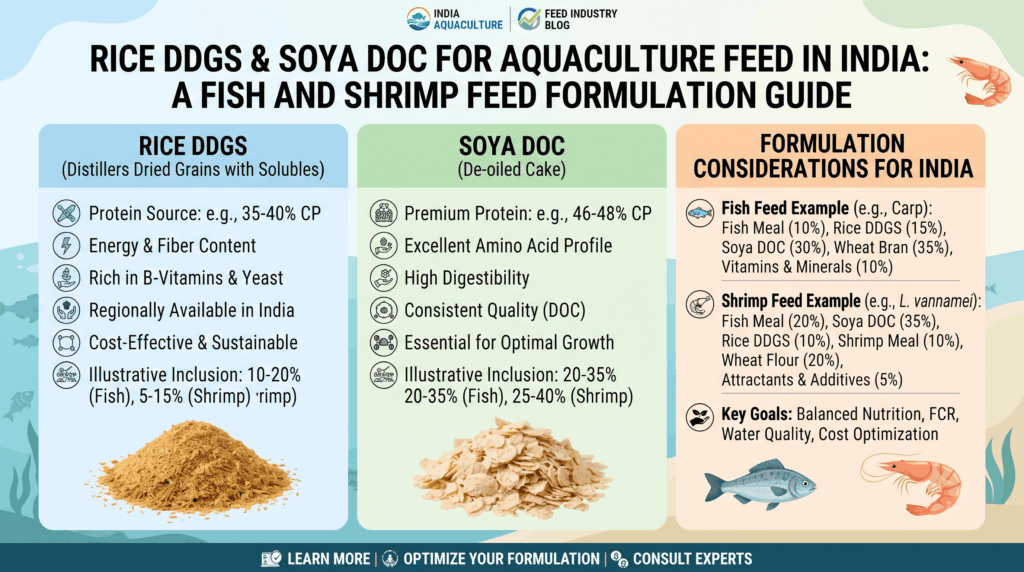
Rice DDGS, a protein-concentrated byproduct of rice-based ethanol production, and Soya DOC (de-oiled soybean cake) both offer a way to hit protein targets without leaning entirely on fishmeal.
Nutritional Comparison for Aqua Feed Formulation
| Ingredient | Protein | Best fit in aqua diets | Note |
|---|---|---|---|
| Rice DDGS | 40–45% (up to 50% in select grades) | Partial fishmeal/soybean meal replacement in shrimp, carp, catfish diets | Adds energy and amino acids; typically blended rather than used as sole protein source |
| Soya DOC | ~44–48% | Primary plant protein in shrimp and finfish feed | Widely used; consistent amino acid profile |
| Soybean meal (top grade, for reference) | Min. 49% | Shrimp feed formulation | Industry benchmark plant protein |
| Fishmeal (for reference) | 60%+ | Hatchery/starter feeds, high-value finfish | Best amino acid completeness, but costly and supply-limited |
Rice DDGS won’t fully replace fishmeal in early-stage or high-value diets, but as part of a blended formulation — alongside Soya DOC and Maize DDGS — it reduces total feed cost while holding protein and energy targets.
Recommended Inclusion Rates by Species
These are general starting ranges — always validate against your own trial formulations and target FCR:
- Shrimp (P. vannamei, P. monodon): Rice DDGS 5–10% of the ration, typically alongside soybean meal or Soya DOC as the primary plant protein
- Carp and catfish: Rice DDGS up to 10–15%, given their higher tolerance for fibre and plant-based inputs than shrimp
- Tilapia: Rice DDGS 10–12%, well tolerated due to tilapia’s omnivorous digestion
- Marine finfish (higher-value species): Lower Rice DDGS inclusion (5% or less), with fishmeal retained for amino acid completeness in early growth stages
Quality Considerations That Matter More in Aqua Feed
Aquafeed is less forgiving of ingredient inconsistency than terrestrial livestock feed — pelleted and extruded feed has to hold its shape in water, and shrimp are highly sensitive to mycotoxin contamination. When sourcing Rice DDGS or Soya DOC for aqua formulations, check for:
- Moisture control (<10%) to prevent fungal growth during storage before pelleting
- Consistent particle size for stable pellet/extrudate binding
- Verified mycotoxin-safe processing — shrimp and larval fish are especially sensitive to aflatoxins
- Batch-to-batch lab reports, not just a spec sheet, since aqua feed formulations have less margin for substitution error than cattle or poultry rations
This is also where Brinda Foods’ existing certifications (ISO 9001:2015, HACCP, CLFMA membership) become directly relevant to aqua feed buyers, not just poultry and cattle customers.
Why Source Aqua Feed Raw Materials From Brinda Foods
- Lab-tested consistency. Every dispatch of Rice DDGS and Soya DOC ships with a verified lab report — critical when formulating for a market as quality-sensitive as shrimp feed.
- Blended sourcing in one place. Rice DDGS, Maize DDGS, Soya DOC, and De-Oiled Rice Bran are all available from a single supplier, simplifying formulation logistics for feed millers who blend multiple protein sources.
- Mycotoxin-controlled processing, which matters more in aqua feed than almost any other segment.
- Trusted since 1987 — three decades supplying feed-grade raw material to Indian manufacturers, now extending into the aquaculture segment as demand grows.
Request a Bulk Quote for Aqua Feed Raw Materials →
Frequently Asked Questions
Can Rice DDGS fully replace fishmeal in shrimp feed?
No. Rice DDGS is best used as a partial protein and energy contributor alongside fishmeal or soybean meal/Soya DOC, not as a full replacement — fishmeal’s amino acid completeness is still valuable, especially in hatchery and starter diets.
What protein grade of Rice DDGS is used in aqua feed?
Aqua feed formulators typically use the standard 40–45% protein grade, with higher-protein grades (up to 50%) available for formulations targeting a leaner inclusion rate.
Why is fishmeal becoming harder to rely on for Indian aqua feed manufacturers?
Domestic fishmeal production (roughly 250,000–350,000 metric tons annually) hasn’t kept pace with India’s aquaculture growth, pushing prices up and prompting manufacturers to blend in plant- and grain-based proteins like Rice DDGS and Soya DOC.
Is Rice DDGS suitable for both shrimp and fish feed?
Yes — inclusion rates differ by species (lower for shrimp and high-value marine fish, higher for carp, catfish, and tilapia), but the ingredient is used across both categories in blended formulations.
How do I get a quote for bulk Rice DDGS or Soya DOC for aqua feed manufacturing?
Send an enquiry with your required protein specification and order volume — Brinda Foods quotes current bulk rates directly for feed manufacturers.