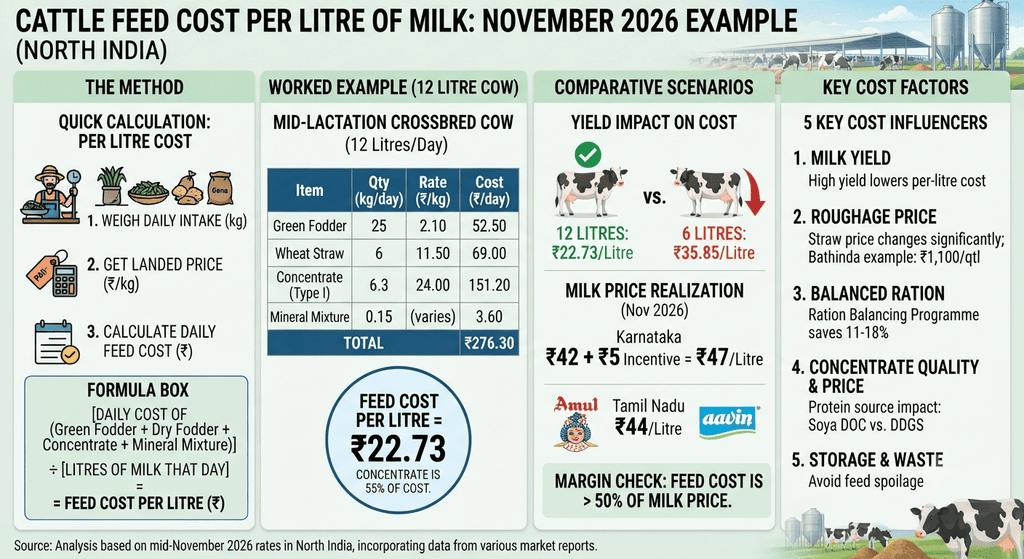
Quick Answer: Feed cost per litre of milk is calculated by adding the cost of everything an animal eats in one day (green fodder, bhusa, dana and mineral mixture) at the price you actually pay for it at your farm, and then dividing this total by the milk she gave that day. As per mid-November 2026 rates in north India, a crossbred cow giving 12 litres comes out to around ₹23 per litre in feed. If the same cow gives only 6 litres, the figure goes up to nearly ₹36.
Almost every dairy owner keeps track of how much is going on feed every month. Very few of them, however, convert this into a per-litre number, though this is the number that really shows whether the payment received for milk is enough to cover the feed.
There is good reason to do this exercise in November. In Karnataka the price paid to farmers went up from ₹35 to ₹42 per litre on 1 November. Tamil Nadu is now paying ₹44 per litre, which we had discussed in our post on the October milk price hikes. In Delhi NCR, Mother Dairy increased retail milk prices by ₹2 to ₹4 per litre from 12 November. On the other hand, wheat straw in Punjab is being sold at almost four times the rate seen at harvest time. With so much change on both sides, any calculation done in the summer months needs to be redone.
Why bother with a per-litre figure?
Feed is the single biggest expense in a dairy. A study by ICAR-NDRI Karnal on ration balancing says that feed makes up roughly 70 per cent of the total cost of milk production. Labour, electricity, vet charges and other expenses together make up the balance 30 per cent.
Looking only at the monthly bill can be misleading. Two farms may each be spending ₹50,000 a month on feed, but if one of them is getting clearly more milk out of that money, its margin will be much better than the other.
This is equally important for feed mills. When a dairy compares your feed bag with a cheaper one, in the end it is comparing the effect of both on its feed cost per litre, whether it says so or not.
The formula!
Feed cost per litre (₹) = daily cost of (green fodder + dry fodder + concentrate + mineral mixture) ÷ litres of milk that day
Daily cost of each item is simply the quantity fed in kg multiplied by its landed price per kg.
Keep a few points in mind while doing this. Weigh the feed for two or three days instead of counting tokris, as the weight of a basket of green fodder keeps changing from one cutting to another. Take the price at which the feed reaches your gate, including transport, and not the dealer’s list price. Per-animal calculation is useful when you are changing the ration of an animal. To judge the dairy as a business, do the calculation for the full herd, including dry cows and heifers. This number will be higher, and this is also the number a bank will look at.
Setting the ration
In most Indian dairies, the quantity of concentrate is still decided by a thumb rule, which is explained in our concentrate feed guide for dairy cows. As per this rule, 1.5 to 2 kg is given daily for maintenance, and 1 kg is added for every 2.5 litres of cow milk. In the case of buffalo, 1 kg is added for every 2 litres.
The quantity of mineral mixture is small, but its cost should still be included. NDDB recommends 100 to 200 g of area-specific mineral mixture per day for milking animals, with higher yielders getting the upper amount.
Roughage is the part that differs the most from one farm to another, mainly depending on how much green fodder is grown on the farm itself. In our example, the cow is given 25 kg of green fodder and 6 kg of wheat straw. You should replace these with the quantities you actually weigh at your farm.
Prices we’re using (November 2026)
| Component | Price used | Basis |
| Green fodder | ₹2.10/kg | Haryana APMC modal rate of ₹210 a quintal on 2 November 2026, range ₹120 to ₹255 (NaPanta) |
| Wheat straw (bhusa) | ₹11.50/kg | ₹1,100 to ₹1,200 a quintal in Bathinda, November 2026 (The Tribune) |
| Compound cattle feed, BIS Type I | ₹24/kg | Dealer listings of ₹1,180 to ₹1,250 per 50 kg bag (our cattle feed price list) |
| Mineral mixture | Your supplier’s rate | 100 to 200 g a day |
These fodder and straw prices are open-market rates. Add freight to get your landed cost.
Wheat straw needs special attention this year. As per The Tribune, straw in Bathinda was being sold at ₹250 to ₹300 per quintal in April and May, and the rate today is more than ₹1,100. In Haryana the rise came even earlier, with wheat straw reaching ₹950 per quintal in Rohtak and ₹1,200 to ₹1,300 in Sirsa in May itself. Dairies that did not buy and store straw at harvest are now paying much more for it.
Worked example: a crossbred cow at 12 litres
Let us take a crossbred cow in mid-lactation that gives 12 litres of milk a day. Her concentrate requirement will be 1.5 kg for maintenance plus 4.8 kg for milk (12 ÷ 2.5), which comes to 6.3 kg per day.
| Item | Kg per day | ₹ per kg | ₹ per day |
| Green fodder | 25 | 2.10 | 52.50 |
| Wheat straw | 6 | 11.50 | 69.00 |
| Concentrate (Type I) | 6.3 | 24.00 | 151.20 |
| Total | 272.70 | ||
| Feed cost per litre (÷ 12) | ₹22.73 |
Mineral mixture isn’t in this table. Divide its daily cost by 12 and add.
As expected, concentrate is the biggest item, at about 55% of her daily feed cost. What is unusual this year is the straw: 6 kg of straw is now costing ₹16.50 more per day than 25 kg of green fodder.
Now let us compare ₹22.73 with the price received for milk. In Karnataka, a cooperative member now gets ₹42 per litre along with a ₹5 incentive from the state government, while Tamil Nadu is paying ₹44 per litre. This means feed alone takes up a little more than half of the milk price, and labour, treatment and the cost of the animal have to be met from the remaining amount.
Same cow, 6 litres
If the yield of the same cow comes down to 6 litres and roughage remains the same, her concentrate will reduce to 3.9 kg (₹93.60) and her total daily feed cost to ₹215.10. However, the cost per litre will go up to ₹35.85. This happens because roughage and the maintenance part of the concentrate have to be given whatever the yield, and when the milk is less, each litre has to bear a bigger share of this fixed cost.
And a buffalo?
For a buffalo giving 10 litres of milk, the concentrate requirement is 2 kg for maintenance plus 5 kg for milk (10 ÷ 2), that is, 7 kg per day. If she is given 30 kg of green fodder and 7 kg of straw at the same prices, her daily feed cost comes to ₹63 + ₹80.50 + ₹168 = ₹311.50, or ₹31.15 per litre.
This is higher than the cow, but buffalo milk is paid for on the basis of fat. For example, Goa Dairy pays ₹78.40 per litre for buffalo milk with 6% fat and 9% SNF. So the correct comparison is between your feed cost and the rate your own society pays for the fat and SNF of your milk, and not any headline milk price.
What does one more litre cost?
The average cost per litre does not show the cost of producing one extra litre. For the cow, each extra litre needs about 0.4 kg more concentrate, which costs ₹9.60 at ₹24 per kg. For the buffalo, it is 0.5 kg, or ₹12. With cow milk being paid ₹42 to ₹44 per litre, these extra litres are clearly profitable. Whether an animal is profitable or not depends more on the fixed part of the cost, which for our cow is ₹157.50 per day for roughage and maintenance concentrate, even before she gives any milk.
What this means for feed mills
For this cow, every ₹1 increase or decrease in the price of one kg of concentrate changes her feed cost by about 52 paise per litre (6.3 kg divided by 12 litres). This ₹1 is largely decided when the mill buys its raw materials.
Given below is a 100 kg dairy concentrate made from the ingredients we supply, using the middle of our November price ranges.
| Ingredient | Kg | ₹ per kg (Nov 2026) | Cost (₹) | Crude protein |
| Maize | 28 | 24.00 | 672 | about 9% |
| Mustard DOC | 22 | 25.50 | 561 | 36% |
| Maize DDGS | 12 | 23.50 | 282 | 28% |
| Rice DDGS | 10 | 29.00 | 290 | 45% |
| DORB | 25 | 12.00 | 300 | 14 to 16% |
| Mineral mixture and salt | 3 | Your rate | ||
| Raw materials (97 kg) | 2,105 | about 22% in the finished mix |
Protein figures are book values. Trust the lab report over them.
The raw material cost comes to ₹21.05 per kg of finished feed, and minerals, grinding, pelleting, bags, freight and GST are still to be added to this. Branded Type I cattle feed is selling at ₹23.60 to ₹25 per kg, so the mill has only a few rupees left to cover its processing cost and margin.
Notes on the ingredient picks:
1. Soya DOC has not been used because of its price. At ₹56.50 to ₹61.40 per kg in mid-November, its cost per kg of protein works out to ₹123 to ₹134, compared to ₹62 to ₹67 for rice DDGS. This may change once crushing of the new soybean crop picks up, and we are following this in our Soya DOC price outlook.
2. The maize being used in feed at present is mostly new kharif crop. Since it provides most of the energy in the mix, its price makes a big difference. Current mandi rates are given in our new-crop maize price update.
3. DORB is the cheapest ingredient in this mix, but its fibre is higher than some other brans (DORB vs rice bran vs wheat bran). At 25 kg, the fibre in the finished feed may come close to the 10% limit for BIS Type I, so the feed should be tested in a lab before it is sold under this grade.
4. For high-yielding herds, a protected protein source is also often added. Our bypass protein guide explains which ingredients can be used for this.
The protein values above are book values and should be used only as a guide. If a lot of mustard DOC comes with two points less protein than expected, the cost of the formula goes up in the same way as it would with a price increase. This is why a certificate of analysis should be taken with every consignment.
Five factors behind the number
From the examples above, it is clear that yield has the biggest effect on cost per litre. The same cow on the same ration costs ₹22.73 per litre at 12 litres and ₹35.85 at 6 litres. The second factor is the price of roughage, which changes much more during the year than the price of concentrate. This is why straw bought at harvest time and stored properly is usually the cheapest roughage a dairy can get.
The third factor is a balanced ration. Under NDDB’s Ration Balancing Programme, the average feeding cost came down from ₹19.49 to ₹17.19 per kg of milk, a saving of 11.8%. The ICAR-NDRI evaluation of the same programme found that feed cost per litre of cow milk came down by about 18 to 19% in field data from Gujarat and Punjab. The fourth factor is the price of concentrate, which depends mainly on the protein source used. The fifth is storage, since feed that gets wet or mouldy is paid for and then has to be thrown away. Our guide to storing DDGS, Soya DOC and DORB explains the basic steps.
Our take for this winter!
We suggest doing this calculation every month. All you need is one day’s weighed feed, the milk record of that day and the current prices. Milk rates in Karnataka and Tamil Nadu have just changed, and straw prices have changed even more, so a per-litre figure worked out in summer will not show the actual feeding cost today.
For feed mills, the aim should not be the cheapest kg of concentrate, but the lowest cost per kg of protein and energy, supported by lab reports.
Frequently asked questions!
1. What is a normal cattle feed cost per litre of milk in India? There is no one figure for the whole country, as fodder prices differ a lot from state to state and season to season. In our November 2026 example, a 12-litre crossbred cow costs around ₹23 per litre. NDDB’s ration balancing field data, collected at older prices, showed ₹17 to ₹19 per kg of milk.
2. How much concentrate does a cow need per litre of milk? As a general rule, 1 kg for every 2.5 litres of cow milk and 1 kg for every 2 litres of buffalo milk, in addition to 1.5 to 2 kg for maintenance.
3. Should mineral mixture be counted in feed cost? Yes. NDDB recommends 100 to 200 g per day for milking animals, so its daily cost should be added to the total before dividing by litres.
4. Why does a low-yielding animal cost more per litre? The cost of her roughage and maintenance concentrate remains the same every day. When milk is less, this cost is divided over fewer litres, so the cost per litre goes up.
5. Is a cheaper concentrate always better? Only if it gives the same nutrients. Compare the cost per kg of protein, check the certificate of analysis, and then calculate the cost per litre with each option.
6. How often should I recalculate? Once every month, and also whenever milk procurement rates or the price of any major ingredient changes.
Work out your feed cost with Brinda Foods
Brinda Foods has been supplying feed raw materials from Panipat, Haryana since 1987 and is an ISO 9001:2015 certified company. We supply maize, mustard DOC, soya DOC, maize DDGS, rice DDGS and DORB. Share your formula with us and we will work out its cost at current rates. You can call us on 9992500442, write to [email protected] or contact Brinda Foods through our website.