
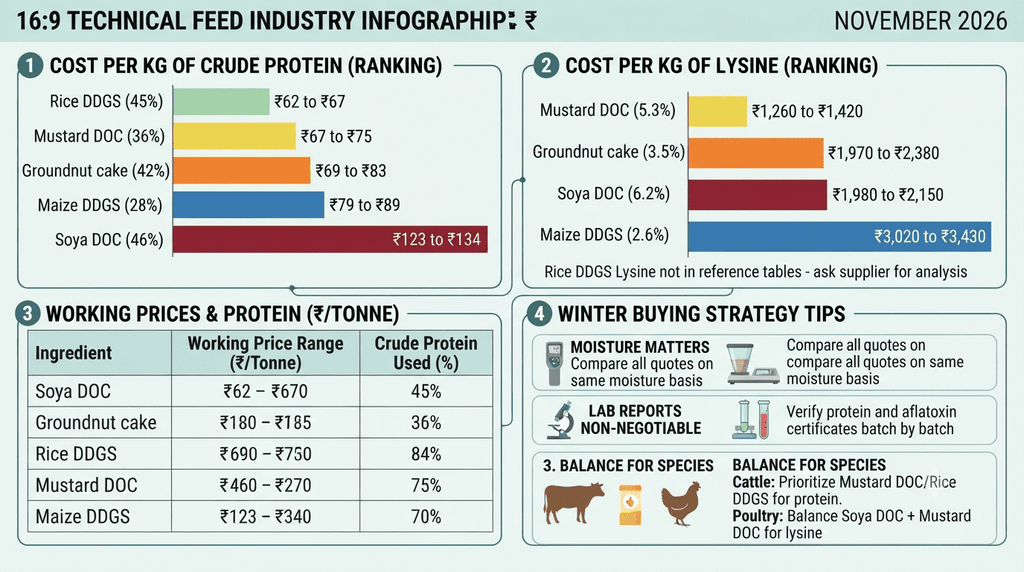
Quick Answer: Mid-November 2026 rates, Rice DDGS and Mustard DOC give you the cheapest crude protein, somewhere around ₹62 to ₹75 a kg of protein. Groundnut cake and maize DDGS land in between (₹69 to ₹89), and soya DOC trails at ₹123 to ₹134. Measure on lysine instead, and the order shuffles. Mustard DOC still comes out on top, Soya DOC pulls level with groundnut cake, and maize DDGS drops to last. So which protein is cheapest really depends on what your formula is short of.
₹25 a kg looks like a bargain next to ₹58. Except you’re not really buying kilos of meal, are you? You’re buying protein, and the lysine and methionine inside it. Divide each price by what the meal actually delivers and the gap with Soya DOC can shrink, grow, or even flip. Below we’ve done that sum for November 2026, with the source for every number, so you can redo it with your own quotes.
Why price per kg can mislead you?
The sum itself takes ten seconds: price per kg divided by the protein fraction. That’s your cost per kg of protein.
Say you have two offers on the table. Soya DOC at ₹58.50 a kg, 46% protein: that’s ₹127 per kg of protein. Mustard DOC at ₹25.50, 36% protein: about ₹71. Mustard still wins. But the real saving is about 44%, not the 56% the sticker prices make it look like.
Before you compare anything, get every quote onto the same moisture basis. A wetter lot carries less protein per kg, and nobody tells you that on the invoice. Our as-fed vs dry matter guide shows how to convert. And compare delivered prices, freight and GST included. An ex-Indore rate and an ex-Panipat rate aren’t the same thing.
The November 2026 working prices!
These meals reprice every week and differ a lot by region. So we’ve used ranges, with the basis for each one spelt out. Swap in your own quotes wherever you have them.
| Ingredient | Working price (₹/tonne) | Crude protein used | Basis for the price |
| Soya DOC | 56,500 to 61,400 | 46% | SOPA meal price formula with mid-November soybean at ₹6,800 to ₹7,200 a quintal and SOPA’s 13 November Indore oil quote |
| Mustard DOC | 24,000 to 27,000 | 36% | SEA port price of $253 a tonne in July and trade quotes near $287 to $288 in September, converted at about ₹94.2 per dollar |
| Groundnut cake (solvent extracted) | 29,000 to 35,000 | 42% | Gujarat trade listings for 40 to 45% protein meal; some premium lots are listed higher |
| Maize DDGS | 22,000 to 25,000 | 28% | Brinda Foods’ November 2026 cattle feed ingredient ranges |
| Rice DDGS | 28,000 to 30,000 | 45% | Brinda Foods’ November 2026 cattle feed ingredient ranges |
All prices are before freight and GST. Protein levels are typical trade specifications; check the lab report for each lot.
Soya DOC first. That range comes from the formula SOPA publishes for its members (bean cost plus ₹2,000 processing, less the value of the 17.5% oil, divided by the 82% meal yield). With beans trading miles above the ₹5,708 MSP, it puts 46% meal well above anything we saw last year. Our soybean meal crisis explainer tells the story of how we got here.
Mustard is trickier because there’s no SOPA-style formula. SEA data reported by Rural Voice had Indian rapeseed meal at $253 a tonne at the port in July 2026, when soybean meal was fetching $617. Commodity Board then quoted mustard DOC at about $287 to $288 in early September. To get rupees we used 94.20 to the dollar, the 13 November close according to PTI. Grade-wise sarson khal rates are on our Mustard DOC price page.
Both DDGS ranges are taken from the ingredient table in our cattle feed price list. Groundnut cake is the hardest one to pin down. Gujarat sellers on trade portals list it anywhere from ₹29 to ₹43 a kg, which tells you how patchy that market is, so get a firm quote with protein and aflatoxin certificates before trusting any number.
Cost per kg of protein, ranked!
| Ingredient | Cost per kg of crude protein | Rank (cheapest first) |
| Rice DDGS (45%) | ₹62 to ₹67 | 1 |
| Mustard DOC (36%) | ₹67 to ₹75 | 2 |
| Groundnut cake (42%) | ₹69 to ₹83 | 3 |
| Maize DDGS (28%) | ₹79 to ₹89 | 4 |
| Soya DOC (46%) | ₹123 to ₹134 | 5 |
Brinda Foods calculation: working price ÷ crude protein fraction.
On crude protein alone, Soya DOC costs almost double what Rice DDGS or Mustard DOC does this month. A year ago the gap was much smaller. Soybean averaged just ₹4,360 a quintal in November 2025, so SOPA’s formula would have put meal far closer to the alternatives.
Maize DDGS looks cheap per kg and still ends up fourth. At about 28% protein, a good chunk of every bag is fibre, fat and leftover starch. That’s not wasted (DDGS brings decent energy). It just isn’t protein, and protein is what you’re paying for here.
The lysine check: where the ranking changes!
Crude protein counts every gram the same. Your broilers don’t. In poultry and pig feed, lysine is usually the first amino acid to run short, and these meals carry wildly different amounts of it. We took average values from Feedipedia (the feed database kept by INRAE, CIRAD, AFZ and FAO) and worked out what one kg of lysine costs you inside each meal.
| Ingredient | Lysine (% of protein) | Cost per kg of lysine |
| Mustard DOC | about 5.3 | ₹1,260 to ₹1,420 |
| Groundnut cake | about 3.5 | ₹1,970 to ₹2,380 |
| Soya DOC | about 6.2 | ₹1,980 to ₹2,150 |
| Maize DDGS | about 2.6 | ₹3,020 to ₹3,430 |
| Rice DDGS | not in the reference tables | ask your supplier for an amino acid analysis |
Lysine values: Feedipedia averages for soybean meal, solvent-extracted rapeseed meal, low-oil peanut meal and maize DDGS. Indian mustard (Brassica juncea) meal can differ from these, so use your lab data where you have it.
Look at what happens. Soya DOC has the most lysine per kg of protein, so on this measure it draws level with Groundnut cake. Maize DDGS, which was mid-table on crude protein, is now the dearest way to buy lysine by some distance. Mustard DOC? Cheapest on both counts.
Strictly speaking, digestibility matters too, which is why least-cost software works on digestible amino acids. Our guide to protein-rich ingredients in feed manufacturing gets into that side of it.
What each ingredient brings and its limits?
- Soya DOC
Nothing else here packs as much lysine into its protein, and big solvent plants turn out a very even product. The only problem right now is the price. Most poultry nutritionists will keep some in the ration for the amino acid balance and trim it wherever a cheaper meal can step in.
- Mustard DOC
On both protein and lysine, this is November’s best value. What holds it back is glucosinolates, the natural compounds in mustard and rapeseed that limit how much nutritionists will put in, particularly for poultry. Our desi mustard meal carries more of them than European or Canadian canola meal, so the inclusion rate depends on the species and on each lot’s lab report.
- Groundnut cake
Solvent-extracted cake from decorticated seed is high in protein and low in fibre. Good stuff, on paper. Feedipedia names aflatoxin as the big worry with peanut meal, though, so treat an aflatoxin certificate for every lot as non-negotiable. Lysine is on the low side too, which explains why it looks better on protein than on lysine.
- Maize DDGS
Protein, energy and fibre in one bag, which is why cattle feed makers like it. One distillery’s DDGS can be quite different from the next, so check protein, fat and colour batch by batch. The corn DDGS price guide has the market side.
- Rice DDGS
At our working prices it’s the cheapest crude protein on the list. Protein claims swing a lot from plant to plant, though, so go by the lab report, not what’s printed on the bag. Our DDGS price comparison shows how rice and maize DDGS get priced against each other.
How to run this on your own quotes?
1. Collect firm delivered quotes for each meal, with GST and freight to your mill.
2. Get the lab protein figure for each lot, on the same moisture basis.
3. Divide price per kg by the protein fraction. That’s your cost per kg of protein.
4. For poultry and pig feed, divide again by the lysine share of protein to get cost per kg of lysine.
5. Feed the results into your least-cost formulation, with your inclusion limits for each meal. Our cattle feed formulation guide walks through a Pearson Square example with Indian ingredients.
Redo it whenever a quote moves by more than a rupee or two. This year the order has changed inside a single month.
Our take for winter buying!
If you run a cattle feed plant, Mustard DOC and Rice DDGS look like the best protein buys right now, with Maize DDGS bringing the energy. Poultry is different; you’ll still want some Soya DOC for the lysine. But it’s a sensible winter to try how far mustard meal plus a bit of synthetic lysine can stretch it, inside each species’ inclusion limits. And if you’re in Gujarat or close by, groundnut cake deserves a look, as long as the aflatoxin report comes with every truck.
Whatever you buy, don’t buy on sticker price. Knock ₹2 a kg off a meal that has 4 points less protein and you’ve often saved nothing.
Frequently asked questions
- What is the cheapest protein source for animal feed in India right now?
At November 2026 working prices, Rice DDGS and Mustard DOC give the cheapest crude protein, at about ₹62 to ₹75 per kg of protein. On a lysine basis, Mustard DOC is the cheapest of the five ingredients compared here.
- How do you calculate cost per kg of protein?
Divide the price per kg by the crude protein fraction. Soya DOC at ₹58.50 a kg with 46% protein works out to about ₹127 per kg of protein.
- Is DDGS cheaper than Soya DOC?
Per kg of crude protein, yes. Maize DDGS works out to about ₹79 to ₹89 and Rice DDGS about ₹62 to ₹67, against about ₹123 to ₹134 for Soya DOC. Per kg of lysine, Maize DDGS is the more expensive option.
- Can Mustard DOC replace Soya DOC completely?
Not usually. Glucosinolates limit how much mustard meal can go into a ration, especially for poultry, so most formulators use it to replace part of the Soya DOC rather than all of it.
- Why is Soya DOC so expensive in 2026?
Soybean is trading far above its ₹5,708 MSP after drought cut Maharashtra’s crop, and about 82% of every tonne of beans becomes meal. High bean prices pass almost straight through to Soya DOC.
Compare protein costs with Brinda Foods
Brinda Foods supplies Soya DOC, Mustard DOC, Maize and Rice DDGS, DORB, and Maize and Rice Gluten to feed mills across India. Send us your monthly volumes and delivery point and we’ll quote the meals side by side, so you can do this sum on real offers instead of ranges. Contact Brinda Foods.


[…] DOC has not been used because of its price. At ₹56.50 to ₹61.40 per kg in mid-November, its cost per kg of protein works out to ₹123 to ₹134, compared to ₹62 to ₹67 for rice DDGS. This may change once […]