Quick Answer
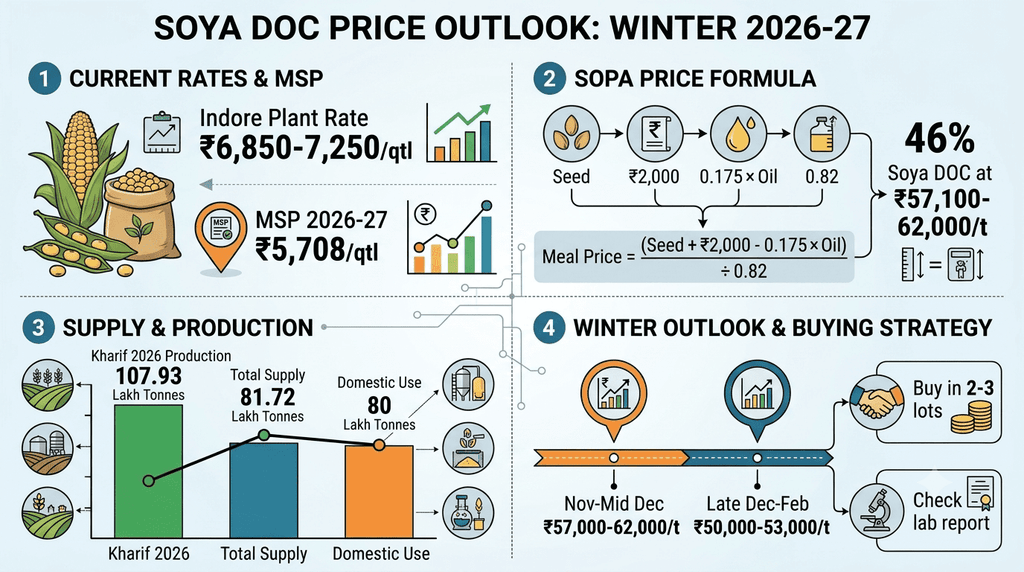
Mill buyers hold their buying decisions in the month of October due to the high prices of Soya DOC. Patriks suggests the Indore plant price listing on 11 November 2026 as ₹6,850 to 7,250/qtl. But as per the yearly rotation, buyer make their decisions around November. However, the price is still surpassing MSP 2026-27: ₹5,708/qtl by ₹1,150 to 1,550.
In the upcoming month, there might be a relaxation in prices, but not up to the expectations of buyers. The relief can be very short of their desired gap. The current pricing scenario of soya Doc can give you more insights of the industry. Let’s dive into it, and compare it to your expectations.
Where are seed prices this week?
- In the month of October and November, buyers usually wait for the new soybean crop, as the arrivals in the mandi bring the prices down. However, this season the scenario is quite different.
- The new crop has been coming into the mandi since late September. As per BigMint, arrivals increased from around 70,000 bags/day to nearly 3 lakh bags/day. But the prices still moved up by ₹400 to 450/qtl, instead of coming down.
- Listings of the All India Poultry Breeders Association (AIPBA) suggest soybean prices have risen by around 30% in this season. This drastic shift in rates has impacted feed mills with the expected budget for 2025-2026.
- Farmers are also holding their stock this time. As the mandi rate is already above MSP 2026-27: ₹5,708/qtl, they are selling in small quantities only and waiting for higher prices.
- The smaller crop size may also raise the prices of products. And the natural calamity, like drought in some parts of Maharashtra, has impacted the crop production. Due to these reasons, the total output is slightly lower than last year.
- Due to the lower supply of seed, the processing plants are now competing with each other. One major plant in Maharashtra has raised its purchase price by ₹300 to 400/qtl.
- For feed mills, this can bring a huge change to the complete cost. And the rising cost for plants with higher seed costs, the Soya DOC price also goes higher.
- The prices in different Mandis differ from each other within a day. Soybeans were listed at ₹8,585/qtl in Dewas mandi on 12 November, while the estimated price was ₹8,131/qtl in Indore’s Laxmi Nagar grain mandi on 11 November (Facts suggested by Patrika).
Note: these are not the real market prices. Both were muhurat deals on the first trading day after Diwali. In this time, traders give a high bid on small lots as shagun.
- The wheat rate at the Dewas mandi on the same day makes it clear. Wheat sold at ₹5,151/qtl, which is almost double its MSP of ₹2,585/qtl.
- Indoor plant delivery price matters the most ranging from ₹6,850 to 7,250/qtl as per the latest details. Soya DOC pricing is based on this rate. You can track this price range and compare it with different quotes you receive.
| Mandi / source | Date | Rate (₹/quintal) |
| Indore processing plants | 11 Nov | 6,850 to 7,250 |
| Maharashtra APMC (average modal) | 7 Nov | 6,759 |
| Kota Bhamashah mandi | 12 Nov | 5,800 to 7,251 |
| Madhya Pradesh (statewide average) | 11 Nov | ~6,000 |
| MSP 2026-27 (yellow soybean) | – | 5,708 |
Why the New Crop Has Not Brought Rates Down?
SOPA mentions that soybean was sown on nearly 5 per cent more land than the last year. SOPA stands for Soybean Processors Association of India. At its conference in Indore on October 17, it provided all the details. The production stands at 107.93 lakh tonnes, which is down by 2.11 per cent, as per the association.
Madhya Pradesh is ranked higher for good soybean crops. The overall estimation shows around 10 lakh tonnes of improvement, which can compensate for the shortfall of Maharashtra crops due to drought in many regions.
Brinda Foods tracked the sowing numbers through the monsoon in its report on the soybean sowing 2026 outlook.
Soy solvent oil was quoted at Rs 1,350-1,355 per 10 kg in Indore on November 12, according to SOPA. Processors recover a larger part of their crushing cost from meal when oil prices are low.
| Item | Kharif 2025 | Kharif 2026 |
| Production (lakh tonnes) | 110.26 | 107.93 |
| Sown area (lakh hectares) | 112.14 | 117.73 |
| Madhya Pradesh output (lakh tonnes) | 43.24 | 57.16 |
How to Work Out a Fair Soya DOC Rate?
SOPA publishes a daily indicative price for soybean meal. It is based on the plant delivery price of soybean, an oil recovery of 17.5 per cent, a meal recovery of 82 per cent and a processing cost of Rs 2,000 per tonne. Feed mills can use the same calculation to check supplier quotes.
Formula: Meal price (Rs/tonne) = (Seed price + Rs 2,000 − 0.175 × Crude oil price) ÷ 0.82
At this week’s plant rates and an oil price of Rs 1,35,250 per tonne, the formula gives Rs 57,100-62,000 per tonne for 46 per cent Soya DOC, ex-plant. SOPA adds Rs 2,000 per tonne for 48 per cent protein and Rs 4,000 for 50 per cent. Freight, bagging and GST are extra.
SOPA’s indicative price for 46 per cent meal was Rs 30,732 per tonne in May 2025. It stood at Rs 43,872 per tonne on January 31, 2026, according to the association’s data reported by igrain.
A Rs 100 per quintal change in soybean moves meal by about Rs 1,220 per tonne under this formula. A Rs 50 per 10 kg fall in soy oil adds about Rs 1,070 per tonne to meal.
| Plant seed price | Oil credit per tonne | 46% meal (ex-plant) | 48% meal | 50% meal |
| Rs 6,300/qtl | Rs 23,669 | ~Rs 50,400/t | ~Rs 52,400/t | ~Rs 54,400/t |
| Rs 6,500/qtl | Rs 23,669 | ~Rs 52,800/t | ~Rs 54,800/t | ~Rs 56,800/t |
| Rs 6,850/qtl | Rs 23,669 | ~Rs 57,100/t | ~Rs 59,100/t | ~Rs 61,100/t |
| Rs 7,250/qtl | Rs 23,669 | ~Rs 62,000/t | ~Rs 64,000/t | ~Rs 66,000/t |
| Change | Impact on Soya DOC |
| Seed +Rs 100/qtl | Meal ~+Rs 1,220/t |
| Seed −Rs 410/qtl | Meal ~−Rs 5,000/t |
| Oil −Rs 50 per 10 kg | Meal ~+Rs 1,070/t |
| Oil +Rs 50 per 10 kg | Meal ~−Rs 1,070/t |
Is There Enough Soymeal in the Country?
SOPA has maintained that the country has enough soymeal for the year. Its balance sheet puts total supply for 2026-27 at 81.72 lakh tonnes and domestic use at 80 lakh tonnes, with around 1.72 lakh tonnes left at the end of September 2027. Processors also hold 8.82 lakh tonnes of soybean, which can yield nearly 7 lakh tonnes of meal, the association said.
The opening stock of soymeal on October 1 was 1.93 lakh tonnes, against 68,000 tonnes a year ago, according to SOPA data reported by Kisan India.
Soymeal exports from India dropped to around 10 lakh tonnes in 2025-26, almost half of the shipments in the previous year, according to SOPA, with high domestic prices making Indian meal costlier than supplies from South America. Brinda Foods had earlier looked at this in its report on the soybean meal export halt 2026. SOPA has said the larger stock that stayed back in the country is enough to meet the needs of the feed industry this season.
| Item | 2025-26 | 2026-27 |
| Opening meal stock (1 Oct) | 68,000 t | 1.93 lakh t |
| Meal export | ~10 lakh t (2024-25: 20.23 lakh t) | – |
| Total supply (projected) | – | 81.72 lakh t |
| Domestic use (projected) | – | 80 lakh t |
| Ending stock, 30 Sep 2027 | – | ~1.72 lakh t |
GM Soymeal Import: Where the Proposal Stands?
The All India Poultry Breeders Association has sent a request to the government for imports up to 30 lakh tonnes of genetically modified soybean meal. It has sought zero-duty shipments from all African origins. But due to the higher cost of feed, SOPA suggested to the Ministry of Commerce on October 26 to reject the request, mentioning there is enough soy meal available in the country.
Market sentiment is accountable for the resent price rises largely. Imports of GM soymeal were last allowed in 2021, when the government cleared 12 lakh tonnes during a similar shortage. A decision on the latest proposal is yet to be announced.
Global Markets
Soybean futures on the Chicago Board of Trade (CBOT) fell 1.2 per cent to a two-month low of USD 12.41 per bushel in late October, Kisan India reported. A record US harvest weighed on prices. Indian soymeal is still costlier than global supplies, and most of it is being sold within the country.
Soya DOC Price Outlook for Winter 2026-27
Brinda Foods expects Soya DOC prices to stay stagnant till mid-December. Farmers are still holding stock, and soy oil prices are not giving processors room to cut meal rates.
Farmers general sell more between late December and February, to meet the cost of rabi sowing and the wedding season. If plant rates ease to Rs 6,300-6,500 per quintal and oil stays where it is, the SOPA formula puts 46 per cent meal at around Rs 50,000-53,000 per tonne.
The government’s decision on GM meal imports, soy oil prices and SOPA’s revised crop estimate for Maharashtra could change this outlook. Rates close to mid-2025 levels are unlikely this season. Soybean would have to fall below MSP for that, and MSP procurement under the Price Support Scheme (PSS) has been approved for soybean in Karnataka and Telangana.
These ranges are indicative and are not an offer.
| Period | Seed rate (assumed) | 46% Soya DOC range |
| Nov to mid-Dec 2026 | Rs 6,850-7,250/qtl | Rs 57,000-62,000/t |
| Late Dec 2026 to Feb 2027 | Rs 6,300-6,500/qtl | Rs 50,000-53,000/t |
Quick Price Check
Soya DOC Price in India | Mustard DOC Price India 2026 | DDGS Price in India | Rice Gluten Meal Price India 2026 | New-Crop Maize Price in November 2026 | Feed Raw Material Price Comparison India
How Feed Mills Can Buy Soya DOC Smarter This Winter
Brinda Foods suggests buying in two or three lots this winter. December needs can be covered now, with part of the January-February requirement left open. The company’s feed raw material buying calendar covers this seasonal pattern.
Buyers can track the Indore plant rate and soy oil price every week, and work out a fair meal price with the SOPA formula. On cost per kg of protein, 48 per cent Soya DOC currently works out at around Rs 123, against Rs 124 for 46 per cent meal.
With Soya DOC at Rs 57-62 per kg, DDGS, Mustard DOC and Rice Gluten are worth re-costing in the protein mix. Brinda’s guides on Groundnut Cake vs Soya DOC and how to reduce animal feed cost in India look at some of these options. A lab report for protein and moisture should come with every lot.
| Grade | Price (approx.) | Cost per kg protein |
| 46% Soya DOC | Rs 57,100/t | ~Rs 124 |
| 48% Soya DOC | Rs 59,100/t | ~Rs 123 |
Frequently Asked Questions
- Will soya DOC get cheaper in December 2026?
There is expected to be a lower price for SOYA doc by the new year beginning. The big difference can be seen in January and February when the supply rises. As of now, the price ranges from ₹6,850 to 7,250/qtl.
- What is the soybean MSP for 2026-27?
The reputed sources mention the MSP for yellow soybean as ₹5,708/qt. It exceeds ₹380 than last year’s ₹5,328/qtl.
- How is the soya DOC price calculated?
SOPA’s methods include ₹2,000 to the seed price per tonne. As per the sources, 17.5% of the crude oil is waived off. And in the end The balance is then divided by 0.82 to estimate the meal price per tonne.
- Are GM soymeal imports allowed this season?
As per the sources, it is not declared yet in November 2026. AIPBA has already sent request for 30 lakh tonnes. But SOPA is already going against of the formal request.
Request a Bulk Quote!
Feed mills can share their monthly requirement and protein specification through the Brinda Foods enquiry page or request a current bulk quote for Soya DOC. The team will share current rates and, if needed, a comparison with other protein sources.
Prices change daily. Figures here are as of November 12, 2026, and are indicative, not an offer.
About Brinda Foods
Brinda Foods supplies feed raw materials to feed mills and feed manufacturers, including Soya DOC, Mustard DOC, Maize DDGS, Rice DDGS, De-Oiled Rice Bran (DORB), Maize Gluten and Rice Gluten.