Quick answer: On 4 November 2026, maize sold at an average of ₹2,685 a quintal (roughly ₹26.9 a kg) across 237 mandis. That’s about 11% over the ₹2,410 MSP. Karnataka is the dearest at ₹3,095, while UP and Bihar are hovering right around MSP at ₹2,375 to ₹2,380. Once you add freight, cleaning and the water you end up paying for, most mills are landing it somewhere between ₹28 and ₹31 a kg.
Normally, an October harvest means cheaper maize. Not this year. Between mid October and the first week of November, the national average actually went up by about 17%, and that’s with new grain already reaching the mandis.
I’ve lost count of how many times I’ve taken the same call this fortnight. A mill owner rings up and says, “Doctor sahab, fasal toh aa gayi, phir rate kyun badh raha hai?” Fair question. So I’ve put down what I’m seeing this week: the actual numbers, where the ethanol tender comes into it, and how we work out a fair price for a wet new-crop truck at the gate.
Maize MSP 2026-27 and where mandi rates stand
Back in May, the Cabinet set this year’s kharif maize MSP at ₹2,410 a quintal. That’s only ₹10 more than last year’s ₹2,400, so it hardly moved.
Honestly, for a feed buyer MSP is more of a reference line than a real price. Government agencies barely procure maize, so it’s private buyers like us, the starch units and the distilleries who end up deciding the rate.
Look at how different this year feels. In the first week of November 2025, Davangere and other Karnataka mandis were trading near ₹1,800, well under MSP. On 4 November this year, 11 out of 15 reporting states were at MSP or above it. The all-India average is ₹275 over MSP, and Karnataka is a full ₹685 over.
So even in peak harvest weeks, the farmer has the upper hand right now.
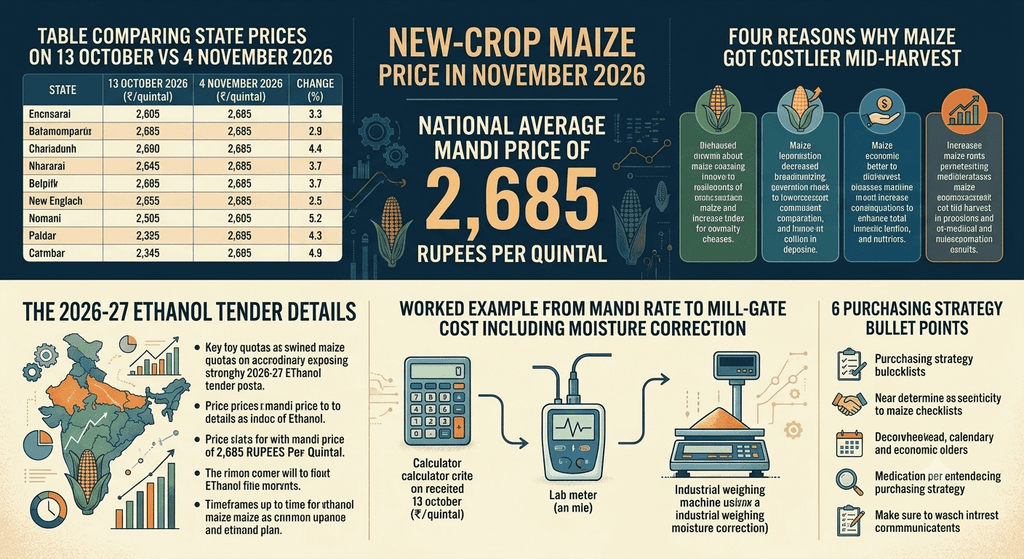
New-crop maize price by state: 13 October vs 4 November 2026
Every big maize state got costlier as the harvest came in. The sharpest jumps were in Rajasthan and Madhya Pradesh, which is a bit ironic, because that’s exactly where new grain landed first.
| State | 13 Oct 2026 (₹/qtl) | 4 Nov 2026 (₹/qtl) | Change in 3 weeks | vs MSP ₹2,410 |
| Karnataka | 2,629 | 3,095 | +18% | +28% |
| Tamil Nadu | 2,658 | 2,834 | +7% | +18% |
| Telangana | 2,547 | 2,825 | +11% | +17% |
| Maharashtra | 2,313 | 2,776 | +20% | +15% |
| Rajasthan | 2,021 | 2,731 | +35% | +13% |
| Gujarat | 2,417 | 2,715 | +12% | +13% |
| Madhya Pradesh | 2,041 | 2,596 | +27% | +8% |
| Andhra Pradesh | 2,545 | 2,561 | +1% | +6% |
| Bihar | 1,750 | 2,380 | +36% | −1% |
| Uttar Pradesh | 2,215 | 2,375 | +7% | −1% |
| India average | 2,291 | 2,685 | +17% | +11% |
Source: Agmarknet (data.gov.in) state averages compiled by ACROP. Tamil Nadu figure dated 2 Nov; Bihar dated 1 Nov and based on one reporting mandi, so treat it as indicative.
If you want to see it day by day, Maharashtra is a good example. Its median mandi rate was ₹2,250 on 12 October. By 4 November it had reached ₹2,771. That’s 23% up, right in the middle of harvest.
So where should you buy? On paper, UP, Andhra and MP are the cheapest origins right now. Karnataka grain only really works if your mill is close by.
Why maize got costlier right in the middle of harvest
From what I’m seeing in the trade and in the data, four things are keeping maize up this November.
- The South grew less. El Niño hit the June rains, and Karnataka ended up planting about 20% less maize, with Maharashtra around 11% down. That’s the belt southern poultry depends on.
- Farmers aren’t in a hurry. When rates are already above MSP, anyone with storage sells a little at a time. Arrivals are going up, just not quickly enough to pull prices down.
- A lot of the grain is wet. Late October rain in Karnataka, Telangana and Andhra slowed drying, so the few dry, clean lots get fought over.
- Distilleries never stopped buying. In the ethanol year that just ended, maize was the biggest single feedstock, with 345 crore litres supplied by August.
Still, there’s plenty more grain on the way. The main Karnataka and Telangana harvest has barely started. It usually picks up from mid November and peaks in December, so most of that supply hasn’t even reached the mandis yet.
And what does all this do to your feed cost? Say maize is 60% of your broiler ration. Then every ₹1 a kg on maize adds roughly 60 paise to a kg of feed. The national average has gone up ₹3.94 a kg since 13 October, so you’re looking at about ₹2.36 more on every kg of broiler feed.
The 2026-27 ethanol tender: the one number to watch this month
The new ethanol supply year began on 1 November. The oil companies have floated a tender for about 1,100 crore litres to cover November 2026 to October 2027, and bids close today, 5 November.
There are two things in that tender I’d watch more closely than any rain forecast.
- This year there’s no ethanol from sugarcane juice or B-heavy molasses at all. The government wants zero sugar going to ethanol, so a bigger share now has to come from grain.
- Maize ethanol is getting a lower price: ₹68.79 a litre (₹66 plus a ₹2.79 incentive), against ₹71.86 last year. Surplus FCI rice is at ₹60.32, damaged grain at ₹64, and the cheapest feedstock gets allocated first.
The Grain Ethanol Manufacturers Association has already said this could pull distilleries toward rice and away from maize.
My take, for what it’s worth: if the final allocation leans heavily on rice, distilleries should buy less maize from December, and mills finally get some breathing room. If rice runs short and maize still gets a big share, today’s firm rates will probably stick. Either way, I’d see the allocation list before signing anything long.
From mandi rate to mill-gate rate: a worked example
The mandi rate is just your starting point. New-crop maize often comes in at 16 to 18% moisture, and you only want to pay for grain at your 14% spec.
Say you buy a 25-tonne truck at ₹2,700 a quintal, and it tests at 16% moisture. On a 14% moisture basis, that’s really only 24.42 tonnes, which takes your actual cost to ₹2,764 a quintal. If it tests at 18%, the hidden cost roughly doubles to about ₹132 a quintal.
Then add everything else to get your landed cost. The fee, cleaning and freight figures below are only examples, so put in your own numbers.
| Cost line | ₹ per quintal |
| Mandi modal price | 2,700 |
| Moisture correction (16% to 14%) | 64 |
| Mandi fee and commission (example, 2%) | 54 |
| Cleaning, bagging and loading (example) | 40 |
| Freight to mill (example) | 180 |
| Landed cost at mill gate | 3,038 (₹30.4 a kg) |
That’s a gap of ₹3.38 a kg between the mandi and the mill gate. It’s also why so many mill owners tell me the rate they read in the paper never matches what’s on their invoice.
Maize price outlook for the rest of November
My guess is that prices stay firm for the first half of November, then ease a little once southern arrivals pick up. I don’t see a big crash this season.
| Scenario | What would cause it | Direction |
| Softer | Ethanol allocation favours rice; Karnataka and Telangana grain arrives dry and in volume | Gradual easing toward the TNAU forecast of about ₹2,700 a quintal |
| Steady (most likely) | Arrivals pick up but farmers keep holding | Sideways near current levels |
| Firmer | Maize wins a large ethanol share; more rain damage in the South | Fresh highs, mainly in southern mandis |
One more date to keep in mind. The government should release its first advance estimate for the 2026-27 kharif crop soon. Last year it came out in late November and showed a record 28.3 million tonnes of kharif maize.
How I’d buy maize this November?
- Lock in 30 to 40% of what you need for December now, with a maize supplier you trust and specs written down.
- Leave the rest open until the ethanol allocation list is out and southern arrivals pick up.
- If you run a North Indian mill, buy from UP and MP first. It’s your cheapest landed option at the moment.
- Set 14% as your moisture line, sample every truck properly and put the deduction formula in every contract.
- Ask for an aflatoxin B1 report with every truck. Late rain and hurried drying make the risk higher this year.
- Take another look at your energy and protein mix. With maize this firm, Maize DDGS at ₹12.5 to ₹15.5 a kg, Rice DDGS and DORB can bring the overall ration cost down.
Frequently asked questions
- What is the maize MSP for 2026-27?
It’s ₹2,410 a quintal, or ₹24.10 a kg, for the kharif crop. That’s just ₹10 up on last year’s ₹2,400. - What is the new crop maize price in November 2026?
On 4 November, the average across 237 Agmarknet mandis was ₹2,685 a quintal. By state, it ran from about ₹2,300 in Punjab up to ₹3,095 in Karnataka. - Why is maize price rising even during harvest?
Weak June rains shrank the southern crop, farmers are selling slowly, and ethanol plants kept buying. On top of that, the big Karnataka harvest hasn’t peaked yet. That usually happens in December. - Will maize prices fall in December 2026?
They could ease slowly once southern arrivals build up, more so if the ethanol tender shifts demand to rice. I wouldn’t bank on a sharp drop this season, though. - What moisture level should feed mills accept in new-crop maize?
Most mills take 14% as the base and deduct for anything above it. For example, a lot bought at ₹2,700 with 16% moisture actually costs about ₹2,764 a quintal on a dry basis. - Which state has the cheapest maize right now?
Uttar Pradesh, Bihar and Andhra Pradesh are trading closest to MSP, somewhere around ₹2,375 to ₹2,560 a quintal.