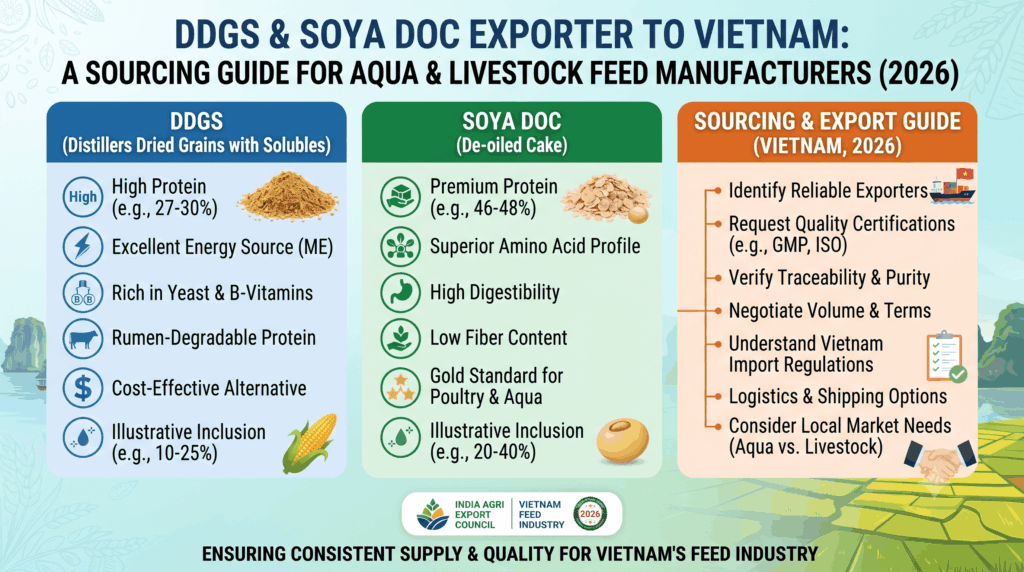
Vietnam’s aquaculture feed industry is one of the fastest-growing in Southeast Asia — valued at roughly $2.70 billion in 2025 and projected to reach $4.36 billion by 2031, growing at an 8.3% CAGR on the back of strong shrimp and pangasius export demand. But that growth runs into a structural problem: Vietnam imports the bulk of its protein feed ingredients. Soybean meal imports alone are projected to hit 7.3 million metric tons in 2026, and the country remains heavily dependent on imported fishmeal and fish oil — inputs that account for 50–60% of total feed production cost and are exposed to global price swings. (Mordor Intelligence)
For Vietnamese feed millers and aqua feed manufacturers, that means one thing: diversifying protein sourcing isn’t optional, it’s a margin strategy. This guide covers where Indian DDGS and Soya DOC fit into that strategy, and what to check before choosing a supplier.
Why Vietnam’s Feed Industry Is Looking at Indian Raw Materials
A few forces are pushing Vietnamese buyers to diversify beyond their traditional South American soybean meal and imported fishmeal base:
- Import concentration risk. With soybean meal imports running into the millions of tons and heavily sourced from Argentina and Brazil, any freight, tariff, or crop-year disruption in South America hits Vietnamese feed costs directly. A secondary, geographically distinct supply base reduces that exposure.
- Fishmeal price volatility. Fishmeal remains essential for hatchery and starter feeds, but it’s expensive and supply-constrained. Blending in plant- and grain-based proteins like Soya DOC and Rice DDGS reduces total formulation cost without abandoning fishmeal entirely.
- Policy tailwinds. Vietnam’s Decree 73/2025/ND-CP introduced tax exemptions and reductions on corn and soybean meal imports specifically to ease feed-cost pressure on domestic producers — a signal that import diversification is being actively encouraged, not just tolerated.
- Rice-based formulation fit. Cereal by-products (rice bran and similar) already make up 25–30% of typical pangasius feed formulations. Rice DDGS — a protein-concentrated co-product of rice-based ethanol production — slots into that same formulation logic while adding protein density that raw rice bran doesn’t offer.
What Indian DDGS and Soya DOC Bring to Vietnamese Feed Formulations
| Ingredient | Crude protein | Typical use in Vietnamese feed | Fit |
|---|---|---|---|
| Rice DDGS | 40–45%+ | Partial soybean meal/fishmeal replacement in pangasius, shrimp, tilapia, and carp diets | Complements existing rice-bran-heavy formulations; adds protein and energy density |
| Maize DDGS | 28–32% | Poultry, swine, and cattle feed; supplemental protein-energy source in aqua blends | Consistent amino acid profile from ethanol co-production |
| Soya DOC | 44–48% | Primary plant protein alongside or blended with South American soybean meal | Diversifies protein sourcing without reformulating from scratch |
These aren’t full fishmeal or soybean meal replacements in every diet — but as blended components, they let Vietnamese formulators hold protein and energy targets while reducing dependence on any single import corridor.
What to Check Before Choosing an Export Supplier
Sourcing feed raw material across a border adds risk that domestic sourcing doesn’t — customs delays, documentation gaps, and inconsistent quality are the most common failure points. Before committing to a supplier, Vietnamese buyers should confirm:
| Checklist item | Why it matters |
|---|---|
| GAFTA/FOSFA compliance | These are the international trade-association standards most commodity buyers and banks expect for grain and feed shipments; non-compliant suppliers can create customs and financing friction |
| Certificate of Analysis (COA) per shipment | Batch-level protein, moisture, and mycotoxin data — not just a generic spec sheet — is what lets your QA team clear each container without guesswork |
| Phytosanitary certification and export documentation handled by the supplier | Import clearance in Vietnam moves faster when the exporter — not the buyer — owns the paperwork |
| Quality certifications (ISO, HACCP) | Baseline evidence of process control, especially relevant for aqua feed given how sensitive shrimp and larval fish are to mycotoxin contamination |
| Track record of export volume and consistency | A supplier with an established export history is lower-risk than one shipping internationally for the first time |
| Single-supplier product range | Sourcing Rice DDGS, Maize DDGS, and Soya DOC from one supplier simplifies logistics and reduces the number of vendor relationships to manage |
Why Feed Manufacturers Source From Brinda Foods
Brinda Foods has supplied feed-grade raw material to Indian manufacturers since 1987, and exports to 25+ countries including Vietnam, UAE, and Thailand. On the checklist above:
- ISO 9001:2015 certified, with HACCP and CLFMA membership
- GAFTA and FOSFA compliant exports, with a Certificate of Analysis (COA) provided on every shipment
- Full export documentation handled end-to-end — phytosanitary certificates, COAs, and compliance paperwork — so the burden isn’t on the buyer’s customs team
- One supplier for Rice DDGS, Maize DDGS, Soya DOC, Mustard DOC, and De-Oiled Rice Bran, simplifying sourcing for feed millers who blend multiple protein sources
- Technical oversight from Dr. Rishabh Chugh (BVSc/MVSc, NDRI Karnal), Director, providing formulation-level credibility beyond a pure commodity trading relationship
For aqua feed buyers specifically, mycotoxin-controlled processing and batch-level lab reporting matter more than in terrestrial livestock feed — shrimp and larval fish tolerate almost no margin for contamination. That’s the same quality bar Brinda Foods already applies across its India-market supply, now extended to export customers.
FAQ
Does Brinda Foods export DDGS and Soya DOC to Vietnam? Yes. Brinda Foods exports to 25+ countries including Vietnam, UAE, and Thailand, with full export documentation — phytosanitary certificates, Certificates of Analysis, and compliance paperwork — handled for every shipment.
Is Brinda Foods’ DDGS suitable for aquaculture feed? Yes. Rice DDGS and Soya DOC are both used as partial protein replacements in shrimp, pangasius, carp, and tilapia feed formulations, typically blended alongside soybean meal or fishmeal rather than as a sole protein source.
What certifications does Brinda Foods hold for export? Brinda Foods is ISO 9001:2015 certified, HACCP compliant, a CLFMA member, and exports in line with GAFTA and FOSFA international trade standards.
What is the crude protein content of Brinda Foods’ Maize DDGS and Soya DOC? Maize DDGS contains 28–32% crude protein; Soya DOC runs 44–48%. Exact batch values are confirmed via the Certificate of Analysis provided with each shipment.
How do I request a bulk export quote? Submit a request through the enquiry page with your required product, volume, and destination port, and the Brinda Foods export team will respond with pricing and documentation timelines.