Quick Answer:
Mills are paying ₹27 to ₹28 a kilo for maize this month, about double what it cost in 2019. Ethanol plants are buying hard; two big southern states planted less, and imports are still tightly capped. The kharif harvest will bring some relief, just not overnight.
Every week, at least one mill owner calls me with the same question. “Doctor sahab, when will maize come down?”
My honest answer: a little, soon. A lot? Not this season.
Maize is more than half of what goes into a broiler feed bag. A one rupee jump in maize is felt across your entire product line within days. This year we haven’t had one rupee jumps. We’ve had several of them, one after another.
Still, I’m not gloomy about it. Harvest season is starting, and feed mills today have more tools than they had during the 2024 squeeze. Let me explain what’s going on and what I’d do if I were running a mill right now.
Where the Price Actually Is?
Mint reported in late September that poultry buyers were paying ₹27 to ₹28 per kg (ChiniMandi carried the story too). Six or seven years back, the same grain went for ₹12 to ₹14.
Mandi rates look lower, but they’re farm gate numbers. By the time grain is cleaned, dried, loaded, trucked and the trader takes his margin, it costs a good deal more.
MSP for kharif maize this year is ₹2,410 a quintal. On 13 October, the state averages looked like this:
| State | Avg. mandi price (₹/quintal) | Approx. ₹/kg | Versus MSP |
| Tamil Nadu | 2,658 | 26.6 | +10% |
| Karnataka | 2,629 | 26.3 | +9% |
| Telangana | 2,547 | 25.5 | +6% |
| Andhra Pradesh | 2,545 | 25.5 | +6% |
| Gujarat | 2,417 | 24.2 | At par |
| Maharashtra | 2,313 | 23.1 | −4% |
| Uttar Pradesh | 2,215 | 22.2 | −8% |
| Madhya Pradesh | 2,041 | 20.4 | −15% |
| Rajasthan | 2,021 | 20.2 | −16% |
| Bihar | 1,750 | 17.5 | −27% |
Source: Agmarknet-based state averages compiled by acrop.app, 13 October 2026.
The South is well above MSP. That makes sense, because that’s where the big poultry belts are, and Karnataka’s crop is short this year. In the North, early kharif grain has started coming
in, so rates are softer there. Once you add freight, though, most of us are still looking at ₹27 or
₹28 at the mill gate.
Feed prices have gone up with it. Business Today put poultry feed at about ₹25 a kilo in April and over ₹30 by September.
When and From Where Fresh Grain Arrives?
We get two harvests a year, which is a blessing if you plan for it.
| Season | Key states | Arrival window | What to expect |
| Early kharif | Madhya Pradesh, Rajasthan, Gujarat, Uttar Pradesh, Maharashtra | Late September to November | First new grain; often wet |
| Main kharif | Karnataka, Telangana, Andhra Pradesh, Maharashtra, Bihar | November to January | Karnataka from mid November, peak in December |
| Rabi | Bihar, Andhra Pradesh, Telangana, Tamil Nadu, West Bengal | March to June | Drier, cleaner; Bihar is key for the North |
Nationally, kharif maize area is only about 2 percent lower than last year: 93.02 lakh hectares against 94.89, according to Agriculture Ministry sowing data. That sounds fine until you see where the drop happened. Karnataka planted 20.4 percent less maize and Maharashtra 10.6 percent less, mostly because the June rains failed when El Niño set in. Trade estimates suggest Karnataka’s crop could be down by about a quarter.
So I’d expect prices to drift lower through November and December, not fall off a cliff.
Ethanol, Food, Feed: Everyone Wants the Same Grain!
Ethanol is the reason this market feels so different now.
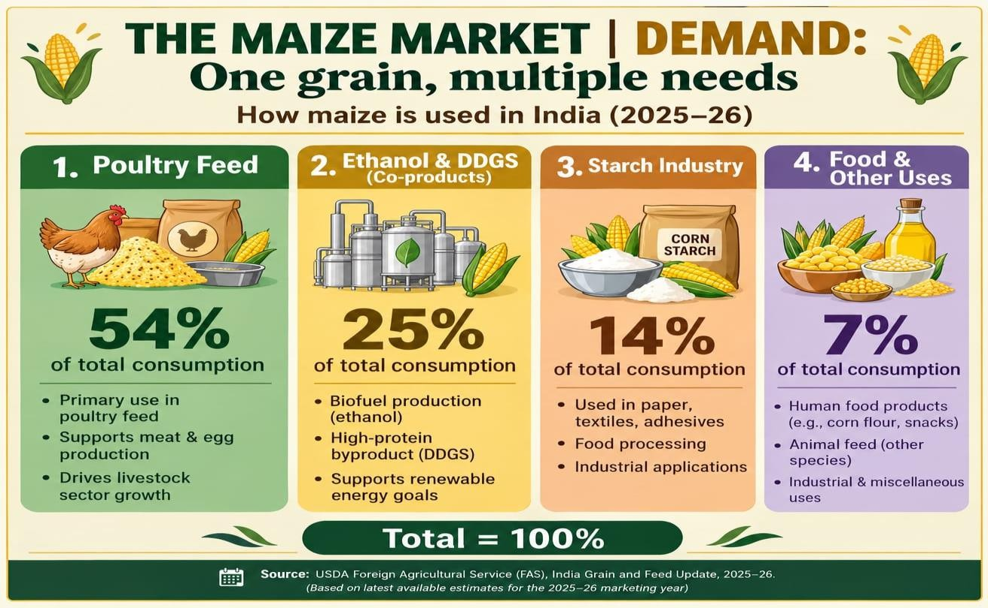
In 2021-22, maize contributed nothing to India’s ethanol blending. By the current supply year it supplies around 37 percent. The Economic Times (via ChiniMandi) reckons distilleries use around 17 million tonnes of maize now. In 2022 they were using roughly one million.
Look at the policy side and you’ll see why this isn’t slowing down. E20 petrol became standard from 1 April. Maize ethanol fetches ₹71.86 a litre, which is better than most other feedstocks. Sugar looks tight for next year as well, so the Grain Ethanol Manufacturers Association expects distilleries could need 40 to 50 percent more maize.
Food and starch buyers haven’t gone anywhere either. Starch units, snack makers and cornflake brands keep buying steadily, and they pick off the cleanest lots because they pay extra for them.
Then there’s us. Poultry alone uses about 60 percent of India’s maize. We’re still the biggest buyer, but we’re now bidding against distilleries backed by government pricing. Some in the industry have warned of a shortfall of up to 17 million tonnes for 2025-26, record crop or not.
There’s one upside I’d point every nutritionist to. All that ethanol production throws off DDGS. Our own October price guide has bulk Maize DDGS at ₹12.5 to ₹15.5 a kilo, with 28 to 32 percent crude protein. Used within sensible limits, it can take real pressure off your protein bill.
What About Imports?
Imports can help at the edges, but they won’t solve this.
India allows 0.5 million tonnes a year at 15 percent duty under the tariff rate quota. Above that, you’re paying around 50 percent. And it has to be non-GM, which leaves very few countries that can supply.
We did import about 0.9 million tonnes in 2024. Down To Earth, quoting Commerce Ministry data, pointed out that this was more than the previous seven years put together. Most of our imported maize now comes from Myanmar, around two thirds by value, while Ukrainian supply has dried up.
Poultry bodies keep asking for duty-free imports. Nothing new has been announced for this season so far. The other thing worth watching is the interim India and US trade deal from February, which allows a quota of American DDGS at lower duty. Edible oil processors have warned it could affect domestic feed and maize markets, so keep an eye on how that plays out.
Can Mills Take the Hit?
Quick sum. If maize is 60 percent of your broiler ration, every rupee it rises adds about 60 paise to a kilo of feed. Going from ₹22 to ₹28 adds around ₹3.60. That’s roughly the increase we’ve all watched happen this year.
Integrators have pushed some of it onto egg and chicken prices. Some retailers are quietly absorbing part of it so customers don’t walk away. Mills are caught in the middle.
So can we absorb it? I think so, but it means changing how we buy. The mills I see doing well right now plan their buying a season ahead instead of reacting to each week’s rate.
What I’d Do This Season?
- Buy with the harvest. November to January, then March to May. Those are your windows. Building big stocks in July or August, when everyone is short, is how you overpay.
- Don’t pay for water. New kharif maize is often damp. Hold the line at 14 percent moisture and put the deduction formula in the contract. It’s a small thing that saves real money over a season.
- Test for aflatoxin on every lot. I’d make this non-negotiable, because late rain plus rushed drying raises the risk. Ask for a lab report on B1 with each truck.
- Loosen your energy mix a bit. The Consumer Affairs Ministry itself has said mills are using broken rice, bajra, rice bran and wheat by-products. Sit with your nutritionist, run the least cost numbers, and see what a few percent of substitution does to your margin.
- Use DDGS. Maize DDGS and Rice DDGS are easier to source than they’ve ever been. Every rupee you save on protein is a rupee you can spend on maize.
- Book part of your volume early. Thirty to fifty percent with a supplier you trust, with specs in writing. You’re protected if prices spike and still flexible if they ease.
- Watch Delhi as closely as the weather. The new ethanol year starts in November. A grain allocation decision or a duty change can move this market faster than any rain forecast.
Where This Leaves Us?
Maize isn’t just feed anymore. It’s fuel too, and I don’t see that changing.
But I’m hopeful. India grows far more maize than it did a few years ago, fresh grain is days away from the mandis, and DDGS is more plentiful than ever. Mills that buy with the seasons, check what comes through the gate, and stay flexible on formulation will come through this with their margins mostly intact.
About the Author!
Dr. Rishabh Chugh is a veterinarian and animal nutrition specialist at Brinda Foods, a family-run feed raw material supplier since 1987. He works with feed manufacturers on DDGS, dairy nutrition and feed quality.
Brinda Foods supplies feed-grade Maize, Maize DDGS, Rice DDGS, Soya DOC, Mustard DOC, De-Oiled Rice Bran, Maize Gluten and Rice Gluten to feed manufacturers across India. Every batch ships with its nutritional specification sheet.
Bulk enquiries: 9992500442 | sales1@brindafoods.com | www.brindafoods.com