
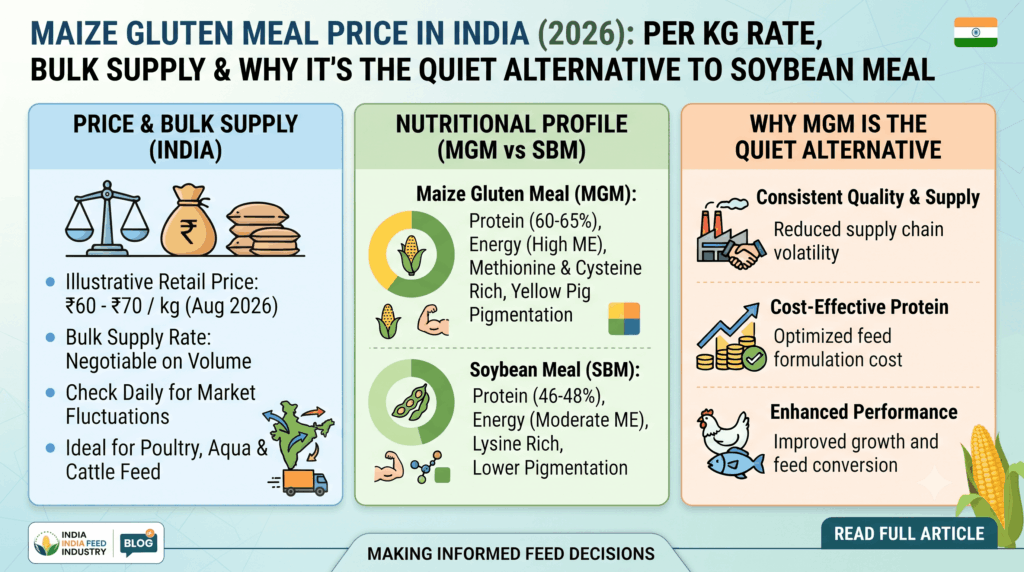
Quick answer: As of September 2026, Maize Gluten Meal (MGM, also called corn gluten meal, 60% crude protein) trades between ₹35–48/kg for verified, lab-tested bulk feed-grade material in India, with premium low-moisture, consistent-colour lots running up to ₹48–52/kg. This is meaningfully cheaper, per unit of protein, than soybean meal — which remains elevated even after easing from its mid-2026 peak — which is why more feed mills are quietly adding maize gluten meal into rations that used to lean almost entirely on soya.
A word of caution before you shop by price alone: general marketplace listings for “maize gluten” range wildly, from around ₹10/kg to ₹45/kg, because a large share of that inventory is actually lower-protein maize gluten feed (roughly 20% CP, a different byproduct) mislabelled or loosely labelled alongside genuine 60% CP maize gluten meal. Confirm the protein guarantee before comparing any two quotes.
Current Maize Gluten Meal Price (October 2026)
| Grade / Protein | Typical Price Range | Best Suited For |
|---|---|---|
| Standard bulk, 60% CP (±2%) | ₹35–42/kg | Cattle, dairy, general poultry rations |
| Premium, low-moisture, consistent colour grade | ₹42–48/kg | Broiler/layer feed (pigmentation-sensitive), aquaculture |
| Verified export-spec material | ₹48–52/kg | Feed mills matching international buyer specs |
| Mislabelled “maize gluten” (actually low-protein gluten feed, ~20% CP) | ₹10–20/kg — not comparable | Should not be priced or purchased against MGM specs |
| Bulk / mill-direct (multi-tonne, contract) | Lower end of the 60% CP range, negotiated further on volume | Feed mills, integrators, large dairy operations |
Maize Gluten Meal is a comparatively young commodity category in the Indian feed trade — supply is concentrated around maize wet-milling and starch-processing hubs, and pricing data is thinner and less standardised than for established commodities like Soya DOC or DDGS. Treat the range above as directional and always request a lab certificate rather than relying on a marketplace listing price.
Quick Read: Mustard DOC Price in India (2026)
Quick Read: DORB Price in India (2026)
Why Maize Gluten Meal Is Getting a Second Look in 2026
Maize Gluten Meal isn’t new to Indian feed formulation, but it has stayed a niche ingredient — used mainly for its natural xanthophyll pigmentation in poultry diets — while soya DOC did most of the protein heavy lifting. That’s shifting.
The soybean meal crisis changed the math. India’s 2025–26 soybean crop fell roughly 17% year-on-year, and soybean meal prices spiked past ₹65/kg at their mid-2026 peak before easing to roughly ₹57–59/kg by late July, per SOPA’s ex-factory Indore data — still historically elevated, with little relief expected before the new kharif crop reaches crushing plants around September–October. See our full breakdown in the soybean meal crisis in India (2026). Against that backdrop, a 60% crude protein ingredient priced well under soybean meal on a per-kg-of-protein basis is hard for formulators to ignore.
It’s a concentrated protein, not a filler. At 60% CP, Maize Gluten Meal packs roughly 30% more protein per kilogram than standard Soya DOC (42–46% CP) and more than double Mustard DOC (35–38% CP). That density matters when freight is a meaningful share of delivered cost — you’re paying to move less dead weight per unit of protein delivered.
Cost per kg of protein — the number that actually matters. At representative October 2026 prices, soybean meal (₹58/kg ÷ 46% CP) works out to roughly ₹126 per kg of protein delivered. Maize Gluten Meal (₹40/kg ÷ 60% CP) works out to roughly ₹67 per kg of protein — nearly half the cost. Even against Soya DOC’s more moderate bulk feed-grade pricing (₹43/kg ÷ 45% CP ≈ ₹96/kg protein), Maize Gluten Meal still comes out meaningfully cheaper per unit of protein.
It solves two specs at once. Beyond protein, Maize Gluten Meal carries high metabolizable energy, so it contributes to both the protein and energy lines of a ration simultaneously — useful when you’re trying to hit two formulation targets without adding a third ingredient.
Maize Gluten Meal vs. Soybean Meal, Soya DOC & Maize DDGS: Cost Comparison
| Ingredient | Typical Price (October 2026) | Crude Protein | Approx. Cost per kg of Protein |
|---|---|---|---|
| Soybean Meal (ex-factory, premium grade) | ₹57–66/kg | 44–48% | ~₹126/kg protein |
| Soya DOC (standard bulk feed-grade) | ₹40–46/kg | 44–46% | ~₹96/kg protein |
| Maize Gluten Meal | ₹35–48/kg | 60% (±2%) | ~₹67/kg protein |
| Maize DDGS | ₹12.5–15.5/kg | 28–32% | ~₹47/kg protein |
| Mustard DOC | ₹20–27/kg | 35–38% | ~₹63/kg protein |
Maize DDGS still wins on raw cost-per-protein because it’s a lower-value byproduct to begin with, but it can’t match Maize Gluten Meal’s protein density or its energy contribution per kilogram — the two ingredients solve different formulation problems rather than compete head-on. Most mills that adopt Maize Gluten Meal use it as a protein “top-up” layered alongside Soya DOC, Mustard DOC, or DDGS, not as a wholesale replacement. For the fuller ingredient-by-ingredient breakdown, see our DDGS vs. Soya DOC vs. Mustard DOC vs. DORB comparison guide.
What Determines the Price You Actually Pay
Crude protein guarantee. The single biggest price driver. Genuine 60% CP material commands a real premium over the loosely labelled “maize gluten” listings that are actually closer to 20% CP maize gluten feed — always request lab verification, not a label claim.
Moisture content. Feed-grade Maize Gluten Meal should run under 10–12% moisture. Higher-moisture lots are cheaper but risk mould and reduced shelf life, and you’re effectively paying protein-grade prices for water weight.
Colour consistency. A uniform yellow colour signals proper wet-milling and drying, and matters commercially if you’re using the ingredient partly for its pigmentation value in poultry diets — inconsistent colour batches undermine that use case even if protein specs check out.
Proximity to wet-milling/starch plants. Supply is concentrated around India’s maize starch processing hubs; buyers further from those hubs pay a growing freight premium, similar to the dynamic seen with DORB and rice-milling regions.
Order volume and contract terms. As with every bulk feed raw material on this list, single-lot marketplace pricing overstates what mills and larger operations should be paying. Multi-tonne, recurring-order buyers have real room to negotiate below listed rates.
How to Buy Maize Gluten Meal in Bulk Without Overpaying
1. Insist on a lab certificate confirming 60% (±2%) crude protein before comparing any quotes. This is the single most important step — a cheap “maize gluten” quote is frequently a different, much lower-protein product.
2. Check moisture and colour together, not separately. Both indicate processing quality, and a lot that’s off on one is often off on the other.
3. Compare cost per kg of protein, not sticker price, against your current soya or mustard DOC spend. Maize Gluten Meal’s real value proposition only shows up when you run the protein-adjusted math.
4. Source from a supplier with consistent batch-to-batch specification. Because this is a comparatively newer, less standardised category in the Indian market, supplier consistency matters more here than for an established commodity like Soya DOC.
5. Factor in amino acid balance before scaling inclusion. Maize Gluten Meal is relatively strong in methionine but, like other maize-derived proteins, needs checking against lysine requirements — particularly in poultry starter diets — before you push inclusion rates up.
Frequently Asked Questions
What is the current Maize Gluten Meal price per kg in India? As of October 2026, genuine 60% CP Maize Gluten Meal trades between ₹35–48/kg for bulk feed-grade material, with premium low-moisture, consistent-colour lots running up to ₹48–52/kg. Marketplace listings as low as ₹10–20/kg typically reflect a different, lower-protein product (maize gluten feed, ~20% CP) rather than genuine maize gluten meal — always confirm the protein guarantee.
Is Maize Gluten Meal cheaper than soybean meal? On a cost-per-kg-of-protein basis, yes — meaningfully so. At representative October 2026 prices, Maize Gluten Meal works out to roughly ₹67 per kg of protein delivered versus roughly ₹126 per kg for soybean meal, even after soybean meal eased from its mid-2026 peak.
Can Maize Gluten Meal fully replace soybean meal or Soya DOC in a ration? No — it’s best used as a concentrated protein top-up alongside Soya DOC, Mustard DOC, or DDGS rather than a full replacement. Amino acid balance, particularly lysine, should be checked before scaling inclusion, especially in poultry starter diets.
What’s the difference between maize gluten meal and maize gluten feed? Maize gluten meal is the high-protein fraction (around 60% CP) separated during maize wet-milling. Maize gluten feed is a separate, much lower-protein byproduct (roughly 20% CP) from the same process. The two are frequently confused in marketplace listings, which is why price comparisons across “maize gluten” listings can be so wide and misleading.
Where can I get a bulk quote for Maize Gluten Meal? Brinda Foods supplies Maize Gluten in bulk from Panipat, Haryana, to feed mills and integrators across North India, with every batch lab-tested for protein, moisture, and aflatoxin before dispatch. Send an enquiry for a current bulk quote — pricing is confirmed at time of order given how thin and fast-moving this market segment still is.
About Brinda Foods
Brinda Foods has supplied animal feed raw materials from Panipat, Haryana since 1987. We provide bulk supply of Maize Gluten, Soya DOC, Mustard DOC, De-Oiled Rice Bran (DORB), Maize DDGS, Rice DDGS, and other feed ingredients to mills and farms across North and Central India. ISO 9001:2015 certified.
Get today’s bulk quote: Send an enquiry | Call: [9992500442]


[…] Comparison IndiaCorn DDGS Price India 2026Rice Gluten Meal Price India 2026Dorb Price In India 2026Maize Gluten Meal Price India 2026Soya Doc Price India 2026Maize DDGS Price India 2026Mustard Doc Price India 2026Maize Animal Feed […]
[…] Comparison IndiaCorn DDGS Price India 2026Rice Gluten Meal Price India 2026Dorb Price In India 2026Maize Gluten Meal Price India 2026Soya Doc Price India 2026Maize DDGS Price India 2026Mustard Doc Price India 2026Maize Animal Feed […]
[…] IndiaCorn DDGS Price India 2026Rice Gluten Meal Price in India 2026Dorb Price in India 2026Maize Gluten Meal Price India 2026Soya Doc Price India 2026Maize DDGS Price India 2026Mustard Doc Price India 2026Maize Animal Feed […]