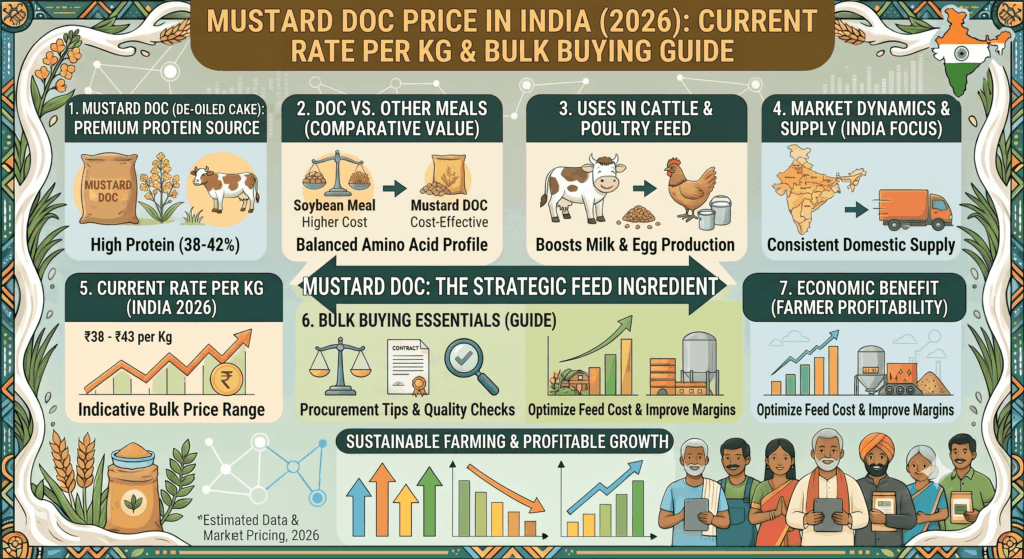
Quick answer: As of September 2026, Mustard DOC (De-Oiled Cake, also called sarson khal) is trading between ₹20–27/kg for standard feed-grade bulk lots (35–38% crude protein), with premium low-glucosinolate or higher-protein lots running up to ₹28–32/kg. Rates have firmed slightly from earlier in the year, tracking a strengthening mustard seed market — national average mandi seed prices were running about 21% above MSP as of end-July. Retail and small-lot listings on general marketplaces range more widely, from ₹18/kg for lower-grade material up to ₹35–36/kg for organic or specialty-grade cake — reflecting the wide quality spread in this market more than genuine price movement.
Because Mustard DOC pricing tracks the mustard seed crushing cycle closely, always confirm today’s rate with your supplier rather than relying on last month’s number.
Current Mustard DOC Price Snapshot (September 2026)
| Grade / Protein | Typical Price Range | Best Suited For |
|---|---|---|
| Standard feed-grade, 35–38% CP | ₹20–27/kg | Cattle, buffalo, sheep, goat rations |
| Higher-protein / low-glucosinolate grade | ₹27–32/kg | Poultry blends, premium ruminant diets |
| Small-lot / retail (under 1 tonne) | ₹18–36/kg (wide spread by quality) | Individual farmers, small feed shops |
| Bulk / mill-direct (multi-tonne, contract) | Below listed retail rates — negotiated | Feed mills, dairy cooperatives, large livestock operations |
These ranges reflect North Indian sourcing hubs — Haryana, Punjab, Rajasthan, UP — where most of India’s mustard crushing capacity is concentrated. As a rough conversion reference, mustard seed was averaging ₹7,278/quintal (₹72.8/kg) nationally as of 31 July 2026, per Agmarknet data — about 21% above the government’s ₹6,000/quintal MSP, with Haryana, Rajasthan, and Punjab mandis running ₹74–76/kg and UP somewhat lower around ₹68/kg. A standard quintal of seed yields roughly 60 kg of de-oiled cake alongside 38–40 kg of oil, which is the underlying driver of DOC supply and price.
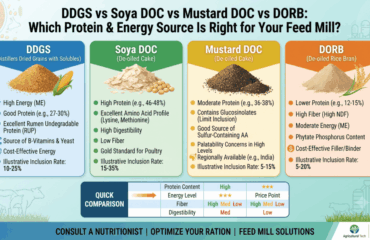
Quick Read : Soya DOC Price in India (2026)
Quick Read : DORB Price in India (2026)
Why Mustard DOC Is India’s Most Underpriced Protein Source
Mustard DOC consistently trades at ₹8–12/kg cheaper per unit of protein than Soya DOC, India’s dominant feed protein source — yet it remains under-used relative to its cost advantage. A few factors explain both the price gap and the underuse:
Domestic, non-import-dependent supply. Unlike Soya DOC, which is exposed to international soybean meal price swings, Mustard DOC is produced entirely from India’s domestic mustard crop — concentrated in Rajasthan, Haryana, MP, and UP. This insulates it from the kind of global price shocks that pushed Soya DOC up roughly 25–30% over the past 18+ months.
Glucosinolate perception. Mustard DOC’s natural glucosinolate content (which can affect palatability and thyroid function at high inclusion rates) has historically limited its use to conservative inclusion levels, keeping demand — and price — lower than its protein value would otherwise support. In practice, glucosinolates are a manageed formulation variable, not a hard limit, particularly in ruminants where rumen microbes partially degrade them.
Regional supply concentration. Because mustard crushing is concentrated in specific belts, buyers outside those regions often pay a freight premium that isn’t reflected in mandi-side pricing — one reason marketplace listings show such a wide ₹15.50–36/kg spread.
What Determines the Price You Actually Pay
Crude protein and glucosinolate level. Standard Mustard DOC runs 35–38% CP; low-glucosinolate, higher-protein lots command a ₹4–6/kg premium and are worth it for poultry or high-inclusion ruminant formulas.
Oil residue. Feed-grade Mustard DOC should carry low residual oil (expeller vs. solvent-extracted cake differs meaningfully) — solvent-extracted cake is typically cheaper and more consistent for bulk feed use.
Moisture content. Should be under 10–11% for safe storage; higher-moisture lots are cheaper but carry mould risk and reduce actual protein delivered per bag.
Order volume and contract terms. As with all feed raw materials, single-bag retail pricing overstates what mills and larger operations actually pay. Multi-tonne, recurring-order buyers should be negotiating meaningfully below listed retail rates.
Season. Mustard is harvested primarily in spring (March–April), so DOC supply — and typically price — is most favourable in the months immediately following harvest, tightening later in the year.
Mustard DOC vs. Soya DOC: Cost and Formulation Comparison
| Factor | Mustard DOC | Soya DOC |
|---|---|---|
| Price (September 2026) | ₹20–27/kg (standard grade) | ₹40–46/kg (standard grade) |
| Crude protein | 35–40% | 44–46% |
| Cost per kg of protein | ₹8–12/kg cheaper | Baseline |
| Key limitation | Glucosinolates limit inclusion rate | None major; price is the main constraint |
| Best inclusion rate (cattle/buffalo) | 10–15% of ration | Flexible |
| Best inclusion rate (poultry) | 5–8%, with monitoring | Flexible |
The practical approach most Indian feed millers take isn’t full replacement — it’s partial substitution, typically swapping 20–35% of a formula’s Soya DOC for Mustard DOC to meaningfully cut protein cost while staying within safe inclusion limits. Species-specific inclusion rates, glucosinolate management, and formulation guardrails are covered in full in our Complete Mustard DOC Guide for Feed Millers.
How to Buy Mustard DOC in Bulk Without Overpaying
1. Confirm crude protein and glucosinolate level in writing. These two specs, more than price alone, determine what you’re actually getting — a cheap lot with high glucosinolates and low protein can cost more in performance than it saves in price.
2. Ask whether the cake is expeller-pressed or solvent-extracted. Solvent-extracted cake generally offers more consistent protein and oil specs at bulk scale, which matters more as order size grows.
3. Buy closer to harvest season (April–June) if you can store it. Post-harvest pricing is typically most favourable; buyers who can commit to larger, well-timed purchases capture meaningful savings over spot-buying later in the year.
4. Compare cost-per-unit-of-protein against Soya DOC, not just the sticker price. Mustard DOC’s real value proposition is the ₹8–12/kg protein cost advantage — make sure your formulation is actually capturing it.
5. Source from a supplier with consistent regional supply, not just the lowest online quote. Marketplace listings showing ₹15.50/kg are often small lots, lower grades, or unverified quality — confirm specs before treating any single listing as the market rate.
Frequently Asked Questions
What is the current Mustard DOC price per kg in India? As of September 2026, standard feed-grade Mustard DOC (35–38% CP) trades between ₹20–27/kg for bulk orders, with premium low-glucosinolate or higher-protein grades running ₹27–32/kg. Small-lot marketplace listings show a much wider ₹18–36/kg range, largely reflecting quality and volume differences rather than genuine market movement. Rates have firmed modestly as mustard seed itself trades about 21% above MSP nationally.
Why is Mustard DOC cheaper than Soya DOC? Mustard DOC typically costs ₹8–12/kg less per unit of protein than Soya DOC, largely because it’s a domestic, non-import-dependent product with lower per-unit processing value than soybean, and because glucosinolate-related inclusion limits have historically kept broader demand — and pricing power — lower.
Is Mustard DOC safe to feed at high inclusion rates? Glucosinolates limit high inclusion, but managed correctly — 10–15% in cattle and buffalo diets, 5–8% in poultry with monitoring — Mustard DOC is safe and widely used commercially in India. Full inclusion guidance by species is in our Mustard DOC Complete Guide.
What’s the difference between Mustard DOC and mustard cake (khal)? The terms are often used interchangeably in Indian markets, though “cake” or “khal” sometimes refers to expeller-pressed material with higher residual oil, while “DOC” (De-Oiled Cake) specifically indicates solvent extraction with minimal residual oil. Confirm the extraction method with your supplier, as it affects both price and nutritive value.
Where can I get a bulk quote for Mustard DOC? Brinda Foods supplies Mustard DOC in bulk from Panipat, Haryana, to feed mills and farms across North and Central India. Request a current bulk quote — pricing is confirmed at time of order given seasonal and daily rate movement.
About Brinda Foods
Brinda Foods has supplied animal feed raw materials from Panipat, Haryana since 1987. We provide bulk supply of Mustard DOC, Soya DOC, De-Oiled Rice Bran (DORB), Maize DDGS, Rice DDGS, and other feed ingredients to mills and farms across North and Central India. ISO 9001:2015 certified.
Get today’s bulk quote: brindafoods.com/mustard-doc | Call: [9992500442]

[…] Quick Read: Mustard DOC Price in India (2026) […]
[…] Quick Read: Mustard DOC Price in India (2026) […]
[…] current alternative-protein pricing, see our guides on Mustard DOC and DORB, and for the full soybean meal crisis breakdown, read Soybean Meal Crisis in India […]
[…] Quick Read : Mustard DOC Price in India […]
[…] In India 2026Maize Gluten Meal Price India 2026Soya Doc Price India 2026Maize DDGS Price India 2026Mustard Doc Price India 2026Maize Animal Feed Price Nutrition Guide India 2026Rice Ddgs Price India […]