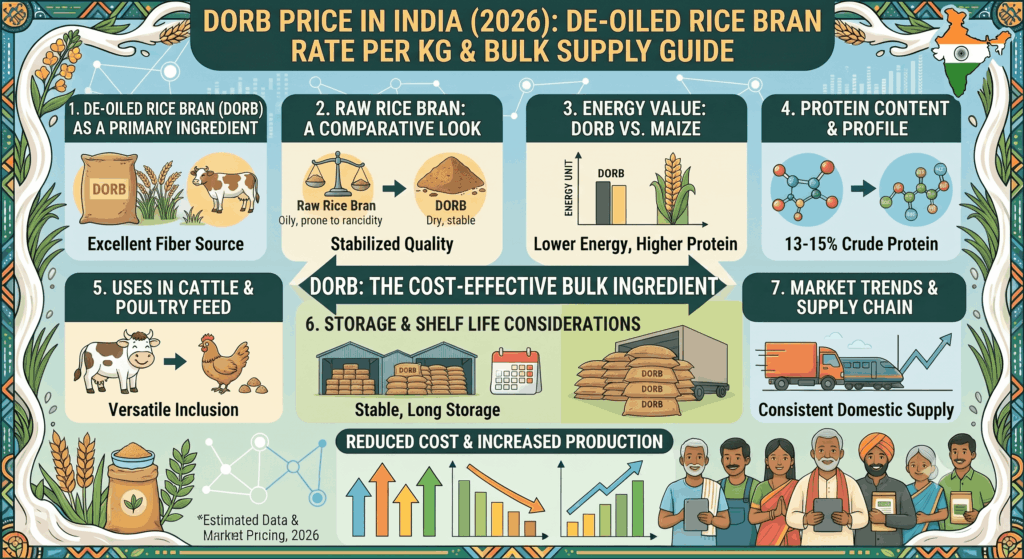
Quick answer: As of September 2026, DORB (De-Oiled Rice Bran) trades between ₹19–20/kg (₹19,000–20,000/tonne) for standard feed-grade bulk lots, with better-graded, low-FFA material toward the upper end of that range and occasionally up to ₹19–22/kg in some regional markets with tighter supply. DORB remains meaningfully cheaper than maize, though that gap has narrowed — a record 2025–26 kharif maize harvest pushed mandi maize prices below the government’s MSP for a period, and maize is now trading closer to ₹18–22/kg rather than the ₹26+/kg highs seen earlier in the year.
DORB pricing varies more by region and grading than almost any other feed raw material, so the range below is a starting point, not a substitute for confirming today’s rate with your supplier.
Current DORB Price (September 2026)
| Grade / Quality | Typical Price Range |
|---|---|
| Standard feed-grade, low FFA (under 3%) | ₹19–20/kg |
| Higher-grade, consistently graded, low oil residue | ₹13–15/kg |
| Regional premium markets (supply-constrained) | ₹21–22/kg |
| Bulk / mill-direct (multi-tonne, contract) | Lower end of range, negotiated further on volume |
DORB is produced across India’s rice-milling belt, so prices are lowest close to major rice-processing hubs — Punjab, Haryana, UP, Andhra Pradesh, and West Bengal — and rise with distance from those regions due to freight.
Why DORB Pricing Varies So Widely
Unlike Soya DOC or Mustard DOC, which trade in a relatively tight band, DORB listings across Indian marketplaces show an unusually wide spread — from around ₹19/kg to over ₹20/kg for material described the same way. Three factors explain most of that spread:
Grading inconsistency. DORB quality depends heavily on residual oil content (should be 1–2% post-extraction) and free fatty acid (FFA) level. High-FFA DORB (above 3%) is cheaper but can depress palatability and cause digestive issues — so lower price often reflects lower grade, not a better deal.
Extraction method. Solvent-extracted DORB (lower residual oil, more consistent) commands a premium over expeller-pressed material, which is cheaper but less standardized.
Proximity to rice mills. Because DORB is a byproduct of rice bran oil extraction, and India’s rice-milling capacity is concentrated regionally, buyers near major hubs pay meaningfully less than buyers sourcing from further away — a bigger swing factor for DORB than for most other feed raw materials, given its relatively low per-kg value makes freight a larger share of delivered cost.
Seasonal rice harvest timing. Supply is most abundant shortly after the main rice harvest (roughly October–December and April–May depending on region), typically the most favourable buying window.
Export demand reopening. The government lifted a two-year export ban on DORB in October 2025 to support the rice-milling and solvent extraction industry, after having imposed it in 2023 to keep domestic feed supply and prices stable. Renewed export demand from Vietnam, Thailand, and other Asian buyers is a factor that could firm up domestic DORB prices later in 2026 as it competes with feed-sector demand — worth watching if you’re planning large forward purchases.
Quick Read : Mustard DOC Price in India (2026)
Quick Read : Soya Doc Price in India (2026)
Why DORB Is a Cost-Effective Energy Substitute for Maize
DORB remains meaningfully cheaper than maize, though the gap has narrowed since earlier in 2026. A record 2025–26 kharif maize harvest (production estimated near 422 lakh tonnes, up from 377 lakh tonnes the year before) pushed mandi maize prices below the government’s MSP of ₹24/kg for a period, and maize is now trading in roughly the ₹18–22/kg range in most mandis and on NCDEX feed futures — well off the ₹26+/kg highs seen earlier in the year. Feed-industry buying at these lower levels could firm maize prices back up over the second half of 2026, so treat this comparison as a snapshot, not a fixed gap.
| Ingredient | Typical Price (September 2026) | Primary Role | Cost Advantage |
|---|---|---|---|
| Maize | ₹18–22/kg | Energy source | Baseline |
| DORB | ₹19–20/kg | Energy + moderate protein/fibre | ₹4–12/kg cheaper |
At 10–20% inclusion in cattle and buffalo energy formulas, and 5–10% in broiler finisher diets, DORB still delivers meaningful cost reduction with minimal to no performance impact when sourced within spec — even with maize off its earlier highs. The full manufacturing process, quality grading criteria, and inclusion guardrails are covered in How De-Oiled Rice Bran (DORB) Is Made.
What Determines the Price You Actually Pay
Free fatty acid (FFA) level. This is the single most important quality-price driver for DORB. Below 3% FFA is the standard target for feed-grade material; higher-FFA lots are cheaper but riskier for palatability and shelf life.
Residual oil content. Should be 1–2% post-extraction. Higher residual oil suggests incomplete extraction and inconsistent energy value batch to batch.
Moisture. Feed-grade DORB should be under 10–12% moisture; higher-moisture material is prone to rancidity and mould in storage, which shortens the window you have to use it.
Order volume and logistics. Because DORB is priced low per kg relative to bulk weight, freight cost has an outsized effect on total delivered price compared to higher-value ingredients like Soya DOC. Sourcing from a regionally close, established supplier often matters more for DORB than for any other raw material in your formula.
Verified extraction source. Solvent-extraction facilities with consistent process control produce more uniform DORB than smaller expeller operations — worth a modest premium if you’re formulating for poultry, where consistency matters more than in ruminant diets.
How to Buy DORB in Bulk Without Overpaying
1. Request the FFA and oil content on a lab certificate, not just a verbal spec. These two numbers, more than the quoted price, tell you what you’re actually buying.
2. Don’t assume the cheapest listing is the best deal. A ₹9/kg lot with high FFA can cost you more in reduced palatability and intake than a ₹13/kg lot with proper grading.
3. Buy from suppliers near major rice-milling regions if freight matters to your margin. Given DORB’s low per-kg value, transport cost can equal or exceed the raw material cost itself over long distances.
4. Time large purchases around harvest windows. Supply — and pricing — is typically most favourable in the months immediately following the main rice harvest in your sourcing region.
5. Confirm storage conditions before taking delivery of large volumes. DORB with elevated moisture or oil content degrades faster than drier, well-graded material — a real cost if you’re storing more than a few weeks’ supply.
Frequently Asked Questions
What is the current DORB price per kg in India? As of September 2026, standard feed-grade DORB trades between ₹19–20/kg (₹19,000–20,000/tonne) for bulk orders, with some regional markets running ₹15–22/kg where local supply is tighter. Grade (FFA level, residual oil) and proximity to rice-milling hubs are the two biggest price drivers.
Why does DORB price vary so much between suppliers? More than most feed raw materials, DORB pricing reflects real quality differences — free fatty acid level, residual oil content, and extraction method all vary significantly between lots, and freight has an outsized impact given DORB’s relatively low per-kg value. A lower price often signals lower grade, not simply a better deal.
Is DORB a good substitute for maize in feed formulas? Yes, for energy replacement at controlled inclusion rates — typically 10–20% in cattle and buffalo diets, 5–10% in broiler finisher diets. Maize has eased to roughly ₹18–22/kg in mid-2026 after a record kharif harvest, down from ₹26+/kg earlier in the year, but DORB at ₹19–20/kg still offers a real cost saving. Full guidance is in our feed cost reduction guide.
What’s a safe FFA level for feed-grade DORB? Under 3% free fatty acid is the standard target. Above that, palatability and digestive tolerance can be affected, particularly in poultry, so it’s worth requesting lab verification before large orders.
Where can I get a bulk quote for DORB? Brinda Foods supplies De-Oiled Rice Bran in bulk from Panipat, Haryana, to feed mills and farms across North and Central India, with consistent grading on FFA and oil content. Request a current bulk quote — pricing is confirmed at time of order given regional and seasonal movement.
About Brinda Foods
Brinda Foods has supplied animal feed raw materials from Panipat, Haryana since 1987. We provide bulk supply of De-Oiled Rice Bran (DORB), Soya DOC, Mustard DOC, Maize DDGS, Rice DDGS, and other feed ingredients to mills and farms across North and Central India. ISO 9001:2015 certified.
Get today’s bulk quote: brindafoods.com/de-oiled-rice | Call: [9992500442]

[…] Quick Read : DORB Price in India […]
[…] Quick Read: DORB Price in India (2026) […]
[…] Quick Read: DORB Price in India (2026) […]
[…] Quick Read : DORB Price in India […]