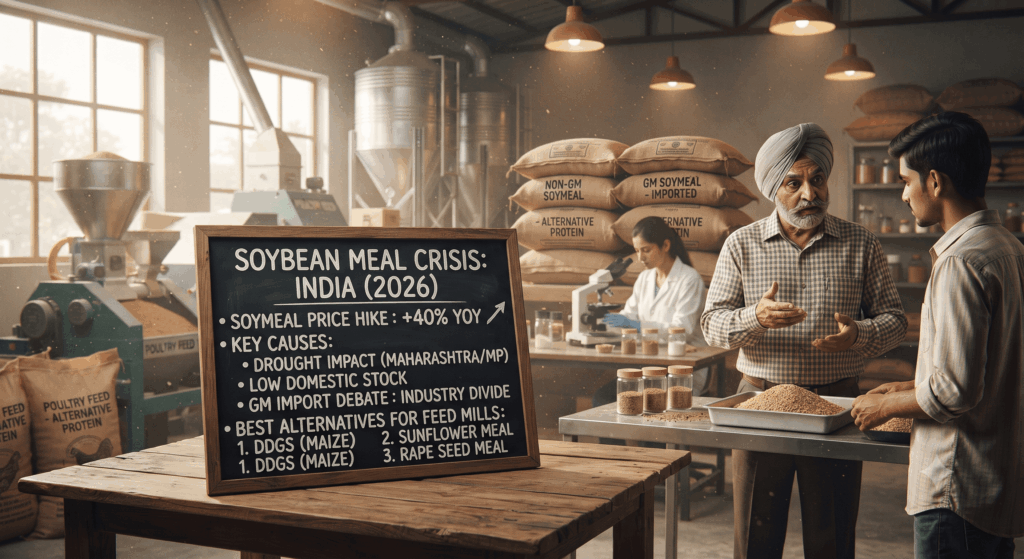
For twenty years, India was one of the world’s reliable soybean meal exporters — prized internationally precisely because it was non-GM. In the space of a few weeks in mid-2026, that story flipped. Traders cancelled export contracts, domestic prices tore past ₹65/kg, and the country that used to sell soybean meal abroad is now booking import cargoes from West Africa. If you run a feed mill, a poultry operation, or a dairy, this is the single biggest cost story of the year — and it isn’t over.
What Actually Happened
The trigger was a straightforward supply shock. India’s 2025–26 soybean crop came in at roughly 12.7 million tonnes, a 17% drop from 15.1 million tonnes the year before, largely on weaker kharif yields. Less soybean at the crushing plants meant less soybean meal coming out the other end — right as poultry and dairy demand for protein kept climbing.
The price response was fast and severe. The Compound Livestock Feed Manufacturers Association of India (CLFMA) reported soybean meal prices climbing more than 40% in a matter of weeks, reaching approximately ₹65–66 per kg — the highest level in roughly four years. On the export side, Indian traders cancelled around 25,000 tonnes of soybean meal contracts booked for May–June shipment as domestic buyers simply outbid international ones. Full-year soybean meal exports for the 2025–26 marketing year (ending September) are now tracking toward roughly 900,000 tonnes — less than half of last year’s 2.02 million tonnes.
The country has effectively swung from net exporter to net importer within a single season. Indian trading houses have already booked around 80,000 tonnes of soybean imports from Benin, Togo, Nigeria, and Niger, with total imports for the year projected to reach as high as 800,000 tonnes — up from a negligible ~2,000 tonnes the previous season.
Why This Hits Poultry Hardest
Soybean meal typically makes up the single largest protein component in Indian poultry rations, and maize and soya together account for 70–75% of a broiler or layer farmer’s total feed cost. When that input jumps 40% in weeks, there’s no absorbing it through efficiency gains alone.
Industry estimates suggest poultry sector profitability could decline by as much as 50% in the 2025–26 marketing year, driven almost entirely by the combined rise in maize and soybean meal costs. Dairy operations are exposed too, though somewhat less acutely, since cattle rations typically carry a lower soya inclusion rate than poultry feed.
The knock-on effect is already visible at retail: feed represents such a large share of production cost that industry voices are warning of pass-through to consumer prices for chicken, eggs, milk, and curd in the coming months — a trend we cover in more depth in our piece on why egg prices are rising in India in 2026.
The GM Import Debate
With domestic supply tight, poultry and feed industry associations — including the Poultry Federation of India and the Confederation of Indian Industry (CII) — have pushed the government to permit imports of genetically modified (GM) soybean meal, requesting approval for roughly 1.5 million tonnes. Their argument: calibrated GM imports would stabilize feed markets quickly while domestic crushing capacity and crop supply recover.
NITI Aayog has reportedly backed a selective opening of feedstock imports with reduced tariffs, while keeping tariffs on finished poultry and dairy products high — a middle path meant to protect feed-consuming industries without exposing meat and dairy producers to import competition.
The opposition is just as organized. Indian soybean processors have resisted large-scale GM meal imports because India’s non-GM status is a genuine export premium — the same non-GM soybean meal that’s now in short supply domestically is the reason Indian meal commands better prices in international markets. Opening the door to GM imports, processors argue, risks undermining that positioning long after the current shortage resolves.
As of the most recent reporting, no large-scale GM soybean meal import approval had been finalized. This is a live policy question — feed millers and integrators should track it closely, since any approval would move prices quickly in the other direction.
What Feed Mills Are Doing About It
Faced with soymeal at four-year price highs, formulators are doing what they always do when one protein source gets expensive: reformulating around it. Two ingredients are absorbing most of the substitution demand.
Mustard DOC
Mustard de-oiled cake typically runs ₹8–12/kg cheaper than soya DOC even before this price spike (see our mustard DOC price guide), and that gap has widened further as soymeal has spiked. It carries a respectable protein profile for both poultry and dairy rations at moderate inclusion levels, and it’s produced domestically at scale across mustard-growing regions, insulating it from the same export/import volatility currently hitting soya. Our complete guide to mustard DOC in animal feed covers inclusion rates and formulation notes in detail.
DORB (De-Oiled Rice Bran)
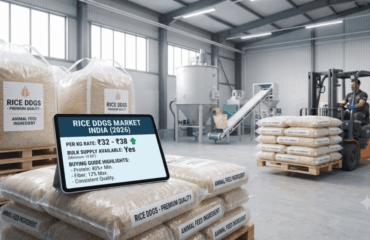
DORB isn’t a direct protein substitute for soymeal, but it plays a complementary role — displacing maize as an energy source, which frees up formulation headroom to manage the protein side of the ration more cost-effectively. As soymeal and maize prices have moved up together this year, DORB’s relative cost advantage has grown; see current rates in our DORB price and bulk supply guide.
The formulation caveat
Neither ingredient is a one-for-one drop-in replacement for soymeal. Mustard DOC carries glucosinolates that limit inclusion rates, particularly in young poultry and layer diets, and amino acid balancing (especially lysine and methionine) needs adjustment when soya inclusion drops. This is a rebalancing exercise, best done with a nutritionist reviewing the full ration — not a straight swap.
Frequently Asked Questions
Why did soybean meal prices spike in India in 2026? A 17% drop in India’s 2025–26 soybean crop (12.7 million tonnes versus 15.1 million tonnes the prior year) tightened domestic supply just as poultry and dairy demand continued rising. Prices responded by climbing more than 40% within weeks, per CLFMA data, to roughly ₹65–66/kg.
Is India still exporting soybean meal? Exports have fallen sharply. Traders cancelled roughly 25,000 tonnes of contracted May–June shipments, and full-year 2025–26 exports are tracking toward about 900,000 tonnes, less than half of the prior year’s 2.02 million tonnes. India has also begun importing soybean from West African countries to cover domestic shortfall.
Has India approved GM soybean meal imports? As of the most recent reporting, the government had not finalized approval for the roughly 1.5 million tonnes of GM soybean meal imports that poultry and feed associations have requested, though NITI Aayog has signaled support for a calibrated opening. This remains an active, closely watched policy decision.
What can feed mills use instead of soybean meal right now? Mustard DOC is the most direct domestic protein substitute at moderate inclusion rates, typically priced ₹8–12/kg below soya DOC. DORB doesn’t replace protein directly but frees up cost headroom on the energy side of the ration. Both require a nutritionist’s review to rebalance amino acids correctly rather than a straight ingredient swap.
The Bottom Line
India’s soybean meal crisis is a supply story, not a demand story — a 17% production shortfall met an industry that had built its cost structure around cheap, abundant, non-GM soymeal. Prices at four-year highs, cancelled exports, and a live GM import debate all point to continued volatility through the rest of the 2025–26 marketing year. Feed mills that move early on formulation — testing mustard DOC and DORB inclusion levels with proper nutritionist oversight rather than waiting for the GM import question to resolve — are the ones best positioned to protect margins through this cycle.
For current rates on the leading alternatives, see our guides on Mustard DOC pricing and DORB pricing and bulk supply.
About the Author: Dr. Rishabh Chugh is a veterinary doctor, animal nutrition specialist, and Director at Brinda Foods Private Limited, Panipat.

[…] grade-wise table is in our Soya DOC price guide, and the background to the spike sits in our soybean meal crisis […]