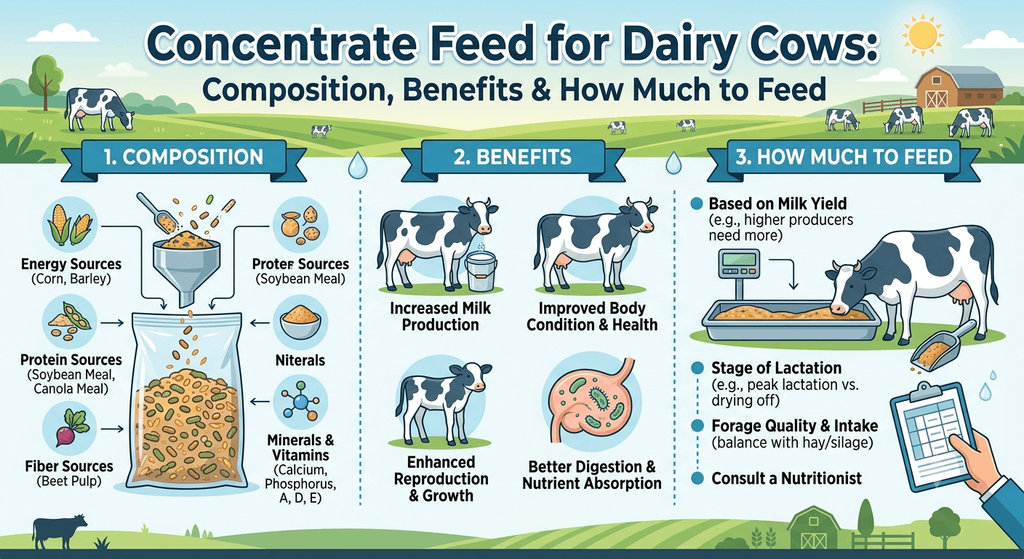
Quick answer: Concentrate feed for dairy cows is a mix of grains, oilseed cakes, brans, by-products, minerals and salt. It gives the cow energy and protein her fodder can’t. A normal dairy concentrate in India has 18 to 22% crude protein and about 65 to 70% TDN. For quantity, most people go by a simple rule: 1 to 2 kg a day for maintenance, plus 1 kg for every 2.5 litres of milk (every 2 litres for buffaloes). Pregnant animals get 1 to 1.5 kg more in the last two months.
Start With the Fodder, Then Talk About the Bag!
Ask ten dairy owners what their cows eat and you’ll get ten different answers about fodder. Berseem in winter. Jowar or maize fodder in summer. Bhusa for a good part of the year when nothing green is left.
- That’s the problem concentrate solves.
Fodder changes all the time. The bag of concentrate shouldn’t. For a feed manufacturer, it is the one piece of the ration you can actually control, and the dairies buying from you know it.
If you want the bigger picture on cattle feed first, read our guide to cattle feed raw materials, quality and formulation. This article is only about concentrate. What’s in it, why it matters and how much a cow needs.
What Counts as Concentrate?
Anything that gives a lot of energy or protein in a small quantity, with not much fibre. Grain is concentrated. Oil cake is concentrated. Straw is not.
A milking cow can fill her stomach with 25 kg of green fodder and still come up short on energy. Give her 3 or 4 kg of a properly made concentrate, and the gap closes.
In the trade, “dairy concentrate” usually means compounded cattle feed or a concentrate mixture from a mill, in pellet or mash form. Larger dairies sometimes mix at the farm. Nothing wrong with that, as long as someone is testing what goes into the mixer.
What Goes Into It?
I break a dairy concentrate into five parts when I explain it to buyers.
- Grains for energy (roughly 25 to 40%)
The starch in grain gets fermented in the rumen and turns into energy for milk. Maize is where most formulas begin. In years when maize gets costly, you’ll see mills use more broken rice, bajra or jowar, depending on the region.
- Oil cakes for protein (roughly 25 to 35%)
Soya DOC is 44 to 48% protein and very reliable, though anyone who bought it in 2026 knows the price hasn’t been kind. Mustard DOC at 34 to 38% protein makes a lot of sense for mills in Haryana, Punjab, Rajasthan and UP. Watch the glucosinolate level before you push the inclusion up.
Down south and in Gujarat, cottonseed cake and groundnut cake are still very common. Groundnut cake needs an aflatoxin test on every lot. I wouldn’t skip that for any supplier.
By-products that give both protein and energy (roughly 10 to 20%)
- Good formulators make their margin here.
Maize DDGS has 26 to 30% protein, extra fat and a decent bypass protein share. One ingredient doing three jobs. Rice DDGS is moving into more dairy rations as well because of its rumen undegradable protein, something we explained properly in our Rice DDGS supplier guide for Haryana.
- Brans (roughly 20 to 30%)
Brans bring fibre, volume and taste, and they keep the bag price sensible. De-Oiled Rice Bran (DORB) has 14 to 16% protein and is about as economical as an ingredient gets. Wheat bran adds phosphorus. Cows like the smell of it too.
- Minerals, vitamins and salt (roughly 2 to 3%)
Mineral mixture around 2%, salt around 1%, and vitamins A, D and E through premix. The BIS standard has minimum levels for all three vitamins, so these can’t be left out.
One example formula, per 100 kg
Treat this as a sample. Real numbers should come from lab reports on your own raw material, this month’s prices and your nutritionist.
| Ingredient | kg | Job in the formula |
| Maize | 30 | Energy |
| De-Oiled Rice Bran | 20 | Fibre, some protein |
| Mustard DOC | 15 | Protein |
| Maize DDGS | 12 | Protein, energy, bypass protein |
| Wheat bran | 12 | Fibre, taste |
| Soya DOC | 8 | Good quality protein |
| Mineral mixture | 2 | Minerals |
| Salt | 1 | Sodium, taste |
| Total | 100 |
On book values this comes to around 20% CP, 68 to 70% TDN, 3% fat and under 8% crude fibre. Comfortably Type II.
The BIS Grades!
Cattle feed in India is covered by IS 2052, and under the Quality Control Order a compounded cattle feed maker needs the ISI mark. The current edition is IS 2052:2023. It replaced the 2009 one, so if your labels were printed years ago, check them again.
These are the grade values most mills refer to:
| Parameter | Type I | Type II | Type III |
| Crude protein (min) | 22% | 20% | 18% |
| Crude fat (min) | 4.0% | 2.5% | 2.0% |
| Crude fibre (max) | 10% | 12% | 15% |
| Acid insoluble ash (max) | 3.0% | 4.0% | 5.0% |
| Moisture (max) | 11% | 11% | 11% |
| Aflatoxin B1 (max) | 20 ppb | 20 ppb | 20 ppb |
Type I is for high yielders. Type II is what sells most across commercial dairies. Type III goes to low-yielding and dry animals when money is tight.
Why Do Dairies Feed Concentrate at All?
Because fodder alone rarely gets a cow past 8 or 10 litres. Indian fodder just doesn’t carry that much energy and protein. There’s more to it, though.
You can feed by yield. A cow giving 20 litres and one giving 6 don’t need the same scoop, and with concentrate you can actually measure the difference.
It’s steady. Green fodder can be great one week and poor the next. A bag made from tested raw material gives the same nutrients on Monday and on Saturday.
It decides your cost per litre. Dairy owners who think in terms of feed cost per litre of milk usually make better buying decisions than those who only look at the bag rate. With milk and feed prices both moving this year, as we covered in our piece on the September 2026 milk price hike, that way of thinking matters.
The formula can bend. When Soya DOC jumps, a mill can shift some protein to Mustard DOC, DDGS or DORB and still reach its CP target.
And buyers get a standard. A cooperative can order Type II and actually check whether that’s what arrived.
How Many Kilos a Day?
This is the question dealers get from farmers most, so brands should print it clearly on the bag.
Three parts to add up. Maintenance, milk and pregnancy.
| Part | Cows | Buffaloes |
| Maintenance | 1 to 1.5 kg (desi), 1.5 to 2 kg (crossbred) | 1.5 to 2 kg |
| For milk | 1 kg per 2.5 litres | 1 kg per 2 litres |
| Last 2 months of pregnancy | 1 to 1.5 kg extra | 1 to 1.5 kg extra |
Example one. A crossbred HF cow of about 450 kg, giving 15 litres, not pregnant. Maintenance is 2 kg. Milk is 15 divided by 2.5, so 6 kg. She gets 8 kg a day.
Example two. Same cow, now seven months pregnant and giving 8 litres. 2 kg maintenance, 3.2 kg for milk, 1.5 kg for pregnancy. About 6.7 kg.
Fodder changes these numbers. On good berseem or lucerne, the first few litres come from the fodder itself, so you can cut back on concentrate. On mostly bhusa, you’ll need more.
And there is a ceiling. Push concentrate above about 60% of the ration and cows start going off feed as the rumen gets unsettled. In early lactation, keep at least 40% of the ration dry matter as roughage.
Some habits that make a difference on the farm:
- Give the day’s quantity in two or three parts, around milking time
- After calving, go up slowly over a week or two instead of all at once
- Keep clean water in front of the animal all day
- Stack bags on pallets in a dry, airy godown, particularly in the rains
What Mills Should Check Before Production?
Every lot. Not only when something smells off.
- Moisture on each truck, and extra care with DORB and oil cakes in humid months
- Crude protein against the supplier’s spec sheet
- Aflatoxin in maize, groundnut cake and DDGS
- Acid insoluble ash, to catch sand or soil
- Colour, smell and feel for mould or heating
- COA and batch papers
Consistent raw material means fewer reformulations and fewer angry calls from dealers.
Mistakes That Keep Coming Up
Mills chasing a protein figure on paper without asking where that protein came from. Formulas built around a single oil cake, which fall apart when its price moves. By-products bought without a moisture check, so the buyer ends up paying for water. On farms, the same scoop for every cow in the shed. And minerals dropped from the formula to save a little money, leaving the whole thing unbalanced.
For forage, fibre and minerals in more depth, have a look at our article on the best feed for dairy cows to increase milk production.
FAQs!
- Concentrate and forage – what’s the difference?
Forage is bulky and fibrous: green fodder, silage, straw. Concentrate is compact and rich in energy or protein: grains, oil cakes, DDGS. A dairy cow needs both.
- What protein level should dairy concentrate have?
18 to 22% crude protein in most cases. Type I is 22%, Type II 20%, Type III 18%.
- Is DDGS fine in dairy concentrate?
Yes. Maize DDGS and Rice DDGS both go into dairy rations for protein, energy and bypass protein. Inclusion depends on the batch report and the rest of the formula.
- A cow giving 10 litres needs how much concentrate?
For a crossbred cow, 1.5 to 2 kg for maintenance and 4 kg for milk. Around 5.5 to 6 kg a day, lower if she’s on good green fodder.
- Should dry cows get any concentrate?
Yes. The maintenance amount, plus 1 to 1.5 kg in the last two months before calving.
- How long can concentrate be stored?
Two to three months for most pellets, if the godown is cool and dry. Damp storage ruins feed faster than time does.
About Brinda Foods
We’re a family business in Panipat, Haryana, supplying animal feed raw materials since 1987. Cattle feed manufacturers, dairy cooperatives and compound feed producers across India buy Maize DDGS, Rice DDGS, Soya DOC, Mustard DOC, De-Oiled Rice Bran, Maize, Maize Gluten and Rice Gluten from us, and every batch leaves with lab tested specification documents.
Take a look at our feed concentrates range, or talk to us about building your next formula on raw material you can depend on.
Bulk quote: Send an enquiry | Call: 9992500442 | Email: sales1@brindafoods.com