
Quick answer: Calf starter is the first dry feed a calf eats. It’s rich in protein, tastes good, and its real job is to get the rumen working while the calf is still on milk. Put a small handful out from day 3 or 4. Refresh it daily. Once the calf eats about 0.75 to 1 kg a day for three days running (usually week 7 or 8), it’s ready to wean. Look for roughly 20 to 21% crude protein on the bag. India’s IS 5560:2024 asks for 23% minimum, but that figure is on dry matter.
You might have seen it very rarely. A calf stays healthier on milk, then you wean it, and it just stops growing for a few weeks. Thin, rough coat, hanging around the trough. Most of the time the reason is simple. It never learnt to eat dry feed early enough. Calf starter fixes exactly the same problem.
This guide will help you to get into the depth and fix the problem. What’s inside a decent starter, when to put it out, how much your calf should be eating week by week, and a homemade mix you can put together from any mandi between Panipat and Meerut for easy and quick accessibility.
And your calf is expected to adapt according to the meal we share with you to gain a better health.
What Is a Calf Starter, and Why Does a Calf Need It?
Here’s something many people don’t realise. A newborn calf digests food more like a puppy than a cow. When it drinks milk, a small fold of tissue called the oesophageal groove closes and sends the milk straight to the abomasum. The rumen gets skipped completely.
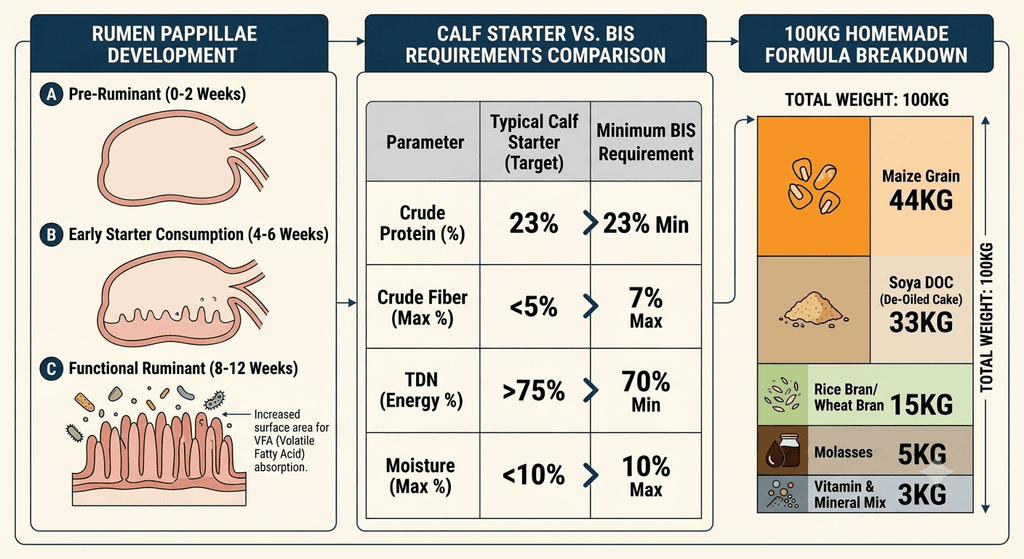
At birth the rumen is tiny. Its inner wall is smooth. It isn’t doing much at all.
Then the calf starts picking at grain, and things get going. The grain sits in the rumen and ferments. That gives off acids, butyrate and propionate mainly, and those acids are what make the rumen wall sprout papillae. Think of them as tiny fingers. Later on, they’re what soak up the goodness from every bit of chara and concentrate the cow eats. Milk won’t grow them. Hay helps a bit. Starter does most of it.
So we like to call it a training feed. It teaches a milk-fed baby to become a ruminant.
How is calf starter different from regular cattle feed?
Quite a lot, actually. A calf grows fast but its stomach is small, so every mouthful needs more protein than a cow’s feed has. Fibre has to stay low too. A baby rumen just can’t handle rough, bulky material. Then there’s taste. Calves are picky eaters, and if the feed is dusty or bitter, they’ll walk away. Even BIS treats them differently. Starter has its own standard (IS 5560). Adult cattle feed sits under IS 2052.
When Should a Calf Start Eating Calf Starter?
Earlier than most people think. Day 3 or 4 is good. Over in Ireland, the farm advisory service Teagasc tells farmers to have fresh starter in the pen from the day a calf arrives, and plenty of feed companies start theirs at four days old.
Don’t expect much in the beginning, though. The calf will sniff it, lick it, push it around, and waste most of it. That’s completely fine. Proper eating usually kicks in around the third week, and that matches how BIS describes calf starter meal: a feed made available from roughly 3 weeks up to about 26 weeks of age.
Getting a slow calf interested
• Drop a pinch into the bucket just after the milk feed. The calf is still in sucking mode and more likely to try it.
• For the first couple of days, rub a few grains on its nose.
• Keep clean water right beside the starter. Honestly, this one makes the biggest difference. Thirsty calves don’t eat dry feed.
• Give a little at a time and chuck out yesterday’s leftovers. Stale, damp starter turns them off quickly.
• If you can, keep calves in pairs or at least where they can see each other. They copy one another.
What Should Calf Starter Contain?
Three things, really. Energy from grain. Good protein from a clean oilcake. And a proper dose of minerals and vitamins. India’s standard, IS 5560:2024, puts actual numbers on this for calf starter meal:
| Parameter (dry matter basis) | BIS requirement for calf starter meal |
| Moisture (as is) | 10% maximum |
| Crude protein | 23% minimum (not from urea) |
| Crude fat | 4.5% minimum |
| Crude fibre | 9% maximum |
| Acid insoluble ash (sand, silica) | 1.5% maximum |
| Common salt | 1% maximum |
| Calcium / Phosphorus | 0.8% / 0.5% minimum |
| Vitamin A / D3 / E | 10,000 / 2,000 / 75 IU per kg minimum |
| Aflatoxin B1 | 20 ppb maximum |
Source: IS 5560:2024, Compounded Feeds for Young Stock, Bureau of Indian Standards.
One thing trips people up here. These are dry matter figures. So a starter with 10% moisture and 23% protein on dry matter will read about 20.7% protein on the bag. Not a typo, just maths. Our piece on as-fed vs dry matter basis shows how to convert one to the other.
Which ingredients are allowed?
BIS doesn’t leave this open. It names what can go in. On the grain side you’ve got maize, barley, jowar, oats, ragi, gram and peas. Dal chunnies are fine (tur, gram, moong, moth, urad), and so is wheat bran. For protein, soya, groundnut, til, linseed, coconut, cottonseed and maize germ cakes are all on there. Then a handful of others: tapioca, sugar beet pulp, skimmed milk powder, whey, lucerne or berseem meal, molasses and brewer’s yeast.
What’s missing is just as useful to know. Mustard cake? Not there. Rice bran and DORB? Also not there. Both only turn up later, in the list for calf growth meal. DDGS doesn’t appear in either. And no animal products at all, other than milk-based ones.
What protein level should calf starter have?
Depends who you ask. Teagasc is happy with 17 to 18% (plus decent energy, at least 12 MJ a kg). Most American feed companies sell 18 to 20%. Our own BIS number is higher, 23%, though that’s on dry matter. Mixing at home? Aim for 20 to 22% as fed and you’re covered whichever rule you follow.
Where does that protein come from? In most starters, soya DOC. It’s loaded with lysine, it’s easy on the gut and calves eat it without fuss. More on why soya DOC works so well in animal feed here.
How Much Calf Starter Should a Calf Eat? A Week-by-Week Guide
Honestly, it varies. Breed matters, size matters, and milk matters most of all. A calf drinking a lot of milk won’t bother much with starter. Cut the milk a little and it eats more. These are rough numbers for a crossbred or bigger dairy calf on a regular milk allowance. Use them to see if things are heading the right way. If your calf is a bit behind one week, don’t worry.
| Age | Typical starter intake per day | What to look for |
| Week 1 | A pinch to about 50 g | Licking and nibbling, most of it wasted |
| Week 2 | 50 to 100 g | Calf goes to the bucket on its own |
| Week 3 | 100 to 250 g | Intake starts climbing; first signs of cudding |
| Week 4 | 250 to 400 g | Regular eating after each milk feed |
| Week 5 | Around 500 g | Good checkpoint: half a kilo a day |
| Week 6 | 600 to 800 g | Start planning to cut milk |
| Week 7 to 8 | 0.75 to 1 kg or more | Ready to wean once held for 3 days |
| Week 9 to 12 | 1.5 to 2.5 kg | Keep the same starter for 2 to 3 weeks after weaning |
Based on Teagasc, Hubbard Feeds and UK extension benchmarks; adjust for your herd.
When is a calf ready to wean?
Watch the bucket, not the calendar. When a calf finishes 0.75 to 1 kg of starter every day for three days straight, it’s ready. Some vets like to see a full kilo or a little more. Got a smaller desi calf? Then use about 1% of its body weight. A 50 kg calf eating half a kilo a day is in good shape.
Then ease off the milk over a week to ten days. Feeding twice a day? Drop to once first. And try not to pile on other stress that same week. Dehorning, vaccination, shifting pens or changing feed can all wait.
Can DDGS or Soya DOC Be Used in Calf Starter?
Soya DOC? Yes, absolutely. It’s on the BIS list and it’s the go-to protein in calf starters everywhere. Just make sure your lot has steady protein, low moisture and smells clean.
DDGS? It can work in a farm mix, within limits. People have tested this properly. Back in 2011, Suarez-Mena and colleagues ran five separate trials (published in the Journal of Dairy Science). Rumen development came out the same with or without distillers grains. Purdue University’s extension notes put the comfortable ceiling at about 20% of starter dry matter. Then South Dakota State pushed harder. At 28%, calves did fine. At 56%? Not so good. Feed efficiency slipped and the papillae came out shorter.
We’ll be straight with you, though, because we sell DDGS too. It isn’t on the BIS list for calf starter meal. Making a BIS-marked starter? Skip it. Lysine is lower than in soya DOC, so use it next to soya, never instead of it. And remember that fermenting grain leaves any mycotoxin behind, about three times stronger. For a young calf, only use a fresh lot with a clean aflatoxin report. Our DDGS guide goes into the numbers.
Mustard DOC? Save it for later. It’s not on the starter list, and that sharp pungent taste puts young calves off anyway. It fits nicely into calf growth meal from around six months. Our mustard DOC feeding guide covers how much to use.
Mash, Pellet or Texturised Starter: Which Is Best?
All three can do the job. What really counts is that the feed is fresh, coarse and not dusty.
| Form | What it is | Strengths | Watch out for |
| Mash | Ground mix of all ingredients | Cheapest, easy to make on farm | Fine dust lowers intake; keep it coarse |
| Pellet | Whole mix pressed into pellets | No sorting, low waste, easy storage | Hard pellets can slow early intake |
| Texturised | Rolled or flaked grain with protein pellets and molasses | Most palatable, encourages chewing | Costs more, shorter shelf life in humid weather |
So which one do calves actually prefer? Researchers tried all three on Brown Swiss calves (the study is in the Asian-Australasian Journal of Animal Sciences). Mash lost. Calves on texturised feed hit weaning intake by about day 41, pellet calves by day 43, and the mash group needed roughly 52 days.
In 2021, Ghaffari and Kertz looked back at decades of trials, some from 1938. Texturised won again, by around 107 g a day over pellets. They did add a warning, though. Results jump around a lot between studies. What works on one farm may not on another.
One old rule still holds up well: in a mash, at least half the particles should be bigger than about 1.2 mm. In plain terms, crack the maize. Don’t turn it into atta.
Simple Homemade Calf Starter Formula (100 kg Batch)
Everything in this mix is on the BIS permitted list, and you’ll find all of it easily in Haryana, Punjab and western UP.
| Ingredient | Quantity (kg) | Role |
| Maize, coarsely crushed | 44 | Main energy source |
| Soya DOC | 33 | Main protein source |
| Wheat bran (chokar) | 15 | Texture, some fibre and phosphorus |
| Molasses (sheera) | 5 | Taste, binds the dust |
| Mineral mixture (with vitamins A and D3) | 2 | Calcium, phosphorus, trace minerals |
| Common salt | 1 | Sodium, appetite |
| Total | 100 |
What it works out to: we ran it, and it comes to about 21% crude protein as fed (call it 23 to 24% on dry matter). Fibre is around 5%. Fat is a touch under the BIS figure. Doesn’t matter on a farm. If you’re a mill going for the BIS mark, though, get your nutritionist to adjust energy and fat.
Keep in mind these numbers use typical ingredient values. Your soya DOC or maize might be a point or two off, so plug in your own lab results. The Pearson Square method in our cattle feed formulation guide makes that quick.
How to mix and store it?
1. Weigh everything. Measuring by the bucket throws the protein right off.
2. Crack the maize coarsely.
3. Mix the maize, soya DOC, chokar, mineral mixture and salt well while it’s all dry.
4. Warm the molasses a little so it runs, then mix it through evenly.
5. Fill clean, dry bags and stack them off the floor, away from the walls.
6. Finish each batch in two to three weeks, faster in the monsoon. If it smells musty or shows mould, throw it out.
Check the mineral mixture label for vitamins A, D3 and E, since BIS sets a minimum for each. Our mineral mixture label guide tells you what to look for. It’s also worth testing one sample from every new batch. When the results come back, here’s how to read the feed lab report.
Thinking of groundnut cake? It’s allowed and often cheaper than soya DOC. The catch is a higher aflatoxin risk, so only use lots that test under 20 ppb.
Common Calf Starter Mistakes to Avoid!
• Giving the calf adult cattle feed. Type I and Type II feeds are made for grown animals and simply don’t have enough protein for a calf.
• Filling the bucket once a week. A big heap goes stale. Little and often works better.
• No water nearby. We see this one all the time. Calves just won’t eat dry feed if they’re thirsty.
• Weaning because the calf is “eight weeks now”. Two calves born on the same night can be weeks apart.
• Switching feeds on weaning day. Stick with the same starter for two or three weeks after milk stops, then blend slowly into the next feed.
What Comes After Calf Starter?
Once the calf is weaned and eating 2 kg or more of starter, start moving it across to calf growth meal. BIS describes this as the feed from about 27 weeks up to roughly two years, and it allows a wider range of ingredients, including mustard cake, rice bran and DORB. Closer to calving, heifers shift again to adult rations. We’ve covered that stage in our guide on concentrate feed for dairy cows.
Sourcing Raw Materials for Calf Starter!
Making your own starter is easy. Making it the same every time is the tricky bit. One truck of soya DOC comes in at 46%, the next at 43%, and suddenly your formula is off. Add damp maize in the monsoon, or a lot with high aflatoxin, and you have a real headache.
We’ve been supplying feed raw materials out of Panipat since 1987, and that consistency is what we work on every day. Soya DOC and maize for your starter, and DDGS, DORB and mustard DOC once calves move on. Every consignment comes with its lab report. Want to know more? Give our team a call.
Frequently Asked Questions!
- At what age should calf starter be introduced?
From the first week. Day 3 or 4 works well. Don’t worry if the calf barely touches it for two weeks; most start eating properly in week 3. Change it daily and keep water right next to it.
- What protein level should calf starter have?
Go for 20 to 22% crude protein on the bag. Foreign guides often say 18 to 20%. BIS asks for 23%, but on dry matter, so a bag with 10% moisture would show about 20.7%.
- How much starter should a calf eat before weaning?
Three days in a row of 0.75 to 1 kg. That usually happens in week 7 or 8. If your calf is eating around half a kilo by week 5, you’re on track.
- Can DDGS or soya DOC be used in calf starter?
Soya DOC is the main protein in most starters and BIS allows it. DDGS isn’t on the BIS starter list. On farms, research shows up to about 20% of starter dry matter is fine, if you balance lysine with soya and use a low-aflatoxin lot.
- Mash, pellet or texturised starter: which is best?
Calves tend to eat more texturised feed and pellets than fine mash. That said, a coarse mash with no dust works fine on most farms. Fresh feed beats fancy feed.
- What is a simple homemade calf starter formula?
Try this for 100 kg: 44 kg crushed maize, 33 kg soya DOC, 15 kg chokar, 5 kg sheera, 2 kg mineral mixture, 1 kg salt. It comes to about 21% protein as fed. Keep it dry and finish it in two to three weeks.
- Can I feed regular cattle feed to a young calf?
Better not. Cow feed is lower in protein and higher in fibre, and it won’t build the rumen the way starter does. Use starter until a few weeks after weaning, then switch to calf growth meal.

[…] age, what overfeeding does, and what all those lost months cost you. Calves still on milk? Read our calf starter feeding guide first and come back after […]