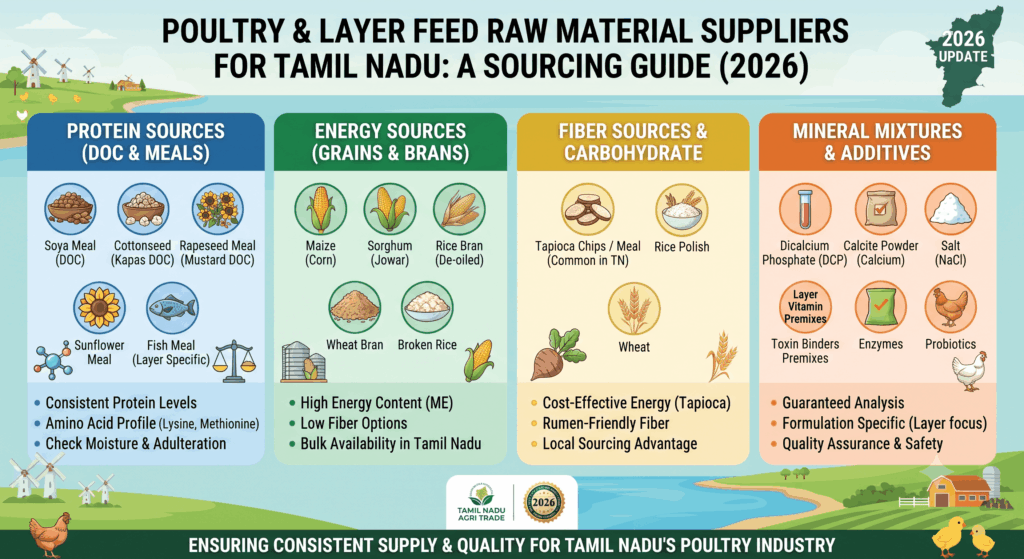
Tamil Nadu is India’s second-largest egg-producing state, and almost all of that scale traces back to one district: Namakkal, known across the industry as the “Egg City of India.” If you’re a layer or broiler feed manufacturer in Tamil Nadu sourcing DDGS, DOC, or DORB, this guide covers what’s driving raw material demand in the state, what layer-feed formulation actually needs from those ingredients, and what to check before committing to a supplier.
Why Tamil Nadu Is a Major Demand Center for Poultry Feed Raw Material
The scale of Tamil Nadu’s poultry sector is easy to underestimate until you see the numbers:
- Namakkal district alone produces 6–7 crore (60–70 million) eggs per day, accounting for roughly 78% of Tamil Nadu’s total egg production — a level of concentration almost unmatched anywhere else in Indian agriculture.
- Tamil Nadu is India’s second-highest egg-producing state, with over 24 billion eggs produced in 2025, behind only Andhra Pradesh.
- Namakkal’s poultry population is estimated at roughly 4.5 crore (45 million) birds, supporting a dense cluster of layer farms, hatcheries, and feed mills operating at industrial scale.
- Namakkal doesn’t just supply India — it exports eggs internationally, including to UAE, Qatar, and Oman, which adds export-grade quality expectations on top of already-high domestic volume demand.
That concentration of layer production means Tamil Nadu’s feed mills run some of the highest-volume, highest-consistency-demand layer feed operations in the country — and layer feed is protein-and-energy intensive, formulated at scale, and highly sensitive to raw material quality variation. A batch quality issue at Namakkal’s scale doesn’t affect one flock; it ripples through a district that supplies eggs nationally and internationally.
What Layer and Broiler Rations Actually Need From DDGS and DOC
Namakkal-scale operations formulate to tight cost-per-egg and feed-conversion-ratio targets, which means raw material selection is a precision decision, not a generic protein swap. Here’s how the core raw materials map onto poultry formulation:
| Raw material | Crude protein | Role in poultry feed | Typical inclusion range* |
|---|---|---|---|
| Maize DDGS | 28–32% | Protein-energy supplement, consistent amino acid profile | Layer: 10–15% · Broiler: 5–12% |
| Soya DOC | 44–48% | Primary plant protein source for layer and broiler rations | Set by target egg output/weight gain and existing ration base |
| Rice DDGS | 40–45% | Cost-effective protein alternative, blended alongside soybean meal | Layer: 10–15% · Broiler: 5–12% |
| De-Oiled Rice Bran (DORB) | Moderate protein, high energy/fibre | Energy component in poultry blends | Formulation-dependent |
*Starting ranges only — validate against your specific formulation, target FCR, and egg/weight output goals before applying at scale.
The nutritional logic for DDGS in layer feed is straightforward but easy to get wrong at volume: DDGS brings a strong methionine and cysteine profile alongside its protein content, both of which matter directly for egg production and shell quality, not just general growth. Getting the inclusion rate wrong in either direction has a cost — too little and you’re leaving feed-conversion efficiency on the table; too much and you can unbalance the amino acid profile the rest of the ration was built around. This is where formulation-level technical support from a supplier — not just a spec sheet — makes a measurable difference at Namakkal’s scale. Our layer feed guide for India and broiler feed guide go deeper into ration-level formulation.
Why Mycotoxin Control Matters More in Tamil Nadu’s Poultry Belt Than Almost Anywhere Else
This is worth a dedicated section rather than a bullet point, because the stakes are different here than in general livestock feed. Layer birds are kept in production for extended cycles, and mycotoxin exposure — particularly aflatoxin — doesn’t just risk acute illness; it suppresses egg output and shell quality gradually, in ways that are easy to misattribute to other causes until the productivity loss has already compounded across a flock. At Namakkal’s density — tens of millions of birds in a concentrated geographic cluster — a raw material quality lapse has more surface area to do damage than it would at a smaller, more dispersed operation.
From a veterinary standpoint, the practical takeaway for procurement teams is this: don’t treat mycotoxin testing as a compliance checkbox on a spec sheet. Ask for batch-level testing data, not just a general assurance, and factor moisture control and storage conditions into supplier evaluation as seriously as protein percentage. Our guide to monsoon mycotoxin risk in animal feed covers detection and prevention in more detail — it’s particularly relevant given how much of Tamil Nadu’s raw material moves in by rail and road through the monsoon season.
What Tamil Nadu’s Poultry Feed Manufacturers Need From a Raw Material Supplier
Namakkal-scale layer and broiler operations run tighter formulation tolerances than smaller general-purpose feed mills. Before finalizing a raw material supplier, Tamil Nadu feed manufacturers typically verify:
- Batch-to-batch protein consistency, backed by a Certificate of Analysis (COA) on every shipment — layer feed formulation has little tolerance for raw material variability at this production scale.
- Mycotoxin-controlled processing, with actual batch-level data available on request — critical for maintaining bird health and egg production consistency across large flocks, as covered above.
- Reliable high-volume supply, not one-off batches — Namakkal’s feed mills need supply chains that can sustain continuous production, not intermittent sourcing that forces reformulation every few months.
- Certifications relevant to export-grade poultry operations — ISO and HACCP certification matter more here given Namakkal’s international egg export market and the quality expectations that come with it.
- Transparent, commodity-linked pricing that tracks visibly with DDGS/DOC market movements rather than opaque per-shipment rates, so procurement teams can plan against predictable cost structures.
More on evaluating suppliers in Cattle Feed Ingredients & Quality Standards and our Layer Feed Guide for India.
Brinda Foods: Pan-India Raw Material Supply Into Tamil Nadu
Brinda Foods (Brinda Feeds Private Limited) is based in Panipat, Haryana, and supplies feed millers and poultry integrators well beyond North India — including Tamil Nadu’s layer and broiler feed sector, alongside Haryana, Punjab, and other North Indian markets. Core raw materials relevant to poultry feed formulation include:
- Maize DDGS — 28–32% crude protein, a consistent energy-protein source for layer and broiler diets
- Soya DOC — 44–48% crude protein, primary plant protein for poultry rations
- Rice DDGS — cost-effective protein alternative for broiler and layer blends
- De-Oiled Rice Bran (DORB) — energy component used in poultry feed formulations
As a veterinarian with an MVSc in Animal Nutrition from NDRI Karnal, my approach to supplying Tamil Nadu’s poultry sector starts from the same principle I apply everywhere: feed performance and bird health are decided at the raw material stage. That’s a clinical statement as much as a nutritional one — I can trace flock health and production issues back to ingredient-level decisions, which is exactly the diligence Namakkal-scale operations need from a supplier, not just a spec sheet and a quote. Learn more on our About Us page, review our certifications, or connect with me directly via my author page.
How Long-Distance Bulk Supply Into Tamil Nadu Works
Sourcing raw material from a North India-based supplier into Tamil Nadu’s poultry belt follows the same proven pattern used across Brinda Foods’ pan-India and export supply chain:
- Specification alignment — confirming protein, moisture, and mycotoxin targets against layer or broiler formulation requirements, set against your specific FCR and egg-output goals.
- Sample and COA review — verifying batch samples meet spec before committing to volume, especially important given Namakkal’s export-grade quality bar.
- Bulk order and freight coordination — rail and road freight from Panipat into Tamil Nadu’s Namakkal/Erode/Coimbatore poultry belt is a well-established route for grain-processing byproducts, with predictable transit windows.
- Standing supply agreement — high-volume layer feed operations typically move to scheduled or standing orders once quality is verified across initial shipments, which stabilizes formulation planning on both sides.
Our guide on sourcing cattle feed raw materials covers the broader supply process in more detail, and the same logistics discipline underpins our supply into other high-volume markets, including Haryana’s feed manufacturing cluster.
FAQs
Does Brinda Foods supply raw material to poultry feed manufacturers in Tamil Nadu? Yes. While based in Panipat, Haryana, Brinda Foods supplies bulk Maize DDGS, Rice DDGS, Soya DOC, and DORB to poultry and layer feed manufacturers in Tamil Nadu, including the Namakkal poultry belt.
Why does Tamil Nadu have such high demand for poultry feed raw material? Namakkal district alone produces 6–7 crore eggs a day and accounts for roughly 78% of Tamil Nadu’s egg production, making the state’s layer feed sector one of the largest and most concentrated in India.
What raw materials are most relevant to layer and broiler feed formulation? Maize DDGS and Soya DOC are the primary protein-energy sources in layer and broiler rations, typically at 10–15% and 5–12% inclusion respectively, often supplemented with Rice DDGS for cost-effective protein blending.
Why is mycotoxin control especially important for Namakkal-scale poultry operations? Aflatoxin exposure suppresses egg output and shell quality gradually, and at Namakkal’s flock density, a raw material quality lapse has more surface area to affect production than it would at a smaller, more dispersed operation. Batch-level mycotoxin testing data, not just a general assurance, should be a standard part of supplier evaluation.
Can a Haryana-based supplier reliably serve Tamil Nadu’s poultry sector at scale? Yes. Bulk rail and road freight from Panipat into Tamil Nadu’s poultry belt is an established logistics corridor for grain-processing byproducts, with large-volume buyers typically moving to standing supply agreements after initial quality verification.
How do I request pricing for bulk DDGS or DOC delivered to Tamil Nadu? Request a quote or contact our team directly with your required product, specification, and delivery location for current bulk rates.
Sourcing feed raw material for a Tamil Nadu poultry or layer feed operation? Request a quote from Brinda Foods today.