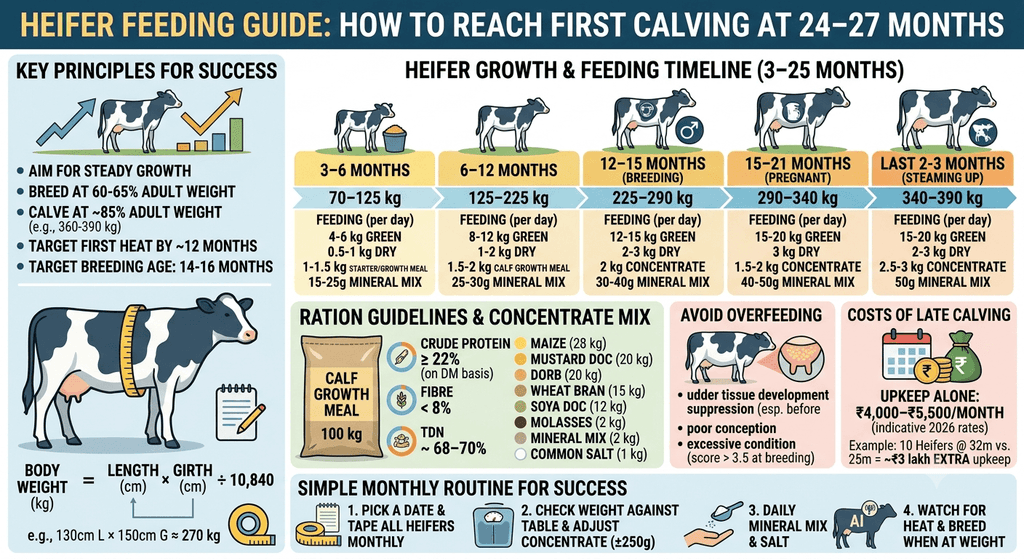
Quick answer: Most crossbred heifers can calve for the first time somewhere between 24 and 27 months. The trick is steady growth. Keep her gaining 500 to 650 g a day after weaning and breed her once she touches about 250 to 290 kg (that’s 60 to 65% of what a grown cow in your herd weighs), which usually happens at 14 to 16 months. In feed terms, that means decent green fodder, around 1.5 to 2 kg of balanced concentrate a day, 25 to 50 g of mineral mixture, and a tape measure once a month. Feed too little and heat comes months late. Feed too much and she puts fat where udder tissue should be. A late heifer isn’t cheap either, since upkeep alone runs ₹4,000 to ₹5,500 a month at today’s rates.
Walk into almost any dairy shed in Haryana or western UP at feeding time and you’ll see the same order. Milking cows first. Dry cows next. The heifer, tied somewhere near the wall, gets bhusa and whatever green is left. Concentrate? Only if the bag isn’t empty.
Nobody does this on purpose. The cows are earning and the heifer isn’t, so she slips down the list. Then one day the farmer realises she’s nearly three and nobody has bred her yet.
But she’s the cow you’ll be milking next year (or the year after, if things go the way they usually do). What she eats between six months and two years decides when that happens.
India actually has proof this works in ordinary herds. NDDB ran a Calf Rearing Programme with milk unions in Gujarat, Punjab and Karnataka. Crossbred heifers on the planned diet put on roughly 653 g a day through their first year, reached puberty at about 12 months, and calved at 24 months on average.
So let’s go through it properly: how fast she should grow, when to breed, how much to feed at each age, what overfeeding does, and what all those lost months cost you. Calves still on milk? Read our calf starter feeding guide first and come back after weaning.
Why Does Age at First Calving Matter So Much?
Simple. Until she calves, a heifer only costs you money. Fodder, feed, a bit of labour, the odd vet visit, and not one litre of milk.
Researchers in different countries keep landing on roughly the same best age for a first calving, somewhere around 23 to 26 months. That’s where lifetime milk and the money spent raising her line up best. Go much earlier and she may still be too small. Go later and you’re basically paying rent on an animal that hasn’t started working.
In India the gap is wide. NDDB says a calf that’s managed scientifically should calve for the first time around 30 to 34 months (they’re talking about desi cows and buffaloes there). In real village conditions? 42 to 51 months for indigenous cows and 43 to 47 for buffaloes. Crossbreds do better, though plenty of them still go past 30.
There’s a herd-size angle too, and people often miss it. Extension figures from the University of Arkansas show that if first calving slips from 24 to 28 months, you need about 11% more replacement heifers just to keep the herd the same size. More mouths, same milk.
What Daily Weight Gain Should a Crossbred Heifer Target?
For most crossbreds, aim for 500 to 650 grams a day from weaning until she’s bred. Once she’s pregnant, 400 to 500 grams a day of her own growth is fine (the calf adds weight on top of that).
Where do those numbers come from? Partly from NDDB’s own crossbreds, which averaged around 653 g a day in their first year. Kenya’s livestock research body KALRO suggests 500 to 700 g for growing dairy heifers, so the two agree. What really matters, though, is that the gain keeps coming every single month. A heifer that does well through winter on berseem and then sits on dry straw all summer loses most of what she built up.
Is faster better? Not really. Studies on big Holstein heifers found that pushing gains past about 900 g a day before 12 months can hold the udder back. Our crossbreds are smaller, so we’d keep it under roughly 800 g a day until she’s bred.
Target weights by age (crossbred heifer, adult weight about 425 to 450 kg)
| Age | Target body weight | What to look for |
| Birth | 25 to 30 kg | Colostrum within the first hours |
| 3 months (weaned) | 70 to 80 kg | Eating calf starter well, chewing cud |
| 6 months | 115 to 130 kg | Moved on to calf growth meal |
| 9 months | 165 to 180 kg | Lean but well grown, shiny coat |
| 12 months | 210 to 230 kg | First heat often shows around now |
| 15 months | 260 to 290 kg | Ready to breed |
| 24 to 25 months | 360 to 390 kg before calving | First calving |
We built this from NDDB’s crossbred growth results plus the usual extension benchmarks (60 to 65% of adult weight at breeding, about 85% at calving). Use it as a guide line and adjust to your own herd.
No weighing scale? A tape will do
Hardly anyone in a village has a cattle scale, and you don’t really need one. A tailor’s tape gets you close enough.
Measure the girth just behind her front legs, then the body length from the point of the shoulder to the pin bone. Both in centimetres. Then work it out like this:
Body weight (kg) = length × girth × girth ÷ 10,840
That’s Shaeffer’s old formula, converted to metric. Say she measures 130 cm long with a 150 cm girth. 130 × 150 × 150 ÷ 10,840 gives you about 270 kg. Jot it in a notebook with the date. After three or four months of doing this you’ll know exactly which heifer is falling behind, and that’s something you honestly can’t judge by eye.
At What Body Weight Should a Heifer Be Bred?
Go by weight. Age comes second.
The usual rule is to breed at 60 to 65% of the weight she’ll have as a grown cow, and to have her at about 85% of that by the time she calves. Mississippi State University’s extension service points out that heifers raised to this target generally have a roomier pelvis and a better developed reproductive tract, so the first calving tends to go easier.
How do you know her adult weight? Look at your grown cows. If they weigh around 425 kg, breed the heifers at roughly 255 to 275 kg.
| Type of animal | Typical adult weight | Weight at first breeding | Usual breeding age | Target first calving |
| HF crossbred | 425 to 475 kg | 270 to 300 kg | 14 to 16 months | 24 to 26 months |
| Jersey crossbred | 350 to 400 kg | 225 to 260 kg | 13 to 15 months | 23 to 25 months |
| Sahiwal, Gir, Tharparkar | 325 to 375 kg | 210 to 240 kg | 18 to 22 months | 28 to 32 months |
| Murrah buffalo | 450 to 550 kg | 290 to 330 kg | 18 to 20 months | 28 to 30 months |
Rough planning figures. Tape a few of your own adult cows and work out 60 to 65% of that.
One more thing. When she shows her first heat, write it down, but you don’t have to rush for the AI technician. Iowa State University reports conception rates rising by about 21% between the first heat and the third. If she’s already at weight by heat two or three, that’s usually the better bet.
How Much Concentrate Does a Heifer Need at Each Age?
Everyone asks this, and the real answer is that it depends on her fodder. A heifer eating plenty of berseem needs a lot less concentrate than one living on wheat bhusa. The table assumes a reasonable mix of green and dry, so treat it as where you start, not where you finish.
Age-wise ration for a growing crossbred heifer (per day)
| Age | Body weight | Green fodder | Dry fodder (bhusa or straw) | Concentrate | Mineral mixture |
| 3 to 6 months | 70 to 125 kg | 4 to 6 kg | 0.5 to 1 kg | 1 to 1.5 kg (calf starter, then calf growth meal) | 15 to 25 g |
| 6 to 9 months | 125 to 175 kg | 8 to 10 kg | 1 to 1.5 kg | 1.5 kg calf growth meal | 25 to 30 g |
| 9 to 12 months | 175 to 225 kg | 10 to 12 kg | 1.5 to 2 kg | 1.5 to 2 kg | 30 g |
| 12 to 15 months (breeding) | 225 to 290 kg | 12 to 15 kg | 2 to 3 kg | 2 kg | 30 to 40 g |
| 15 to 21 months (pregnant) | 290 to 340 kg | 15 to 20 kg | 3 kg | 1.5 to 2 kg | 40 to 50 g |
| Last 2 to 3 months before calving | 340 to 390 kg | 15 to 20 kg | 2 to 3 kg | 2.5 to 3 kg (steaming up) | 50 g |
Add 20 to 30 g of salt and keep clean water in front of her all day. Quantities are as fed, with green fodder taken at about 20% dry matter. Weigh every month and change the concentrate 250 g at a time.
If green fodder runs short (April to June is the usual trouble spot), a rough rule is an extra 0.5 kg of concentrate for every 5 kg of green she’s missing. That lean stretch is exactly when most heifers fall behind. On the flip side, if she’s getting good berseem or lucerne, which already carry a fair bit of protein, you can usually stay at the low end of each range. And when the monthly tape says she’s behind, add 250 g and check again next month. Getting a bit round? Take 250 g off.
What should the concentrate contain?
The Bureau of Indian Standards actually has a separate feed type for heifers in this age band. It’s called calf growth meal, under IS 5560:2024, and it covers roughly six months to two years. It asks for at least 22% crude protein on a dry matter basis, and unlike calf starter it lets you use mustard cake and de-oiled rice bran.
If you’d rather mix your own, this 100 kg batch uses things you’ll find at any mandi between Panipat, Karnal and Meerut:
| Ingredient | Quantity (kg) | Role |
| Maize, crushed | 28 | Main energy source |
| Mustard DOC | 20 | Protein at a sensible price |
| De-oiled rice bran (DORB) | 20 | Energy, fibre and phosphorus |
| Wheat bran (chokar) | 15 | Texture and taste |
| Soya DOC | 12 | Good quality protein, rich in lysine |
| Molasses (sheera) | 2 | Taste, settles the dust |
| Mineral mixture | 2 | Calcium, phosphorus, trace minerals |
| Common salt | 1 | Sodium and appetite |
| Total | 100 |
On typical ingredient values it comes out at about 20% crude protein as fed (call it 22% on dry matter), fibre under 8%, and TDN somewhere around 68 to 70%. Your own mustard DOC or maize could be a point or two off, so put your lab numbers into the Pearson Square from our cattle feed formulation guide and adjust from there.
After her first birthday, some farms swap part of the oilcake for Maize DDGS to bring the cost down. That’s fine, as long as the lot has a clean aflatoxin report. Just remember DDGS isn’t on the BIS list for calf growth meal, so leave it out if you’re making a BIS-marked feed.
Steaming up before the first calving
The last two months of pregnancy are when the calf inside her grows fastest. She’s also building up reserves for her first lactation. So concentrate goes up to 2.5 to 3 kg a day, which most farmers already know as steaming up. Once she calves she moves onto a normal cow ration, and our guide on concentrate feed for dairy cows explains how much to give by milk yield.
What Happens If Heifers Are Overfed?
Plenty of farmers assume more feed means a better cow. With heifers it often goes the other way, particularly before puberty.
Between roughly 3 and 12 months, her udder is building the tissue that will actually make milk. Danish research from the early 1980s showed that when heifers grow too fast in this window, more fat ends up in the udder and less of that milk-making tissue develops. She’ll look great at the mela. Her first lactation, maybe not so much.
Fertility can take a knock as well. Iowa State University lists suppressed heat, poorer conception and early embryo loss among the problems seen in over-conditioned heifers, and recommends moderate condition at breeding rather than a fat one.
And then there’s the money. At about ₹30 a kilo, extra concentrate given to a heifer who’s already on track simply doesn’t come back to you.
So how do you tell? A padded, rounded tailhead is the giveaway. You may also see fat around the brisket, and you won’t feel her ribs under a flat hand any more. On a 1 to 5 condition score, somewhere around 3 to 3.5 at breeding is right. Above that, ease off the concentrate and let her frame catch up.
It tends to happen in two situations: leftover cow feed being tipped into the heifer’s manger, or a heifer being fed up to look good for sale.
Why Do Many Indian Heifers Calve Late?
Usually it isn’t anything mysterious. It’s a handful of everyday habits adding up.
The big one is feeding order. Concentrate goes to the milkers and the heifer gets straw. Her growth drops to 200 or 300 g a day, and puberty drifts out past 20 months.
Then comes the lean season. Green fodder disappears in summer and again around the kharif changeover, and a heifer that stalls for three months hardly ever makes it all back.
Nobody weighs her, so nobody notices. Mineral mixture gets skipped because “she’s not milking anyway”. Straw-heavy rations often run short of phosphorus and trace minerals, and those gaps are commonly linked with weak or irregular heats in young stock. Our mineral mixture guide covers how much to give and what to look for on the pack.
Heats get missed too, especially when she’s tied away from the herd and comes on quietly at night. Some farmers breed at “two years” whatever she weighs, others hold off because “she looks small”, and both cost months. Worms also quietly eat into the feed you’re paying for, so deworm on whatever schedule your vet suggests.
You can see the result in the data. A study on crossbred cattle in Kerala found an average first calving age of around 1,014 days. That’s about 33 months, a full nine months behind what NDDB managed with planned feeding.
What Does Late First Calving Cost the Farmer?
More than most people think. An ICAR article in Indian Farming back in 2019 put it at about ₹3,000 extra for every month first calving gets pushed back. Prices have gone up since then, so we redid the sum at 2026 rates for a crossbred heifer of around 280 kg who isn’t pregnant yet.
Daily upkeep of a heifer waiting to be bred (North India, indicative 2026 rates)
| Item | Quantity per day | Approximate rate | Cost per day |
| Concentrate | 2 kg | ₹30 per kg | ₹60 |
| Green fodder | 15 kg | ₹2.50 per kg | ₹38 |
| Dry fodder (wheat bhusa) | 3 kg | ₹8 per kg | ₹24 |
| Mineral mixture and salt | 40 g + 25 g | ₹5 | |
| Labour, water, deworming, AI share | ₹20 | ||
| Total | about ₹147 a day |
That’s roughly ₹4,400 a month. Your own figure will probably land somewhere between ₹4,000 and ₹5,500, depending on what fodder costs near you, so just drop your local rates into the table.
And that’s only what you spend. Each late month also pushes back the milk money. Say she averages 6 or 7 litres a day in her first lactation and the society pays about ₹40 a litre. That’s ₹7,000 to ₹8,500 worth of milk every month that shows up later than it should.
Now take a small herd of 10 heifers. If they calve at 32 months instead of 25, that’s 7 extra months × ₹4,400 × 10, or about ₹3 lakh in upkeep, and we haven’t counted a single litre of delayed milk yet. For a lot of family dairies, that’s a good new cow or two.
A Simple Monthly Routine That Keeps Heifers on Track
None of this needs fancy equipment. A notebook, a tape and maybe fifteen minutes once a month.
1. Pick a date, say the 1st, and tape every heifer that day.
2. Check her against the weight table. Behind, add 250 g of concentrate. Too round, cut 250 g.
3. Mineral mixture and salt go in every day, milking or not.
4. Think ahead about May and June. Silage or stored hay from a good season keeps heifers off bare straw.
5. From about 11 months in crossbreds, start watching for heat and note every one you see.
6. Breed once she’s in the weight range, ideally on the second or third heat.
7. Ask your vet to confirm pregnancy two to three months after AI.
8. Steam her up for the last two months, then shift her to the cow ration after calving.
Sourcing Raw Materials for Heifer Rations
Your heifer ration is only as steady as what goes into it. One load of mustard DOC tests at 36% protein, the next at 33%, and the mix you worked out so carefully is quietly off target. Add damp maize during the monsoon and you’ve got mould and aflatoxin to think about as well.
We’ve been supplying feed raw materials out of Panipat since 1987, and keeping every batch consistent is pretty much what our team does all day. Maize, Soya DOC, Mustard DOC, DORB and Maize DDGS for your growth meal, each consignment with its lab report. If reading those reports is new to you, start with how to read a feed lab report. For bulk rates, or a hand with putting a heifer ration together, give our team a call.
Frequently Asked Questions
1. What daily weight gain should a crossbred heifer target?
Somewhere around 500 to 650 g a day between weaning and breeding, then about 400 to 500 g a day while she’s pregnant. NDDB’s crossbreds averaged roughly 653 g a day in year one and calved at 24 months. Before breeding, try not to go much over 800 g a day.
2. At what body weight should a heifer be bred?
Once she reaches 60 to 65% of what she’ll weigh as an adult cow. For a typical HF cross that’s roughly 270 to 300 kg, usually at 14 to 16 months. Jersey crosses get there lighter, at about 225 to 260 kg. Weight matters more than age.
3. How much concentrate does a heifer need at each age?
As a starting point, 1 to 1.5 kg a day at 3 to 6 months, 1.5 to 2 kg from 6 to 15 months, about the same through early and mid pregnancy, then 2.5 to 3 kg for the last two months. Plenty of green legume fodder means you can use less.
4. What happens if heifers are overfed?
Growing too fast before puberty is linked with fat building up in the udder in place of milk-producing tissue. Over-conditioned heifers also tend to show weaker heats and settle less easily. A condition score of 3 to 3.5 out of 5 at breeding is the aim.
5. Why do many Indian heifers calve late?
Mostly because they get fed last and least. Straw-heavy diets, no mineral mixture, no monthly weighing, missed heats and breeding by age rather than weight all add months. NDDB puts typical village first calving for indigenous cows at 42 to 51 months.
6. What does late first calving cost the farmer?
At 2026 prices, roughly ₹4,000 to ₹5,500 a month per heifer in feed and upkeep. On top of that, each month holds back around ₹7,000 to ₹8,500 of milk income from her first lactation.
7. Can a heifer calve too early?
Yes. Breed her before she’s at target weight and she may calve small, have a harder time at calving and milk less in her first lactation. For most crossbreds, getting the weight right lands her at 24 to 27 months, which is the window to aim for.